They told you something. Here is what the record says.
Every entry has a permanent number and a permanent link. Send someone
/rebuttals#PR-07 and it opens on that answer.
28 entries published.
6 more are written and held back because they
do not yet meet the evidence standard the rest of this page holds itself to.
These are drafted and held until a citation, a capture, or a review is complete. They are listed here rather than hidden, because a records project should show what it is still working on.
Each entry is tagged with the move it uses, so the method carries to a
deflection you have never seen before.
Entries carry a strategy code from the objection decoder (R1 through R8). Those are response tactics, not entry numbers. Entry numbers are PR.
R1 Tried-but-blocked
R2 Flip-the-villain
R3 Efficacy + one-action
R4 One-to-many
R5 Parity-invert
R6 Closed-doors
R7 Concede-and-turn
R8 Name-the-omission
ELIGIBILITY
Eligibility
PR-01 DOCUMENTED FACT
Why can’t you just start paying again?
Being able to resume payments is the partial-claim test. An ongoing hardship is not.
What to say back
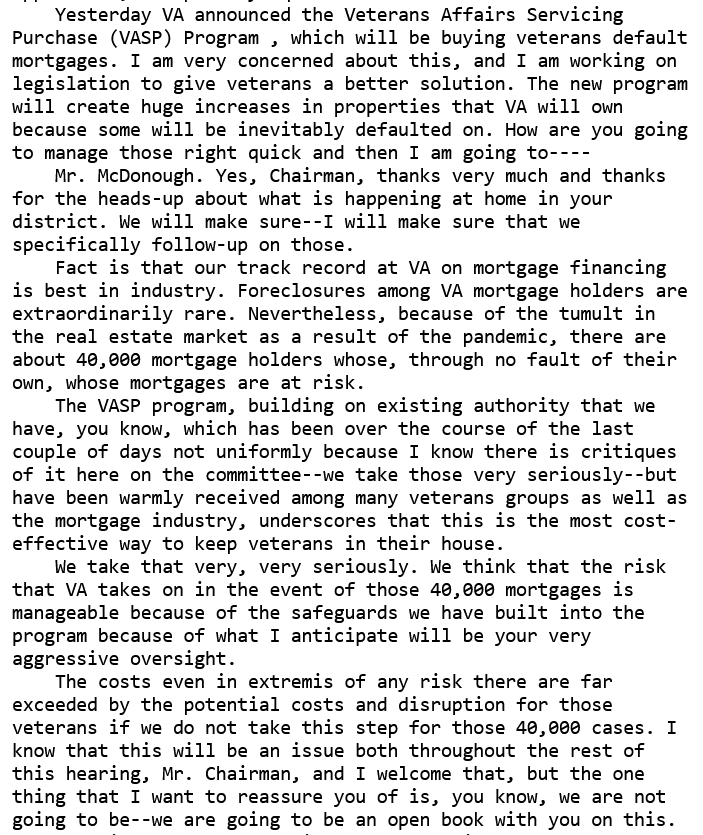
"The partial claim exists for borrowers who can resume the regular payment but cannot cure the arrears, that’s the statutory test. I can resume the regular monthly payment. I’m asking for the arrears to be handled under the partial claim." If you were told this, ask in writing which rule’s eligibility criteria were applied, and cite § 36.4803(d).
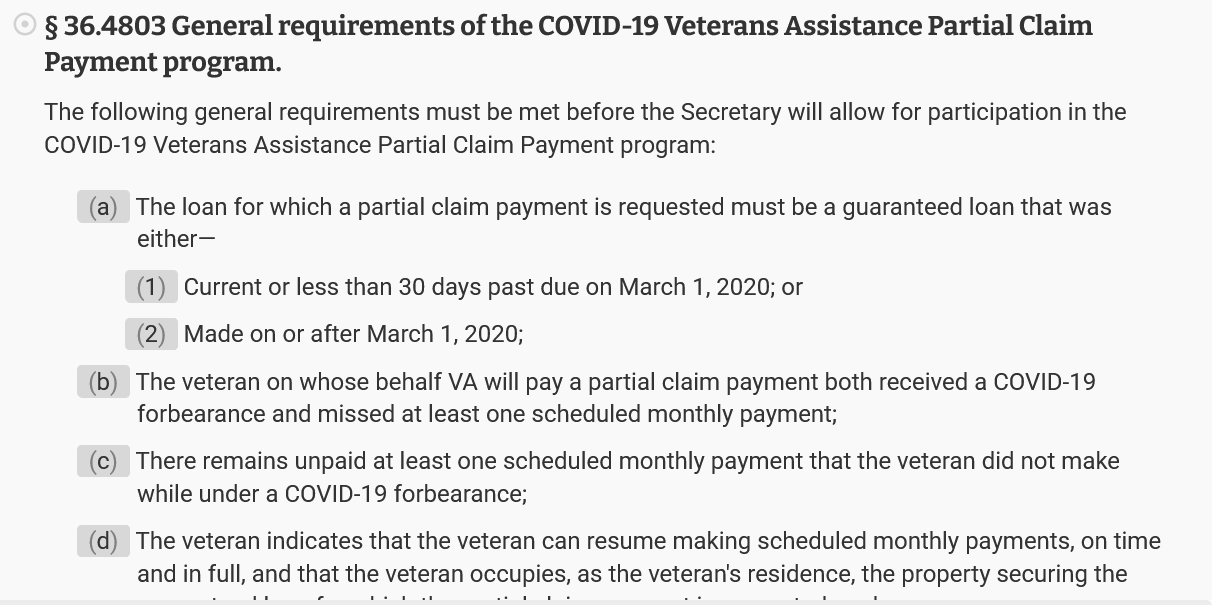
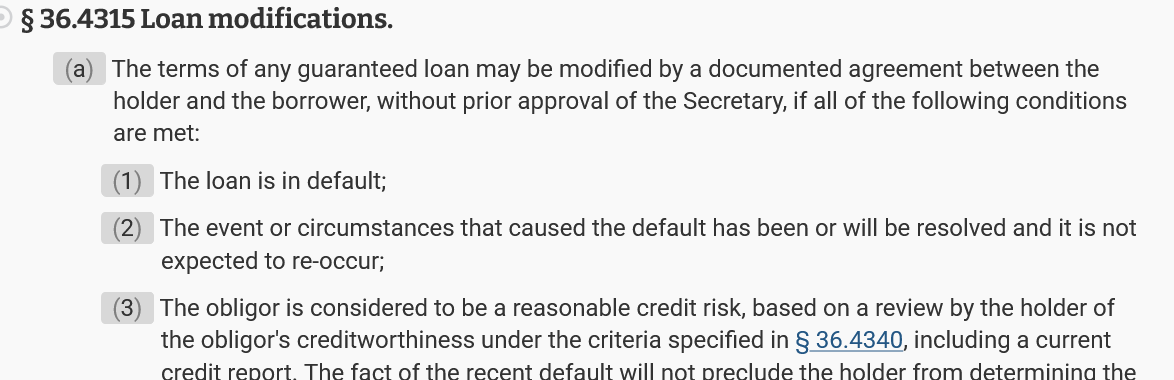
38 U.S.C. § 3737(a), three conditions: VA-guaranteed loan · primary residence · in default or at imminent risk of default. The same standard applied to the COVID-era program: 38 CFR § 36.4803(d) required that "the veteran indicates that the veteran can resume making scheduled monthly payments, on time and in full." Ability to resume the payment, not resolution of the hardship, in both programs, five years apart. MERGED FROM LIVE: the resolution-of-hardship condition belongs to the loan-modification rule, 38 C.F.R. § 36.4315(a)(2), not to the partial-claim rule.
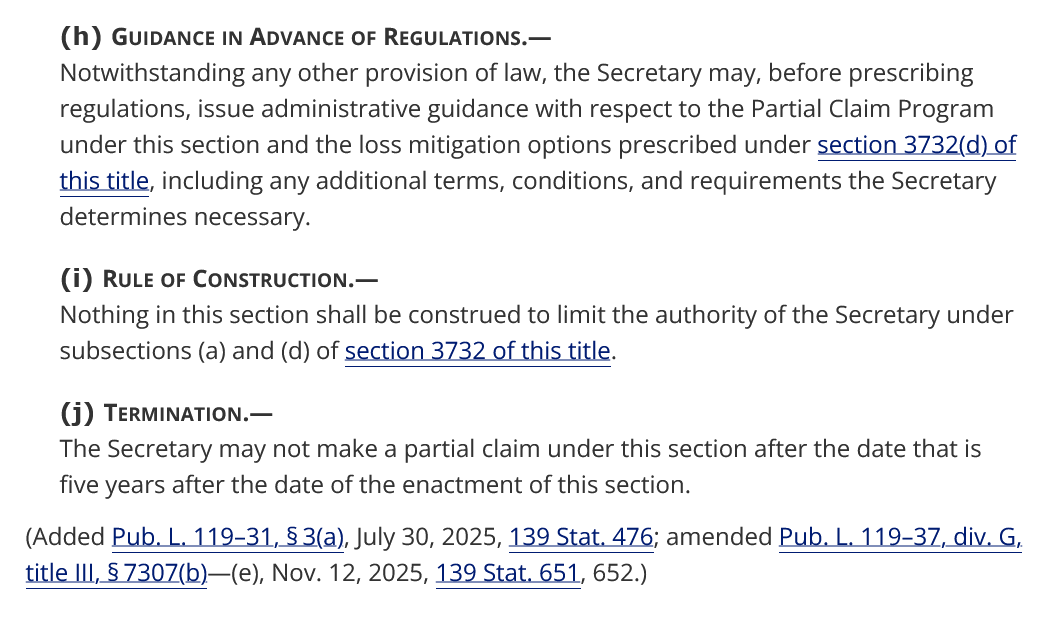
38 U.S.C. 3737(h) Guidance in Advance of Regulations · captured July 202638 CFR 36.4803 COVID-19 partial claim, general requirements · captured July 202638 CFR 36.4315(a)(2) Loan modification terms · captured July 2026
The script line, and what it leaves out
"Your reason for default was not resolved, so you didn’t qualify for help.", the line families report.
What it leaves out: That condition belongs to the loan-modification rule (38 C.F.R. § 36.4315(a)(2), "the event or circumstances that caused the default has been or will be resolved"). The partial-claim rule has no such condition. Its only borrower-capacity test: the veteran "can resume making scheduled monthly payments" (§ 36.4803(d)). Denying the hardship tool because the hardship isn’t "resolved," while offering only a rate-raising modification whose own rule requires a resolved hardship, inverts both rules.
If they say it again
Request the denial in writing with the specific eligibility criterion cited. File CFPB attaching the written denial.
R1 Tried-but-blocked · status COMPLETE · last verified 2026-08-05
PR-02 DOCUMENTED FACT
"You don’t qualify, you’re already in foreclosure."
The statute makes loans in default eligible. The no-foreclosure bar is agency-added, not statutory.
What to say back
"The statute makes loans in default eligible, that’s the whole point of the program. The bar you’re citing is in VA’s handbook, not the law. Please cite the statutory provision that disqualifies me."
§ 3737(a)(3) makes loans "in default or at imminent risk of default" eligible. The "no pending/active foreclosure" bar is M26-4 Ch. 22 § 22.02 a.5 (FINAL, June 1 2026), not in the statute.
If they say it again
Put "cite the statutory provision" in writing to VA and to your congressional office. An unanswered request for a citation is itself a finding.
R8 Name-the-omission · status VERIFIED · last verified 2026-07-26
PR-03 DOCUMENTED FACT
"You had a loan modification recently, so you’re locked out."
The 24-month modification lockout was written by the agency, not by Congress.
What to say back
"That restriction isn’t in the statute. If a prior modification was itself unaffordable or improperly offered, please explain how it can now disqualify me from the remedy Congress created."
Where this comes from
Heard in: servicer loss-mitigation reviews
M26-4 Ch. 22 § 22.02 a.7 (FINAL, June 1 2026), not in § 3737. Verified: this criterion appears in the final chapter and not in the February 2026 draft. The draft instead required six payments since the most recent modification. The final replaced that with a flat 24-month lockout.
If they say it again
Note the serial-modification trap in the CFPB complaint: a bad modification creating a 24-month lockout from the statutory remedy.
R1 Tried-but-blocked · status VERIFIED · last verified 2026-07-26
PR-04 DOCUMENTED FACT
"You filed bankruptcy, so you’re not eligible."
Congress wrote no bankruptcy bar. The agency did.
What to say back
"Active bankruptcy isn’t a statutory disqualifier. If my case is dismissed or discharged, the handbook’s own carve-outs apply. Please state which subsection you’re relying on."
Where this comes from
Heard in: servicer loss-mitigation reviews
M26-4 Ch. 22 § 22.02 a.4 (FINAL, June 1 2026), not in § 3737. Dismissed Ch. 7, dismissed or discharged Ch. 13, and discharged Ch. 7 with reaffirmation are carved out.
If they say it again
This is the catch-22: bankruptcy is often the only emergency stay against eviction, and using it forecloses the loss-mitigation remedy. Document it for oversight.
R1 Tried-but-blocked · status VERIFIED · last verified 2026-07-26
PR-05 DOCUMENTED FACT
"The home isn’t in your name anymore."
The statute says "the borrower." The owner-of-record requirement is agency-added.
What to say back
"The statute refers to the borrower. The owner-of-record condition comes from VA’s handbook. Please identify the statutory basis."
Where this comes from
Heard in: post-foreclosure · successor-in-interest situations · after divorce or a death
§ 3737(a)(2) refers to the borrower’s primary residence. "Current legal owner of record" and the successor-in-interest exclusion are M26-4 Ch. 22 § 22.02 a.8 (FINAL, June 1 2026), not in § 3737.
If they say it again
This is a primary mechanism excluding already-foreclosed families. Raise it as an oversight item, not a servicer dispute, the servicer can’t waive it.
R4 One-to-many · status VERIFIED · last verified 2026-07-26
LOSS MITIGATION AND PROCESS
Loss mitigation and process
PR-06 DOCUMENTED FACT
"You were offered help and you turned it down." / "They were offered help and refused it."
Declining an unaffordable offer is not declining help.
What to say back
"I didn’t decline assistance. I declined one offer that wasn’t affordable. Please send the written evaluation notice for every option I was evaluated for, and the reason each was denied." Get every offer’s rate, payment, and denial reasons in writing; compare the new rate to your existing rate plus one point.
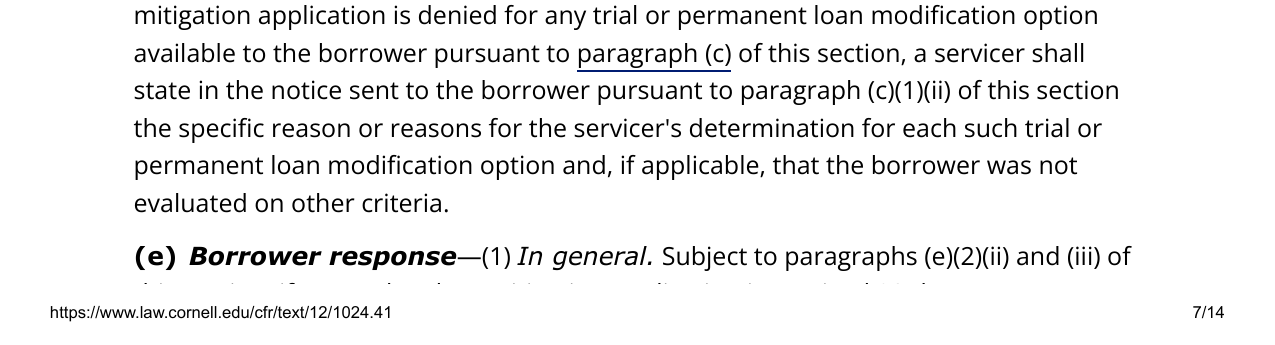
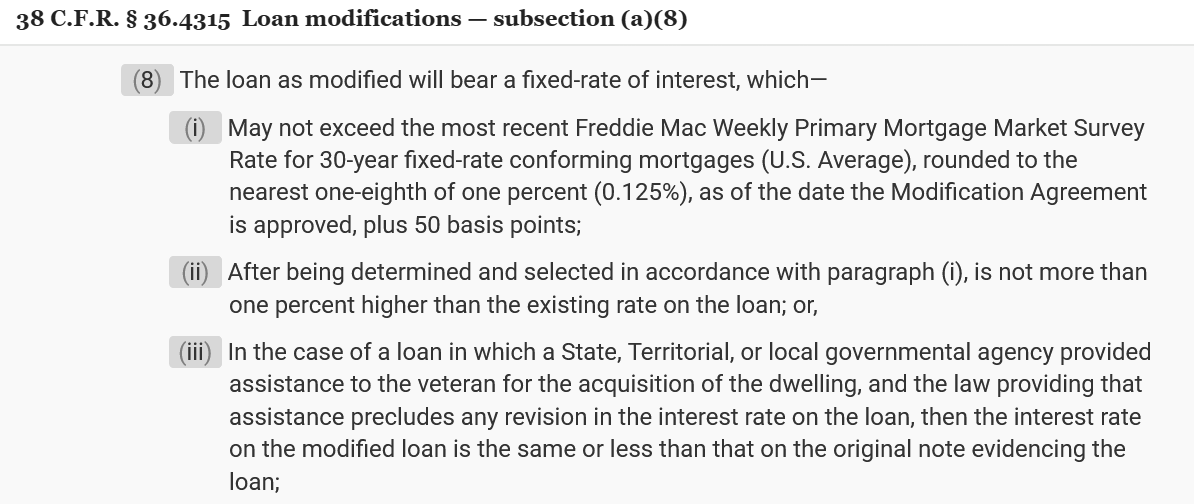
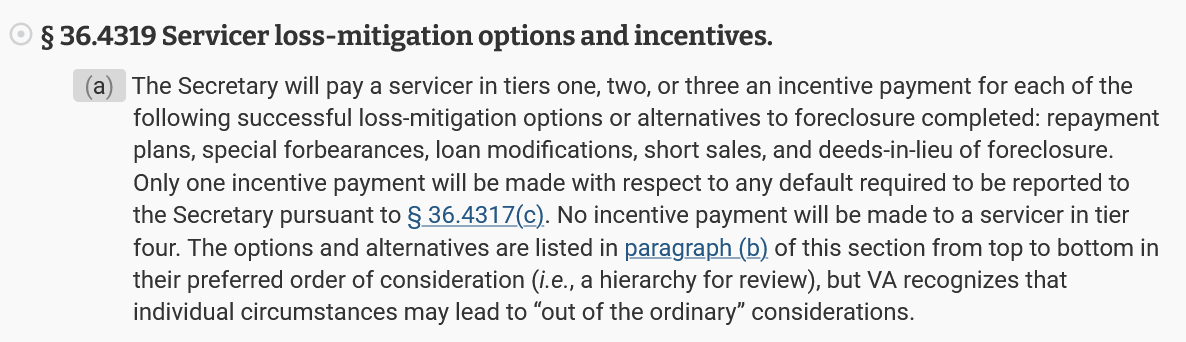
12 CFR § 1024.41 (RESPA / Reg X) loss-mitigation evaluation duties · 38 CFR § 36.4319. MERGED FROM LIVE: federal rules cap rate-raising modifications, 38 C.F.R. § 36.4315(a)(8), not more than one percentage point above the existing rate. In reported cohort cases the "assistance" offered was a modification that raised the interest rate several points, on fixed incomes, raising the payment by half or more.
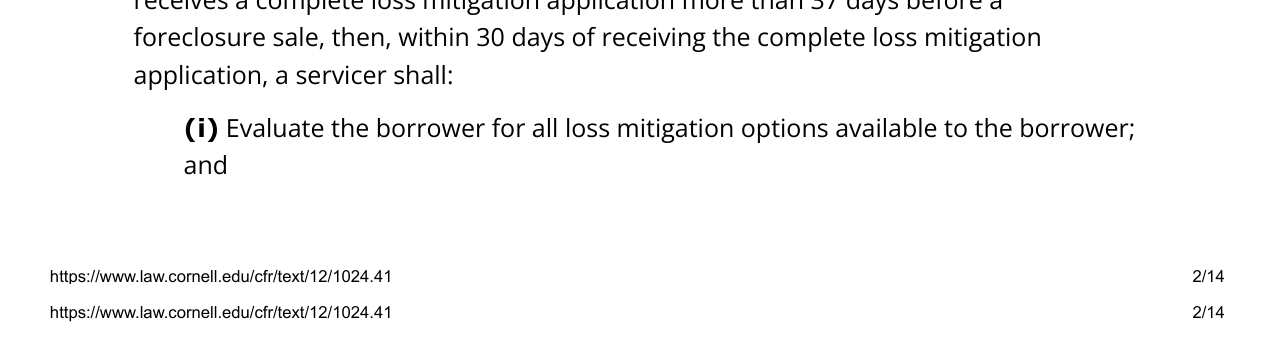
12 CFR 1024.41(d) Denial notice requirements · captured July 2026 · cropped to the rule text; eCFR's own sticky navigation bar overlays the tail of subsection (d)38 CFR 36.4315(a)(2) Loan modification terms · captured July 202638 CFR 36.4315(a)(8) Loan modification limits · captured July 2026
The script line, and what it leaves out
"The borrower was offered assistance and chose not to accept it.", the line families report.
What it leaves out: The "assistance" in reported cohort cases was a modification that raised the interest rate several points, on fixed incomes, raising the payment by half or more. Federal rules cap rate-raising modifications (38 C.F.R. § 36.4315(a)(8): not more than one percent above the existing rate absent prior VA approval) precisely because an unaffordable offer defeats loss mitigation. Families who could afford their original payment were offered only the option they couldn’t, while the tool built for their situation went unused. Refusing a payment you cannot make is prudence, not choice.
Do this → Get every offer’s rate, payment, and denial reasons in writing; compare the new rate to your existing rate + 1%.
If they say it again
A denial with no per-option reason is itself a Reg X problem. Note it in the CFPB complaint.
R8 Name-the-omission · status COMPLETE · last verified 2026-08-05
PR-07 DOCUMENTED FACT
"We have no record of that at this address."
"No record at this address" is not "we didn’t receive it."
What to say back
"Under RESPA, receipt of a loss-mitigation application triggers a written acknowledgement within five business days. Please send that acknowledgement, or confirm in writing that none was sent." Send formal notices by certified mail to the designated address, and keep proof of every other channel. Both matter.
12 CFR § 1024.41(b), written acknowledgement of a loss-mitigation application within 5 business days · § 1024.41(c), evaluation timeline. MERGED FROM LIVE: servicers keep a single designated address for formal error notices, 12 C.F.R. §§ 1024.35–.36, and a carefully worded "no record at this address" does not deny receiving the document through other active channels, including the federal loan technician.
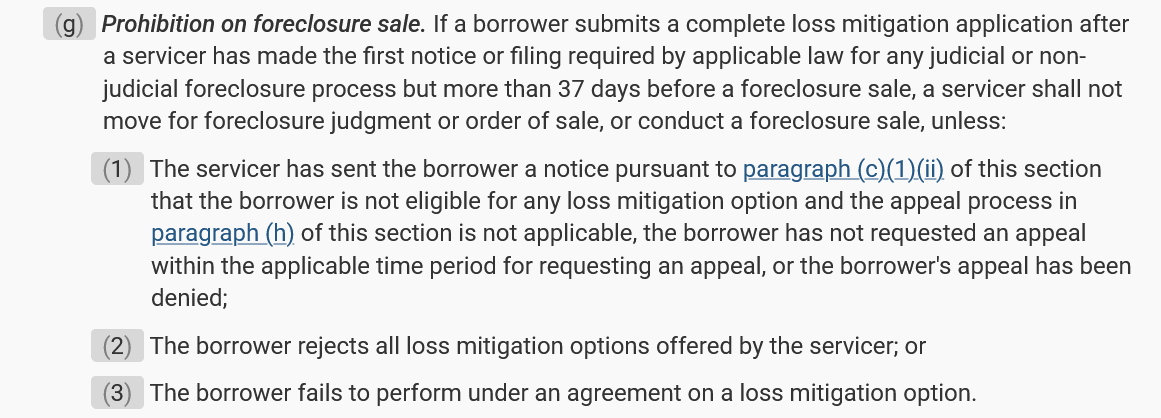
12 CFR 1024.41(c)(1) Evaluation of a complete application · captured July 202612 CFR 1024.41(g) Prohibition on dual tracking · captured July 2026
The script line, and what it leaves out
"After a diligent search, we have no record of receiving your notice at this address.", the line families report.
What it leaves out: Servicers keep a single designated address for formal error notices (12 C.F.R. §§ 1024.35–.36), and a carefully worded "no record at this address" does not deny receiving the document through other active channels, including the federal loan technicians the servicer is already corresponding with. Families report exactly this pattern.
Do this → Send formal notices by certified mail to the designated address, and keep proof of every other channel. Both matter.
If they say it again
Send a Qualified Written Request for the full servicing file including the upload log. Non-response is a separate violation.
R8 Name-the-omission · status COMPLETE · last verified 2026-08-05
PR-08 DOCUMENTED FACT
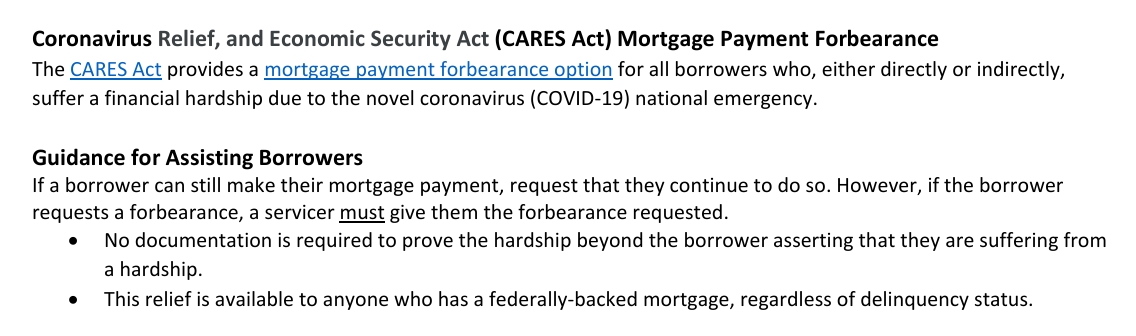
"You’ll owe the whole forbearance amount in one lump sum."
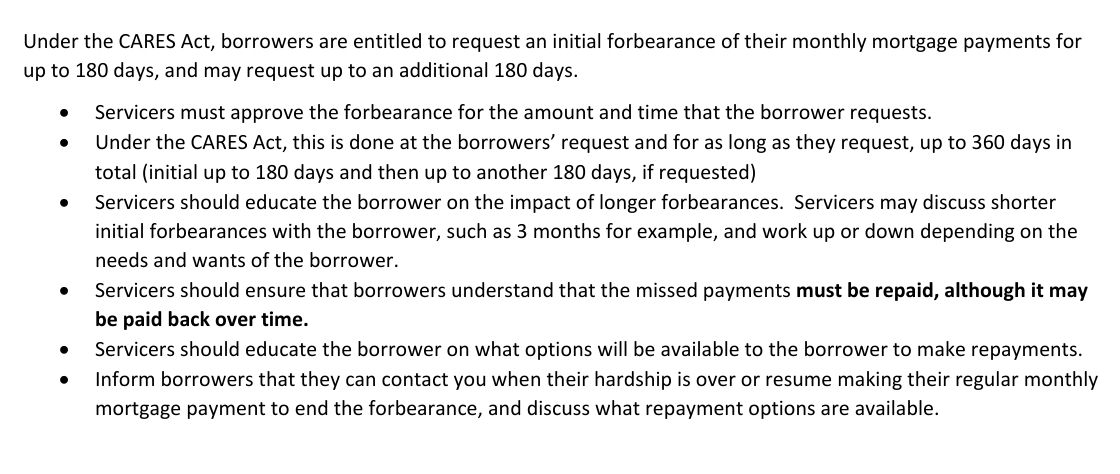
Federal guidance told servicers the opposite, in writing, from the start.
What to say back
"The federal guidance issued to servicers says forbearance amounts are repaid over time and a lump sum isn’t required. Please point to the document that says otherwise."
Where this comes from
Heard in: servicer calls during and after forbearance
CARES Act forbearance fact sheet for FHA/VA/USDA servicers, repayment section · VA COVID-19 borrower guidance
If they say it again
Keep the recording or written statement. A lump-sum demand contradicting published guidance belongs in the CFPB complaint and the OIG supplement.
R2 Flip-the-villain · status VERIFIED · last verified 2026-07-26
PR-09 DOCUMENTED FACT
"You should have known payments would balloon, you signed a disclosure." / "These families overextended themselves."
The written guidance said the opposite. A disclosure cannot undo what the government told servicers to do. These are federally guaranteed loans.
What to say back
"Please produce the specific disclosure you’re referring to, with my signature and its date. Then explain how it squares with the federal guidance stating repayment is over time and not a lump sum." These are federally guaranteed loans. Federal agencies told servicers in writing that paused CARES Act payments would be repaid over time and that a lump sum would not be required. Ask which of those written instructions my servicer followed, and when.
CARES Act § 4022 · federal servicer guidance on forbearance repayment, repayment section · 12 CFR § 1024.41
CARES Act servicer fact sheet Repayment section, no lump sum · captured July 2026CARES Act servicer fact sheet Guidance to servicers · captured July 2026
If they say it again
Request the document. If it doesn’t exist, the request itself is the record.
R1 Tried-but-blocked · status COMPLETE, receipts placed in export · last verified 2026-08-05
AUTHORITY AND THE AGENCY’S OWN NUMBERS
Authority and the agency’s own numbers
PR-10 DOCUMENTED FACT
"VA’s hands are tied, it isn’t statutory."
Congress wrote the authority. The exclusions were written by the agency.
What to say back
"The authority to act exists and Congress specifically authorized acting before the regulations were finished. Which statutory provision prohibits the relief being requested? Please cite it."
38 U.S.C. § 3737(h): "Notwithstanding any other provision of law, the Secretary may, before prescribing regulations, issue administrative guidance … including any additional terms, conditions, and requirements the Secretary determines necessary." Also M26-4 Ch. 22: "Nothing in this handbook is intended to limit the Secretary’s discretion Congress provided under 38 U.S.C. § 3737."
38 U.S.C. 3737(h) Guidance in Advance of Regulations · captured July 2026
If they say it again
Put the citation request in writing to the committee of jurisdiction.
R7 Concede-and-turn · status VERIFIED · last verified 2026-07-26
PR-11 DOCUMENTED FACT
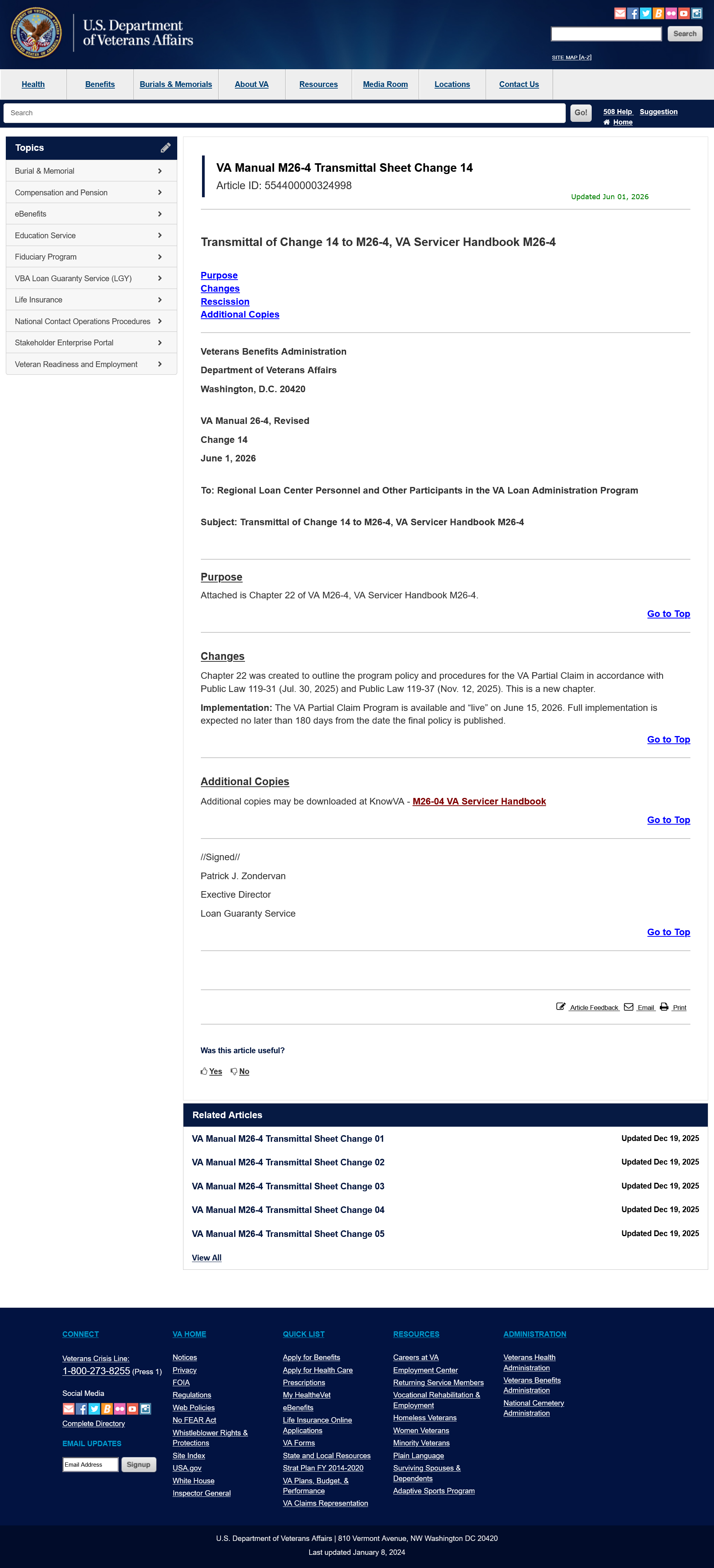
"The program has launched, help is available." / "The program is available."
Launched is not available. Available and live, June 15, 2026. Required to be offered, November 28, 2026.
What to say back
"Available and required are different dates. VA issued the final policy June 1, 2026 and called the program live June 15. The same transmittal sets full servicer implementation at no later than 180 days from publication, which is November 28, 2026. Has my servicer implemented it? What is available to me before then?"
VA final policy M26-4 Ch. 5 and Ch. 22, June 1 2026. MERGED FROM LIVE: M26-4 Transmittal Sheet Change 14 (June 1, 2026) sets full servicer implementation at no later than 180 days from publication, which is November 28, 2026. VA ready for servicer submissions June 15, 2026. Independently flagged by NCLC (launch-day release) and Military.com (June 19, 2026).
M26-4 Transmittal Sheet, Change 14 June 1 2026, servicer implementation within 180 days · captured August 2026
If they say it again
Ask the servicer in writing for its implementation date. No published ETA is itself the answer.
R5 Parity-invert · status VERIFIED · last verified 2026-08-10
PATTERN AND PROCESS
Pattern and process
PR-13 DOCUMENTED FACT
"If the bank was really in the wrong, they wouldn’t be foreclosing."
The mortgage industry warned the VA this would happen, in writing and under oath, before it happened.
What to say back
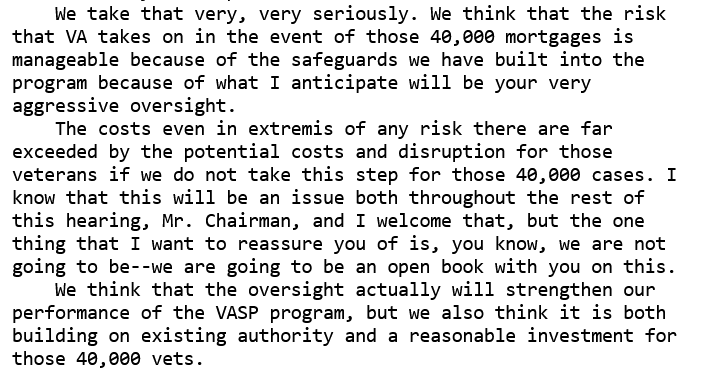
"The companies that do the foreclosing told Congress this would happen, seven weeks before the program ended. They asked the VA to fix it. This isn’t a family that didn’t pay, and it isn’t a bank acting alone."
Where this comes from
Heard in: comment sections · family conversations · staffer prep · reporters before they call
Mortgage Bankers Association white paper, December 12, 2024. MBA testimony to the House Veterans’ Affairs Subcommittee on Economic Opportunity, March 11, 2025, in which Elizabeth Balce, asked what happens to veterans without the rescue program, answered: "the short answer is foreclosure. Period."
If they say it again
Send the hearing link. The quote does the work; do not editorialize on top of it.
R2 Flip-the-villain · status VERIFIED · last verified 2026-07-26
PR-15 DOCUMENTED FACT
"You were in review, so you weren’t really being foreclosed on."
Both were true at once. That is what dual tracking means, and it is what the rule prohibits.
What to say back
"My application was pending and the foreclosure advanced at the same time. Under Regulation X those two things are not supposed to run together. Please send the dates for both."
12 CFR § 1024.41(g), RESPA / Regulation X, restricts moving for foreclosure judgment or sale while a complete loss-mitigation application is pending
12 CFR 1024.41(g) Prohibition on dual tracking · captured July 2026
If they say it again
Request the loss-mitigation log and the foreclosure referral date in writing. The overlap between those two dates is the violation, and it is documentary.
R8 Name-the-omission · status VERIFIED · last verified 2026-08-10
PR-16 DOCUMENTED FACT
"You can’t prove they didn’t send it."
You don’t have to. The rule puts the record-keeping duty on them.
What to say back
"I’m not asked to prove a negative. You’re required to keep the record and produce it. Please send the acknowledgement, the evaluation notice, and the upload log."
Where this comes from
Heard in: agency responses · servicer disputes · anywhere a family is asked to prove a negative
RESPA / Regulation X acknowledgement and notice requirements. Servicers must maintain and produce the servicing file on a Qualified Written Request.
If they say it again
QWR for the full servicing file. Non-production is its own finding, and it shifts the burden back where the rule puts it.
R8 Name-the-omission · status VERIFIED · last verified 2026-07-26
PR-18 DOCUMENTED FACT
"The partial claim is a benefit you’re not entitled to."
VA has written the program as discretionary, not a benefit, and not judicially reviewable. Families should know that before they rely on an appeal.
What to say back
"I understand VA treats this as discretionary and not reviewable. I am asking for the denial in writing with the specific criterion cited, so the record is complete regardless of the review posture."
Where this comes from
Heard in: VA responses · appeals guidance · anywhere a family asks how to challenge a denial
M26-4 Ch. 22 § 22.01(b) (FINAL): the authority "is fully discretionary and is not a home loan benefit." 38 U.S.C. § 3737 provides that a decision under the section is not subject to judicial review and, for § 511 purposes, is not treated as a decision under a law affecting the provision of benefits.
If they say it again
This is a structural finding, not a case dispute. It belongs in front of committee staff: discretionary, not a benefit, and not reviewable, stacked together in one program.
R8 Name-the-omission · status VERIFIED · last verified 2026-07-26
PR-19 DOCUMENTED FACT
"Nothing changed between the draft and the final."
Two of the most exclusionary criteria were added after the comment window closed.
What to say back
"The criteria in the final are not the criteria that were open for comment. Two of them were added afterward."
Where this comes from
Heard in: anyone who commented on the draft and assumes the final matches it
February 2026 draft Chapter 22 compared against the June 1, 2026 final. The draft required six payments since the most recent modification; the final replaced that with a flat 24-month modification lockout (a.7). The final added a.10, extending the bar to COVID-19 partial claims and Refund Modifications. Neither appears in the draft.
If they say it again
This belongs in the notice ledger and in any oversight correspondence. Draft, comment, final is a documented sequence, and the gap between what was commented on and what shipped is part of the record.
R8 Name-the-omission · status VERIFIED, both documents held · last verified 2026-07-26
AUTHORITY, OVERSIGHT AND ACCESS
Authority, oversight and access
PR-20 DOCUMENTED FACT
"The servicer was only following the rules."
Servicers were bound by federal servicing law the entire time.
What to say back
Request the written denial notice for each option. The law requires a specific reason per option.
Only the numbered 2026 waterfall is new. Regulation X, binding the entire time, required servicers to evaluate a complete application against all options within 30 days (12 C.F.R. § 1024.41(c)(1)), give a specific reason for each denial (§ 1024.41(d)), and observe the dual-tracking restriction (§ 1024.41(g)). 38 C.F.R. § 36.4319(a) carries the VA-side duty.
12 CFR 1024.41(c)(1) Evaluation of a complete application · captured July 202638 CFR 36.4319(a) Servicer loss-mitigation options · captured July 202612 CFR 1024.41(d) Denial notice requirements · captured July 2026 · cropped to the rule text; eCFR's own sticky navigation bar overlays the tail of subsection (d)12 CFR 1024.41(g) Prohibition on dual tracking · captured July 2026
The script line, and what it leaves out
"There was no required loss-mitigation process before the new 2026 rules.", the line families report.
What it leaves out: Only the numbered 2026 waterfall is new. Regulation X, binding the entire time, required servicers to evaluate a complete application against all options within 30 days (12 C.F.R. § 1024.41(c)(1)), give a specific reason for each denial (§ 1024.41(d); "Not Reviewed" is not a reason), and not refer to foreclosure or sell while an application was pending (§ 1024.41(f), (g)). VA’s own regulation has described its options as a "hierarchy for review", and paid servicers incentives on it, since 2008 (38 C.F.R. § 36.4319(a)). A hierarchy for review is a waterfall by another name, at regulation tier, the whole time.
Do this → Request the written denial notice for each option. The law requires a specific reason per option.
If they say it again
A denial with no per-option reason is a Reg X violation on its face. It goes in the CFPB complaint with the dates.
R8 Name-the-omission · status COMPLETE · last verified 2026-08-05
PR-21 DOCUMENTED FACT
"Nobody was checking on the servicers."
The agency built a system to determine servicer compliance. The question is whether the servicer reported into it.
What to say back
The one question every oversight office can ask: produce the VALERI event history.
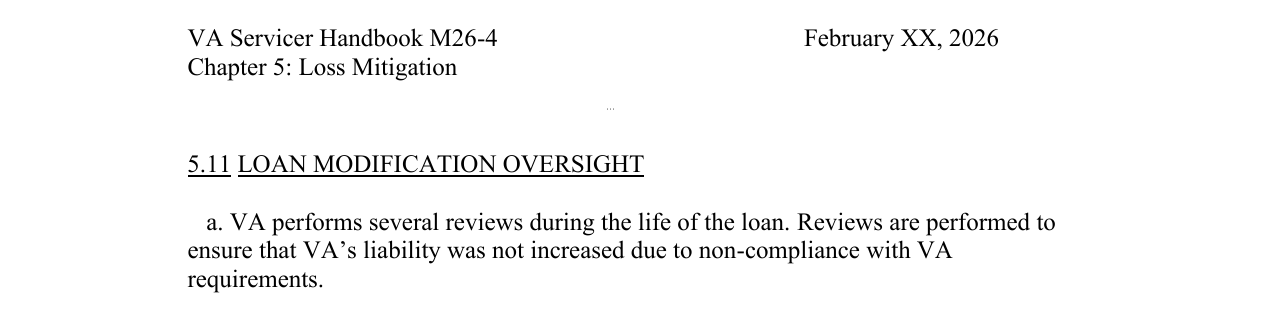
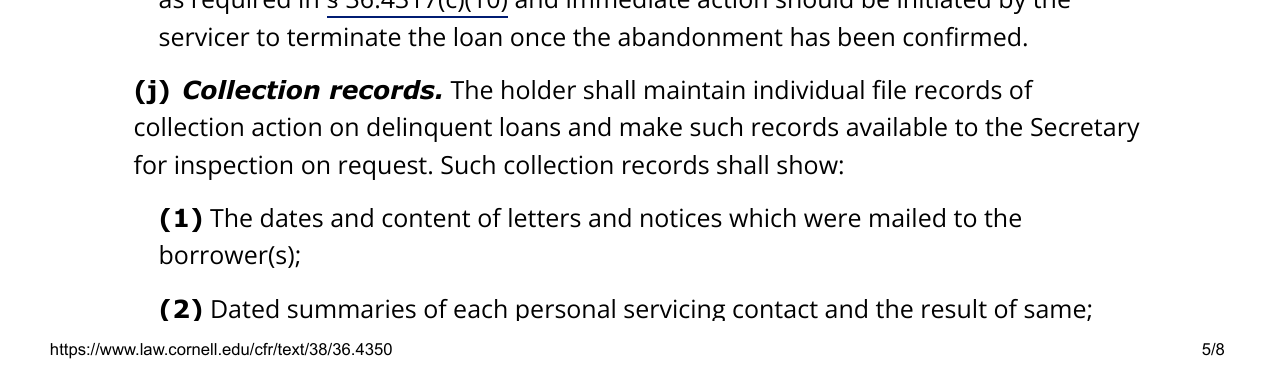
VA built VALERI specifically to track servicer loss-mitigation compliance and inspects servicer files: M26-4 Ch. 5 § 5.11; 38 C.F.R. § 36.4350(j). "We cannot determine compliance" and "the servicer never reported into the system we built to determine compliance" are different statements.
M26-4 Chapter 5, sec 5.11 Loss mitigation waterfall · captured July 202638 CFR 36.4350(j) Servicing procedures for holders · captured July 2026
The script line, and what it leaves out
"There’s no way to know whether proper procedures were followed.", the line families report.
What it leaves out: VA built VALERI specifically to track servicer loss-mitigation compliance and inspects servicer files (M26-4 Ch. 5 § 5.11; 38 C.F.R. § 36.4350(j)). "We cannot determine compliance" and "the servicer never reported into the system we built to determine compliance" are different statements, and the second is checkable. The record either exists in VA’s own system, or its absence is itself the finding.
Do this → The one question every oversight office can ask: produce the VALERI event history.
If they say it again
A FOIA to the VA Regional Loan Center for the VALERI records resolves it directly. Twenty business days.
R8 Name-the-omission · status COMPLETE · last verified 2026-08-05
PR-22 DOCUMENTED FACT
"The VA isn’t the one foreclosing."
The Department is the named plaintiff evicting veteran families.
What to say back
Ask your Member: who is the named plaintiff in these evictions, and under what disposition authority (38 U.S.C. § 3732) could the VA choose otherwise?
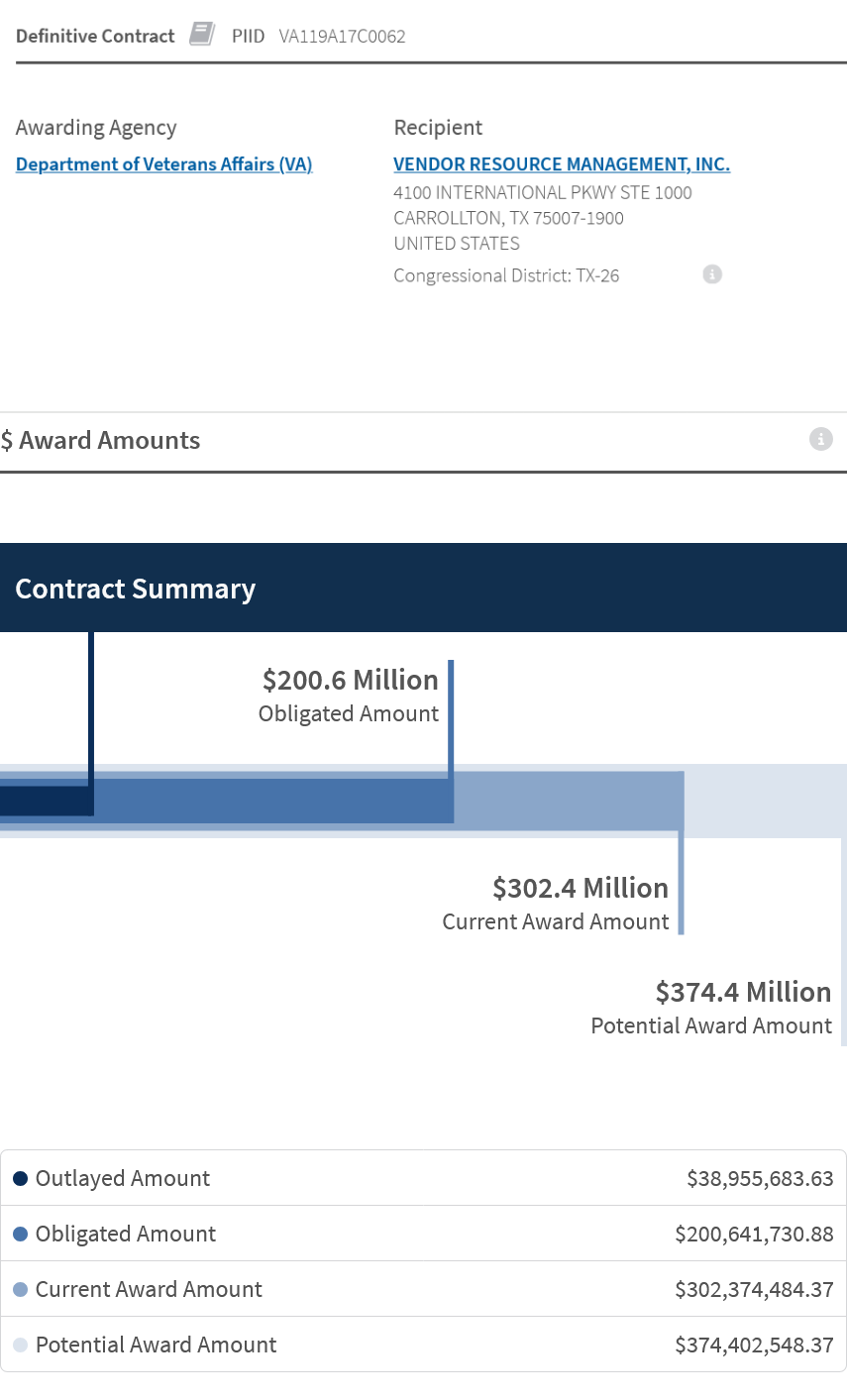
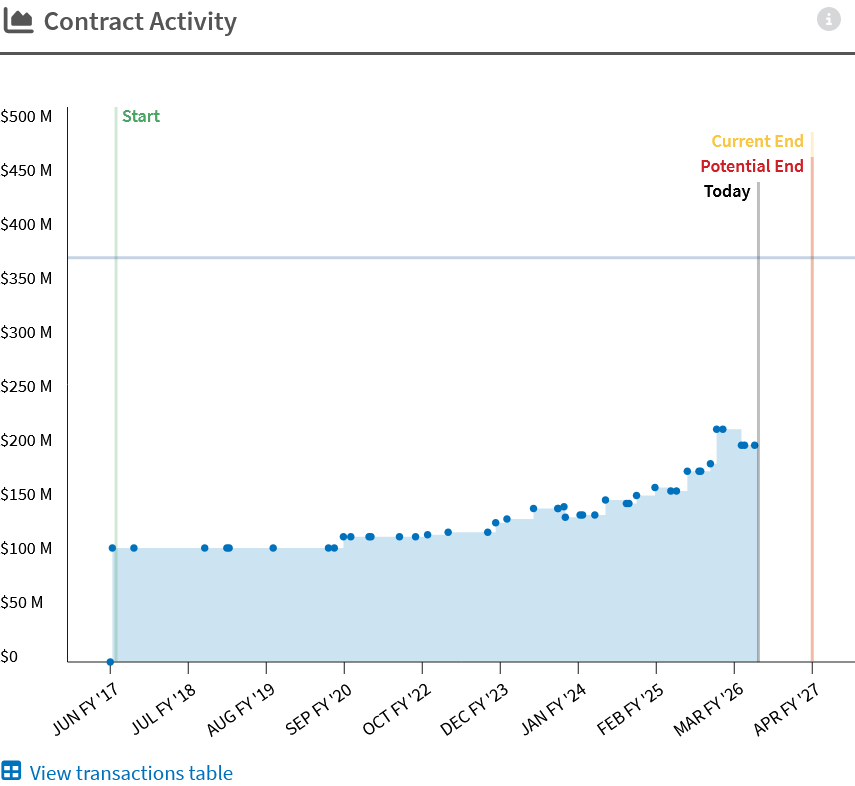
Roughly three of four foreclosed veteran homes are conveyed to the VA (Auction.com data); title passes to the Secretary of Veterans Affairs; post-foreclosure evictions are then filed in the Secretary’s name and executed through the VA’s private REO contractor. 38 U.S.C. § 3732 is the disposition authority under which VA could choose otherwise.
USAspending, VRM contract Contract award to Vendor Resource Management · captured July 2026USAspending, VRM contract Contract activity · captured July 2026SVAC hearing, May 20 2026 Sec. Collins on the June 15 standup date · captured July 2026
If they say it again
This is an oversight question, not a servicer dispute. Put it to the committee of jurisdiction in writing.
R2 Flip-the-villain · status COMPLETE · last verified 2026-08-05
PR-23 DOCUMENTED FACT
"VASP was cancelled because it was illegal."
No neutral body ever found VASP unlawful, and the VA itself called the authority "existing."
What to say back
Read the authority analysis on the Policy and Fiscal page. Then ask which neutral body made the finding, and when.
VA’s own April 2024 launch materials stated it had "existing authority to establish and implement VASP under 38 U.S.C. § 3732 and § 3720." No GAO opinion, CRS analysis, OGC memo, or court ruling ever held otherwise. 38 U.S.C. § 3737(h) separately authorises acting before regulations are prescribed.
VA budget request FY2025-2026 VA describes the authority as existing · captured July 2026VA budget request FY2025-2026 VASP participation figures · captured July 202638 U.S.C. 3737(h) Guidance in Advance of Regulations · captured July 2026
If they say it again
Ask for the legal opinion in writing. There is no published one. The absence is the answer.
R7 Concede-and-turn · status COMPLETE · last verified 2026-08-05
PR-24 DOCUMENTED FACT
"Helping them would cost taxpayers more."
Prevention was the cheap option, by the government’s own math.
What to say back
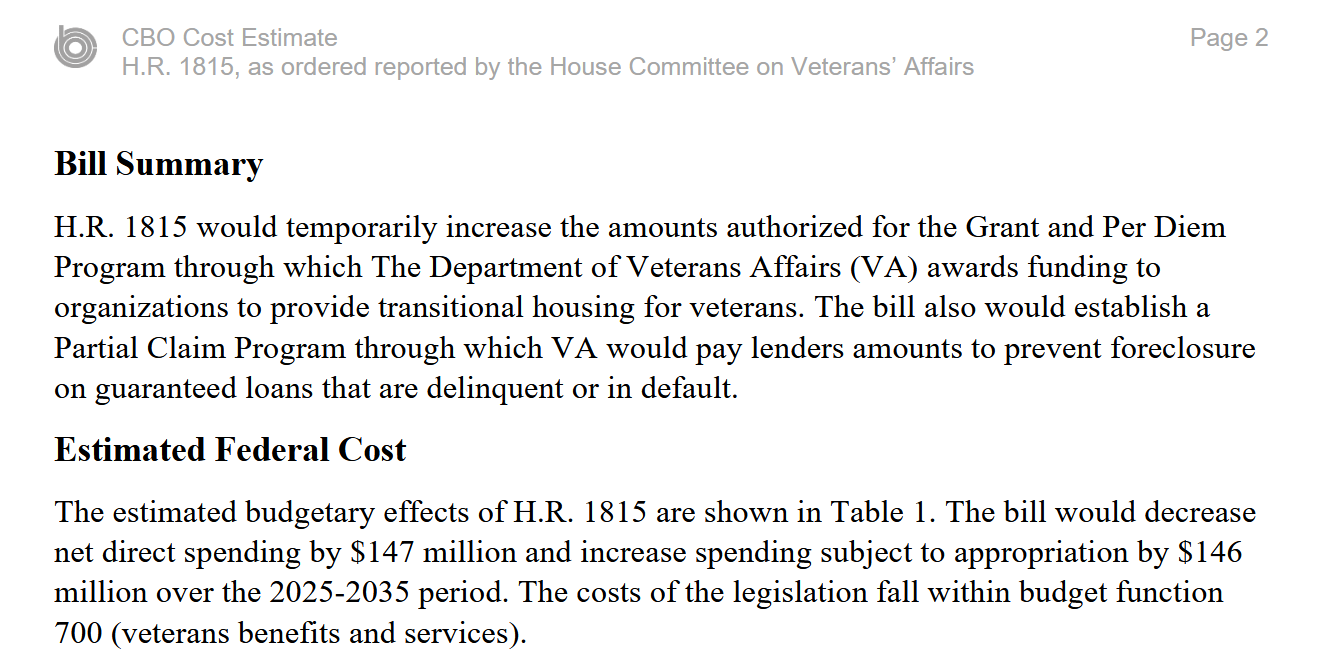
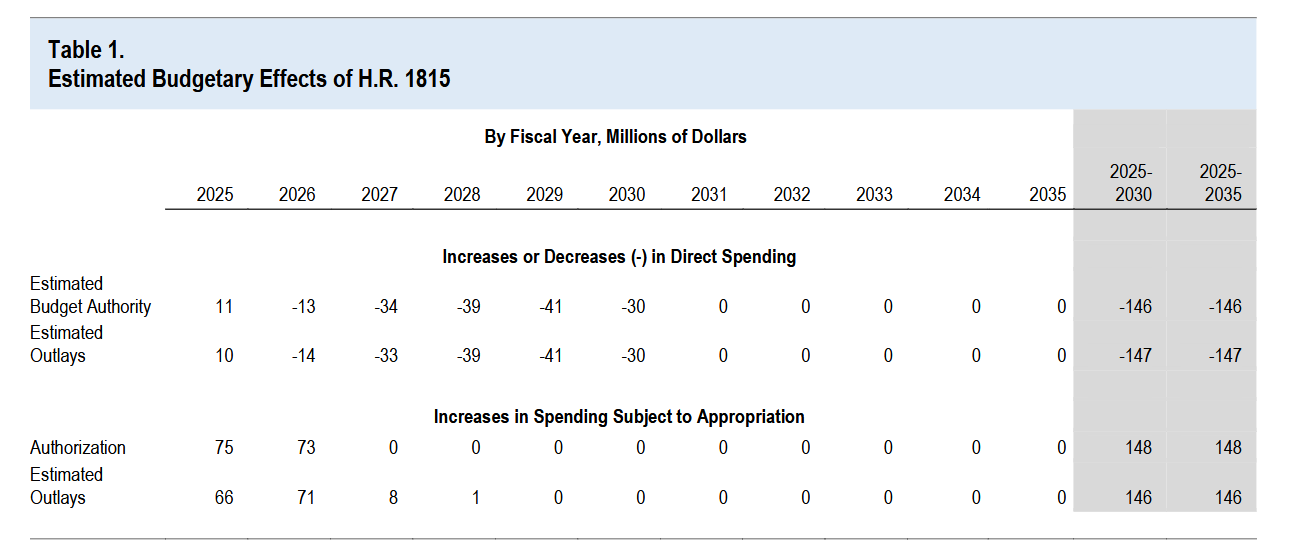
See the fiscal two-path on the Policy and Fiscal page: the foreclosure path costs more than the partial-claim path, and CBO scored it.
The multi-billion figures cited are gross loan-purchase volume, not net cost, buying a re-performing loan is an asset offset by repayments. CBO scored the replacement partial-claim law as reducing net direct spending by $147 million, including $294 million in offsets.
CBO cost estimate, H.R. 1815 Net savings projection · captured July 2026CBO cost estimate, H.R. 1815 Table 1, both spending lines · captured July 2026
If they say it again
Send the CBO score. It is a government document and it ends the argument on its own terms.
R7 Concede-and-turn · status COMPLETE · last verified 2026-08-05
PR-25 DOCUMENTED FACT
"Homeowners have more legal protection than renters."
After a foreclosure sale, the former owner usually has less protection than a tenant in the same building.
What to say back
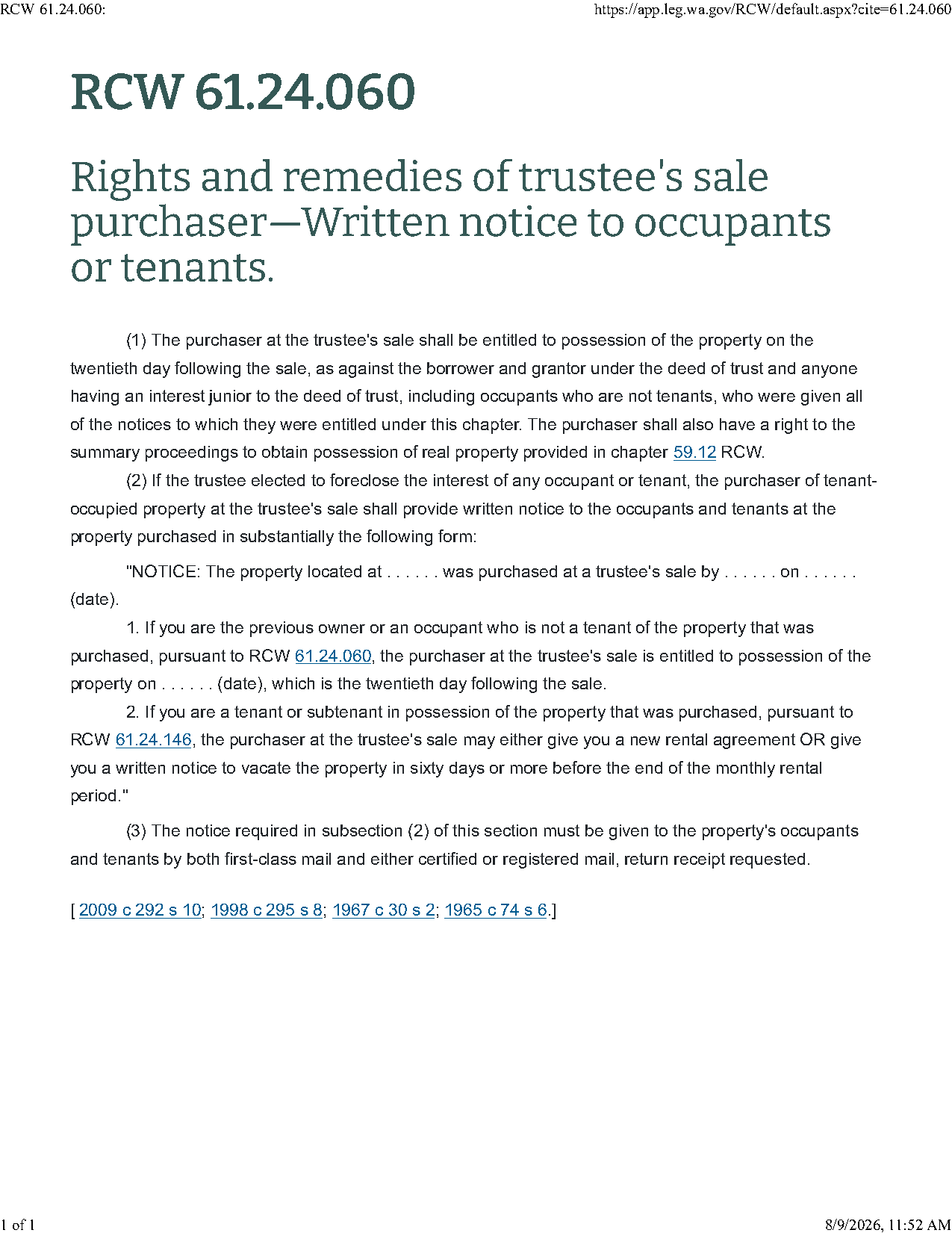
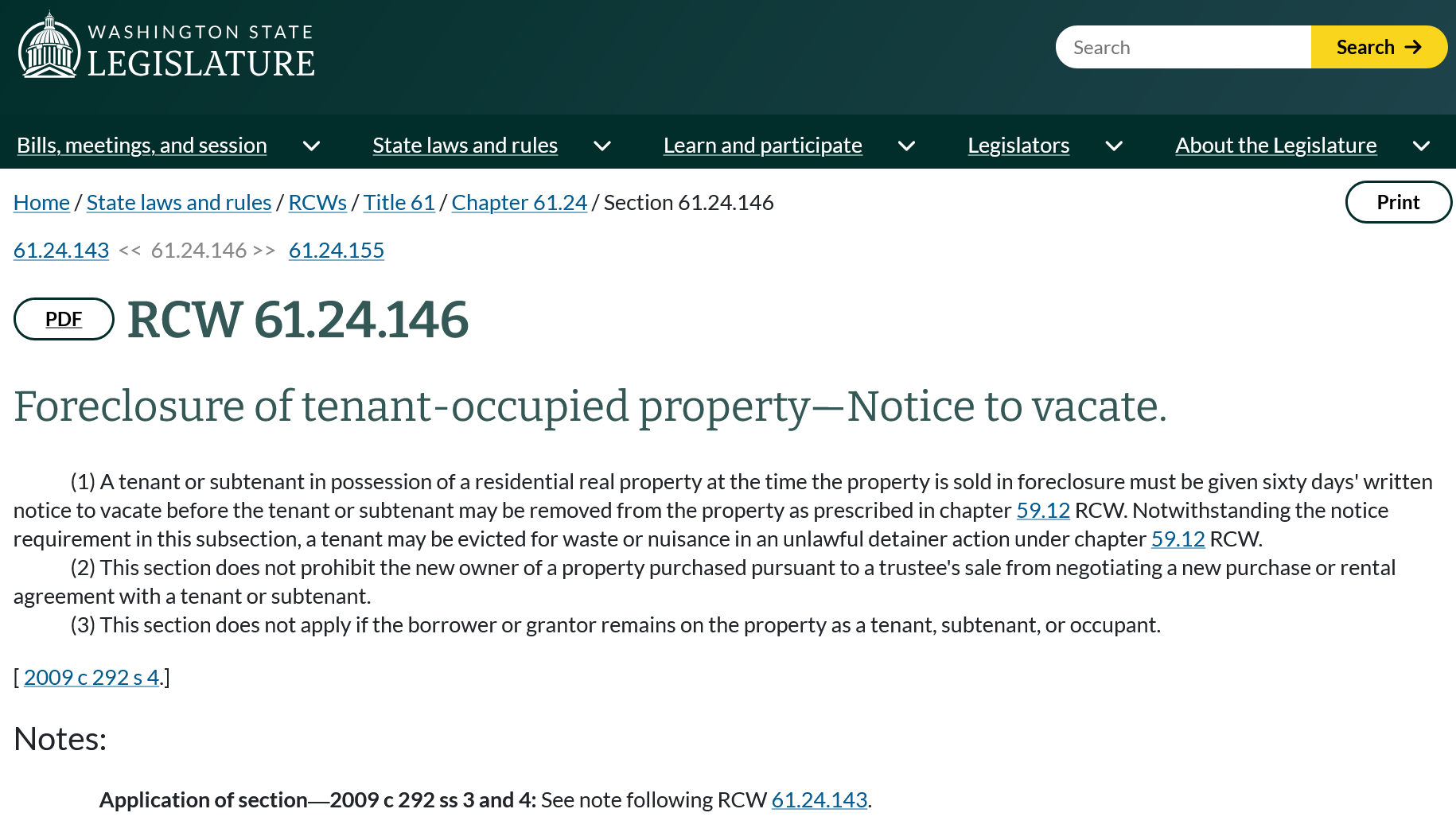
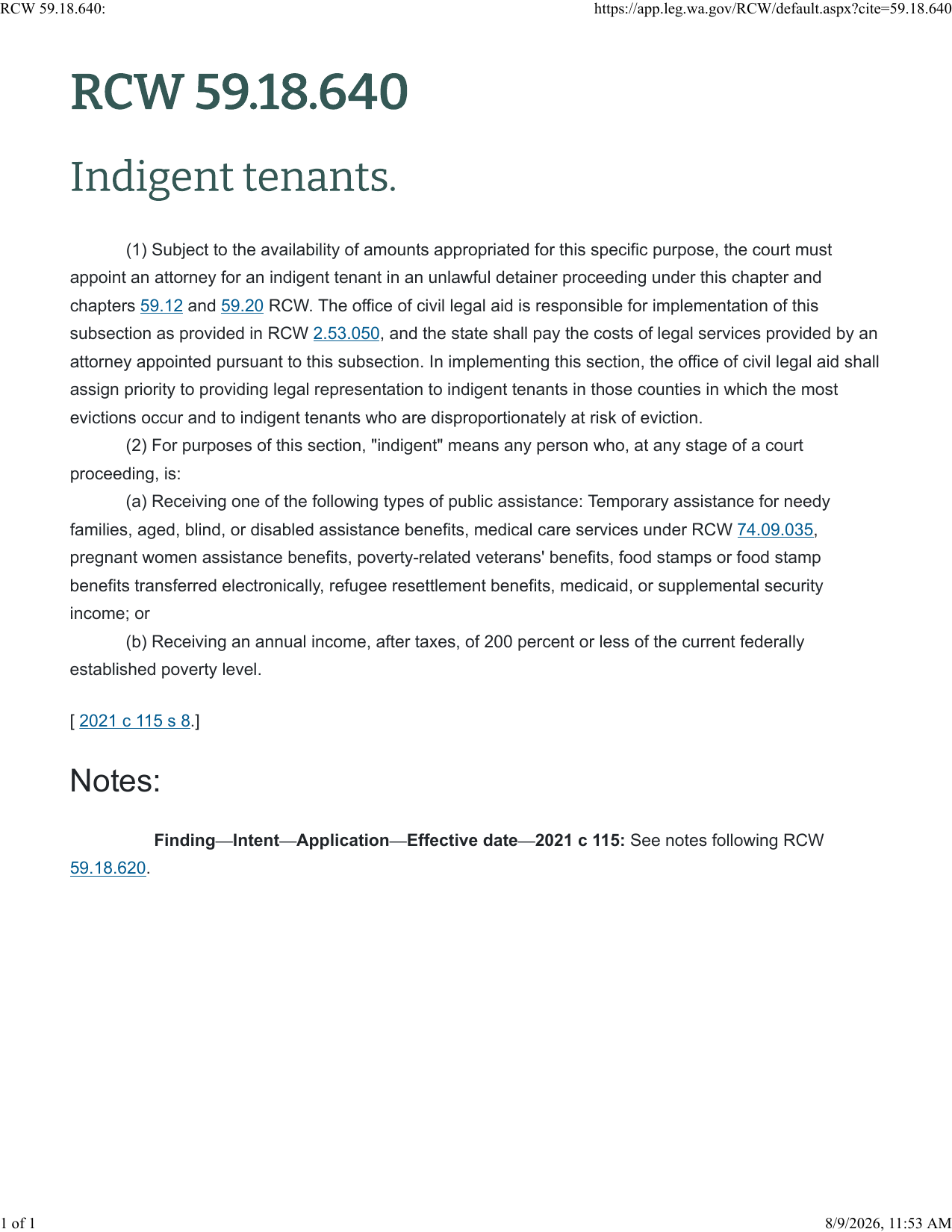
"In Washington a tenant in a foreclosed property gets sixty days' written notice, and that section says it does not apply if the borrower or grantor stays on the property. The purchaser gets possession on the twentieth day. The appointed-counsel statute is written for an indigent tenant and is subject to available appropriations. I am the former owner, so I have twenty days and I should not count on counsel."
Where this comes from
Heard in: comment sections · legal-aid intake · anywhere post-foreclosure occupancy comes up
In Washington a tenant in a foreclosed property gets sixty days' written notice to vacate under RCW 61.24.146, and that section says in terms that it does not apply if the borrower or grantor remains on the property. RCW 61.24.060(1) gives the purchaser possession on the twentieth day as against the borrower and grantor and occupants who are not tenants. The appointed-counsel provision, RCW 59.18.640(1), is written for an indigent TENANT in unlawful detainer proceedings under chapters 59.18, 59.12 and 59.20, and it is expressly SUBJECT TO THE AVAILABILITY OF AMOUNTS APPROPRIATED FOR THIS SPECIFIC PURPOSE. So the notice protection excludes the former owner on the face of the statute, and the counsel provision is written for tenants and is funding-contingent even for them. Wyoming has a three-month statutory redemption with the right to remain during it; Washington has none.
RCW 61.24.060(1) Purchaser’s possession on the twentieth day · captured August 2026RCW 61.24.146 Sixty-day tenant notice, excludes the remaining borrower · captured August 2026RCW 59.18.640(1) Tenant appointed counsel, funding-contingent · captured August 2026
If they say it again
This is a state-law finding. It belongs in state legislative outreach, not in a servicer dispute.
R7 Concede-and-turn · status VERIFIED · last verified 2026-08-10
PR-26 DOCUMENTED FACT
"Refer them to legal aid."
Referral is treated as the end of the obligation. For a household still in the home after a sale, it frequently is not.
What to say back
"Which provider takes post-foreclosure veteran cases in my state? I need a name, not a referral line."
Not a statutory claim. Describes how foreclosure-defense and eviction right-to-counsel programs are scoped: foreclosure-defense programs generally close the file at the sale, and eviction-counsel programs generally cover landlord and tenant cases. A post-sale former owner is neither.
If they say it again
Document every referral that did not produce representation, with the date and the reason. The pattern is the finding.
R8 Name-the-omission · status COMPLETE, structural finding, no receipt · last verified 2026-08-05
PR-27 DOCUMENTED FACT
"VA cannot impose a foreclosure moratorium."
VA pressed for one twice, in November 2023 and again in May 2024, and published its reasons in the circulars both times.
What to say back
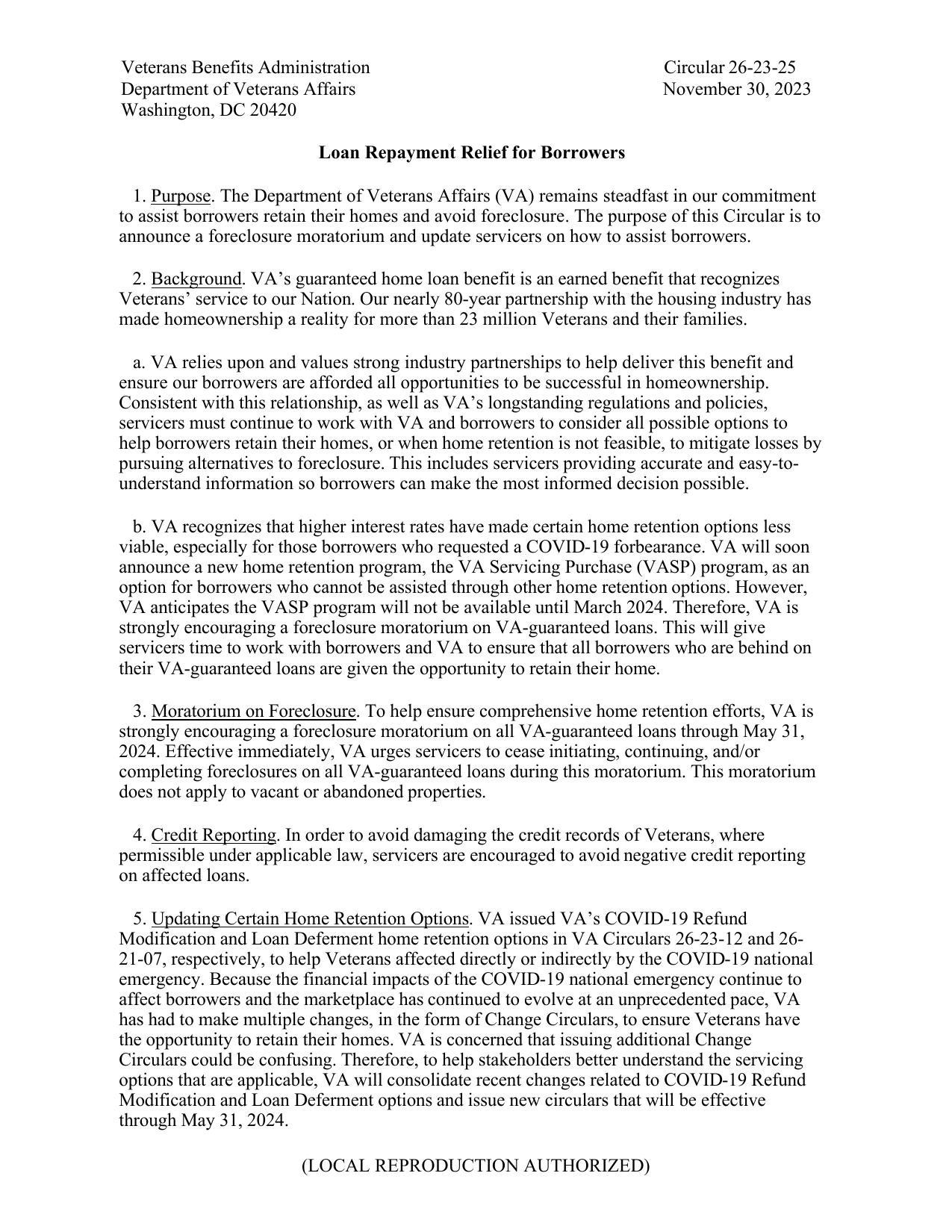
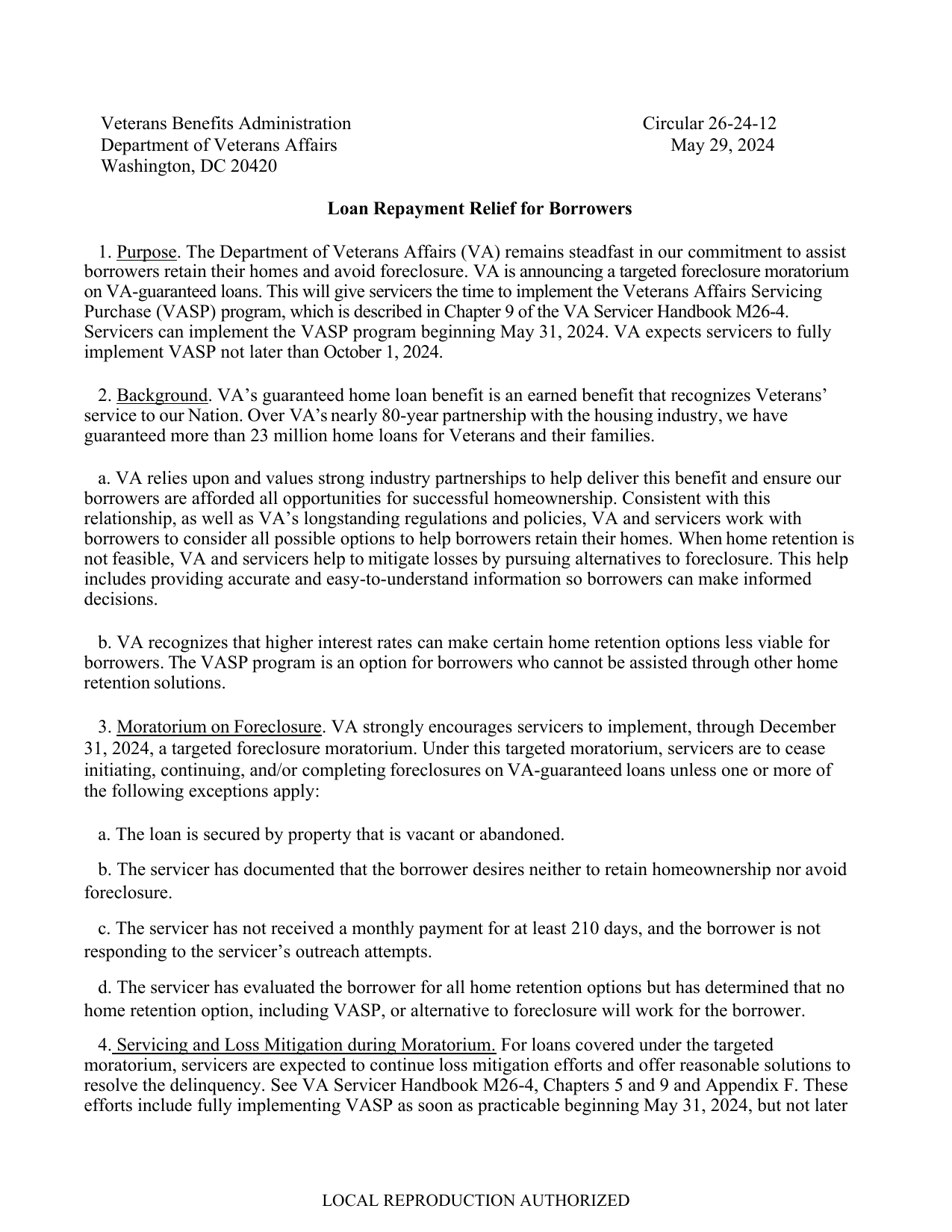
"VA has done this twice. Circular 26-23-25, November 30, 2023, strongly encouraged a moratorium on all VA-guaranteed loans through May 31, 2024. Circular 26-24-12, May 29, 2024, extended it as a targeted moratorium through December 31, 2024. Both gave the reason in the text: to buy servicers time to stand up the program. What has VA done for the November 28, 2026 deadline?"
VBA Circular 26-23-25 (November 30, 2023) section 3 strongly encouraged a foreclosure moratorium on all VA-guaranteed loans through May 31, 2024, excepting vacant or abandoned properties. VBA Circular 26-24-12 (May 29, 2024) section 3 extended relief as a TARGETED moratorium through December 31, 2024. As issued it named four exceptions: vacant or abandoned; borrower documented as not wanting retention or to avoid foreclosure; no payment for at least 210 days with no response to outreach; all retention options including VASP evaluated and none workable. Change 1, issued June 21, 2024, deleted the 210-day exception (S197), so for most of the moratorium there were three, not four. The base circular was never reissued, so the PDF VA still serves at that address prints the deleted paragraph. Neither circular imposes a moratorium. Both encourage one, and both cite 38 U.S.C. 3704(d) and 38 C.F.R. 36.4336, the power to audit a servicer and bar it from the program.
VBA Circular 26-23-25, Nov 30 2023 Section 3, moratorium encouraged through May 31 2024VBA Circular 26-24-12, May 29 2024 Section 3, targeted moratorium through Dec 31 2024
If they say it again
Ask what changed between 2024 and now, in writing, to the committee of jurisdiction.
R7 Concede-and-turn · status VERIFIED · last verified 2026-08-25
PR-28 DOCUMENTED FACT
"We do everything we possibly can to keep them in their homes."
The deflection runs in a fixed two-step sequence: blame the servicers, then blame the veterans. The original cause was federal action.
What to say back
"Everything you possibly can includes the partial-claim authority Congress gave you in July 2025 and the moratorium authority VA used in 2023 and again in 2024. Which of those was exercised, and on what date?"
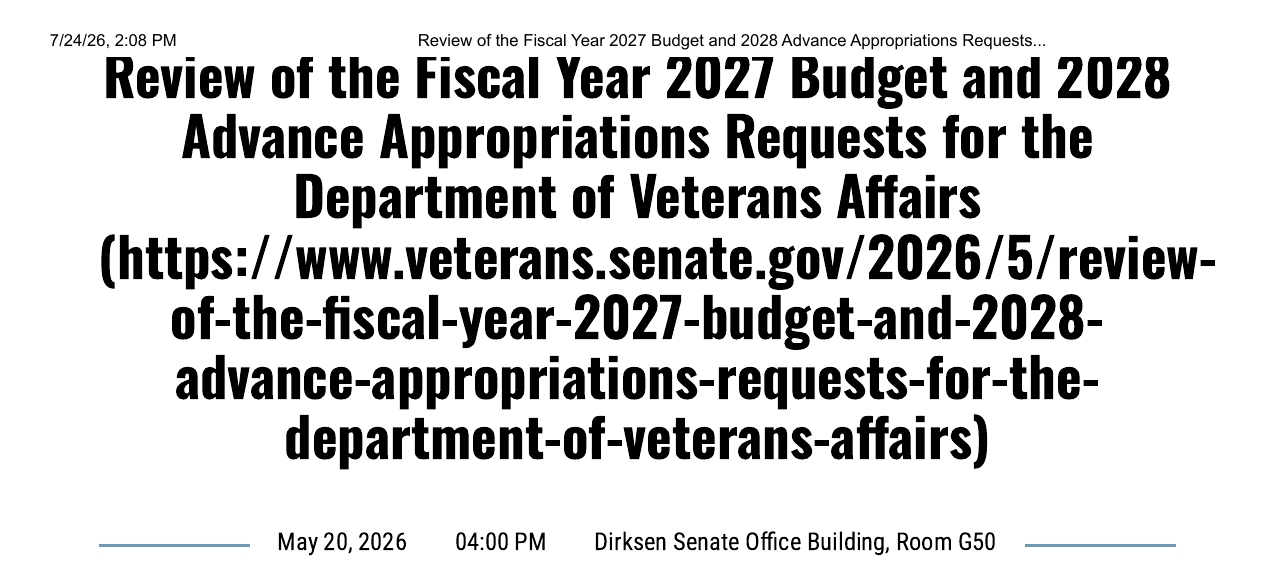
Sec. Doug Collins, Senate Veterans’ Affairs Committee, May 20 2026, pressed by Sen. Blumenthal on the 15,000+ families already foreclosed on. Step one: "Remember the VA is about putting people in homes. We don’t take people out of homes. Those are the mortgage bankers that take them out. We don’t take anybody out of homes." Step two: "we do everything we possibly can to keep them from that end."
Senate Veterans’ Affairs Committee, May 20 2026 Sec. Collins on foreclosures · C-SPAN program 679573
If they say it again
Ask which of the two authorities was exercised, in writing, to the committee of jurisdiction.
R7 Concede-and-turn · status VERIFIED · last verified 2026-08-20
PR-32 DOCUMENTED FACT
"VASP was a bailout for lenders."
The same statement that said it named the replacement: a partial claim so veterans could stay in their homes. Congress passed that in July 2025. It still is not running.
What to say back
"That is from the April 3, 2025 joint statement by Chairman Bost and Rep. Van Orden. In the same statement they said the plan was a partial claim program so veterans could stay in their homes. Congress passed it in July 2025, by voice vote in both chambers. Servicers have until November 28, 2026 to implement it. Which families were supposed to hold on for those sixteen months, and on what?"
Joint statement of Chairman Mike Bost and Rep. Derrick Van Orden, House Committee on Veterans' Affairs, April 3 2025. Verbatim: "The Biden-Harris administration wrongfully jeopardized the future of this benefit by allowing billions of dollars to be used towards bailouts for lenders by creating the VASP program." The same statement, four sentences later: "This action underscores House Republicans' intent to establish a partial claims program at VA to ensure veterans' can stay in their homes if they're in financial hardship while still protecting the American taxpayer." It also carries the committee's own fiscal case: "Instead of reinstituting the partial claim program for an average loan delinquency of $22,500, VA chose to purchase these loans through the VASP program at an average of $292,000," a figure the statement says has since risen to $320,000. H.R. 1815 passed the House on May 19 2025 under suspension of the rules, which requires a two-thirds majority, by voice vote, and passed the Senate without amendment by voice vote on July 15 2025. It was signed July 30 2025. Neither chamber held a roll-call vote, so no individual vote tally or recorded opposition exists. VA called the Partial Claim Program live on June 15 2026 and set full servicer implementation at no later than November 28 2026.
If they say it again
Ask, in writing to the committee of jurisdiction, for the date a family already in default could first use the partial claim.
R7 Concede-and-turn · status VERIFIED · last verified 2026-08-25
PR-33 DOCUMENTED FACT
“VASP was never statutory. VA created it, so VA could end it.”
Congress did not write VASP. Congress did write the partial claim. Seven of the ten rules VA uses to decide who qualifies appear nowhere in that law.
What to say back
“You are right that Congress did not create VASP. Congress did create the partial claim, in law, in July 2025. Congress wrote three conditions. VA’s handbook lists ten. Which statute authorizes the other seven?”
Congress enacted the Partial Claim Program at 38 U.S.C. § 3737 in the VA Home Loan Program Reform Act, Pub. L. 119-31, signed July 30 2025. Section 3737(a) sets three conditions for an eligible loan, including that the loan be “in default or at imminent risk of default.” VA’s own handbook, M26-4 Chapter 22, effective June 1 2026, lists ten qualifying criteria. Seven of the ten, § 22.02 a.2, a.4, a.5, a.6, a.7, a.8 and a.9, appear nowhere in the statute. Two of those seven were added after the public comment window closed: the 24-month modification lockout and the COVID partial claim bar.
If they say it again
Ask, in writing to the committee of jurisdiction, for the statutory citation behind each of the seven handbook criteria.
R7 Concede-and-turn · status VERIFIED · last verified 2026-08-28
PR-34 DOCUMENTED FACT
“The VA Home Loan Affordability Act caps seller concessions at six percent, the same as FHA.”
The bill text does not say that. It limits the seller fees actually paid by the veteran. A concession is money the seller puts toward the buyer’s costs, which is the opposite direction.
What to say back
“I want to check one thing against the bill itself. The one-pager says it caps seller concessions at six percent. The text at section 2(d)(3) says the seller fees actually paid by the veteran may not exceed six percent. A concession is what a seller puts toward my costs; that sentence is about what I pay. Which one does the bill do?”
Where this comes from
Heard in: the sponsor’s one-pager · the committee rollout release · coverage repeating them
H.R. 8532, the VA Home Loan Affordability Act. The sponsor’s one-pager says the bill would “cap seller concessions at 6% to match FHA standards for nonveterans.” The committee bill print, at SEC. 2(d)(3), adds a new paragraph to 38 U.S.C. 3710(b) reading that “the seller fees actually paid by the veteran do not exceed six percent of the outstanding balance of the loan.” Both documents are the sponsor’s own, published the same day. Nothing here says the bill is bad or that anyone misdescribed it on purpose; a one-pager is a summary, and the closing-cost cap in the same subsection is a real gain. Only the enacted text would govern.
If they say it again
Ask the sponsor’s office, in writing, to confirm which quantity paragraph (10) limits, and whether the one-pager will be corrected. The answer is checkable against the print rather than a matter of opinion.
R8 Name-the-omission · status VERIFIED · last verified 2026-08-30
SIDEBAR, FOR FAMILIES
"Your exemption was revoked", usually a lapsed renewal, not a revocation
Property tax and the disabled-veteran exemption
This varies by state, so always confirm what your own state law says. Disabled-veteran property-tax exemptions are typically income-based with periodic renewals, in Washington, RCW 84.36.379–.389. A missed renewal is not a county "revocation." Families in Washington and Wyoming have both reported being told an exemption was revoked when the record showed a lapsed renewal. If your escrow jumped and you were told your exemption was "revoked": pull your county assessor record, check whether your servicer had your exemption documents, and ask in writing why the exempt rate wasn’t applied.