Impact and the record
What happened to families during each VA mortgage-relief policy period, 2020–2026
The rest of this record holds dates, rules and claims. This page holds harm, and puts the document next to the sentence.
Elsewhere on this site you can find what happened and when, what the rules said, and what this project asserts. None of those answers the question a family actually asks: what did this do to people, and how do you know.
The unit here is not a date and not a claim. It is a period, what that period did, and the paper that proves it. Every quotation below is a verbatim line read off the document itself, not a summary of it, and every entry carries the claim and source numbers it rests on so you can check it against the registers.
This page is deliberately incomplete, and it says where. Several periods have documents this project holds but has not yet captured to a standard fit to publish. Those are marked in place rather than left as silence, because a gap you can see is part of the record and a gap you cannot is a defect.
PERIOD NAVIGATION
Five policy periods show which VA mortgage-relief options existed from 2020 to 2026
Each period below keeps its own receipts and limitations. This rail is only the orientation layer.
2020 → Oct 2022
Families were told missed payments could be repaid over time; the VA-specific exit later expired.
Oct 2022 → May 2024
The COVID tool had expired and the replacement had not yet opened.
May 2024 → May 1 2025
The replacement operated for about eleven months before VA ended it.
May 2025 → Jun 2026
Congress passed a replacement in July 2025; implementation followed later.
Jun 2026 → rollout
VA launched the Partial Claim; access still depends on servicer implementation and loan-level eligibility.
Period labels orient; they do not replace the receipt/source blocks. Dates and status must stay tied to the detailed record.
2020 to October 2022
Everyone got the same help. Only veterans lost the way out of it
Families were told in writing that missed payments would not come back as one lump sum. For VA borrowers, the tool that made that promise good expired.
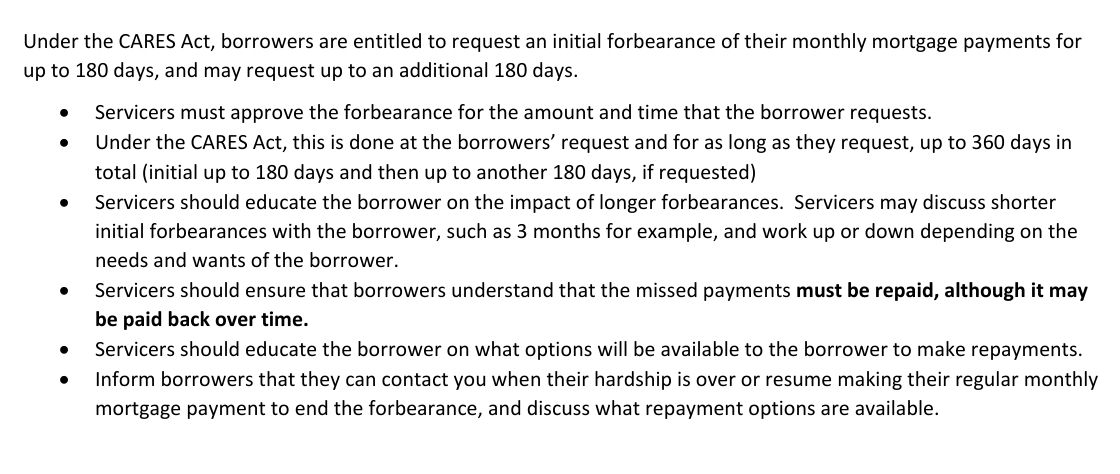
"Servicers should ensure that borrowers understand that the missed payments must be repaid, although it may be paid back over time."
Why it mattersThe promise was never that the debt disappeared. It was that repayment would be spread out. That is the promise a family relied on.
"Inform borrowers that they can contact you when their hardship is over or resume making their regular monthly mortgage payment to end the forbearance, and discuss what repayment options are available."
Why it mattersResuming the normal payment was named, in the guidance, as a way out. Families who tried exactly that are the ones this record is about.
Nothing here is unique to veterans. The same guidance covered everyone. What differed was whether the exit still existed when the hardship ended.
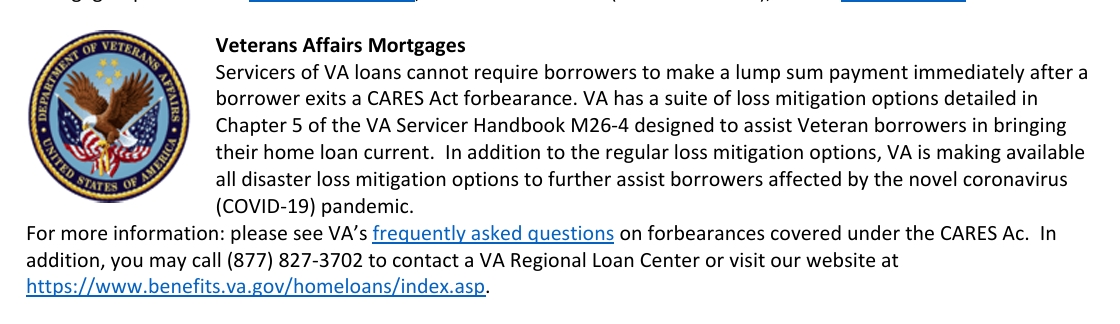
"Servicers of VA loans cannot require borrowers to make a lump sum payment immediately after a borrower exits a CARES Act forbearance."
Why it mattersThis is the rule for VA loans specifically, written by VA, on VA letterhead. It is not an inference from the general guidance.
"VA has a suite of loss mitigation options detailed in Chapter 5 of the VA Servicer Handbook M26-4 designed to assist Veteran borrowers in bringing their home loan current."
Why it mattersThe options were named and located. What this record documents is what happened to families who asked for them.
The fact sheet tells servicers what they cannot do. It does not say what happens when they do it anyway.
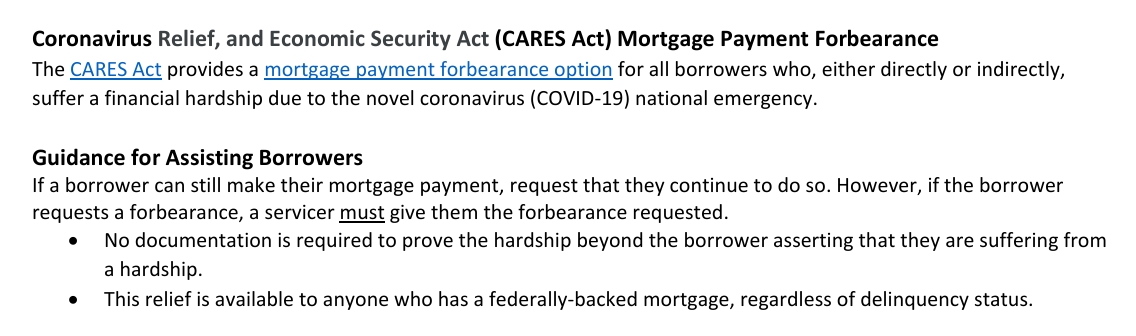
"if the borrower requests a forbearance, a servicer must give them the forbearance requested."
Why it mattersMust, not may. The word is underlined in the original.
"No documentation is required to prove the hardship beyond the borrower asserting that they are suffering from a hardship."
Why it mattersFamilies were later asked for paperwork the guidance says was never required.
"This relief is available to anyone who has a federally-backed mortgage, regardless of delinquency status."
Why it mattersAlready behind on payments did not disqualify anyone. That is the opposite of how the later eligibility barriers were built.
This page set the entitlement wide. The narrowing came afterwards, and it came from policy, not from the statute.
What the period did. The promise was made in writing and for most borrowers it was kept. The exit that made it work for VA borrowers was written with an end date. A family that entered forbearance on the terms published could reach the end of it and find the tool meant to catch them had closed. Nothing about that family's income had changed.
AWAITING CAPTURE A second entry for this period, the VA borrower FAQ on the COVID-era partial claim at S054, is written and not published. The only capture this project holds is a screenshot that does not meet the standard used on this page. It ships when a clean capture and its checksum exist.
October 2022 to May 2024
The first gap. The COVID tool expired and nothing replaced it for nineteen months
A pause is not a solution. It is a delay with a date on it.
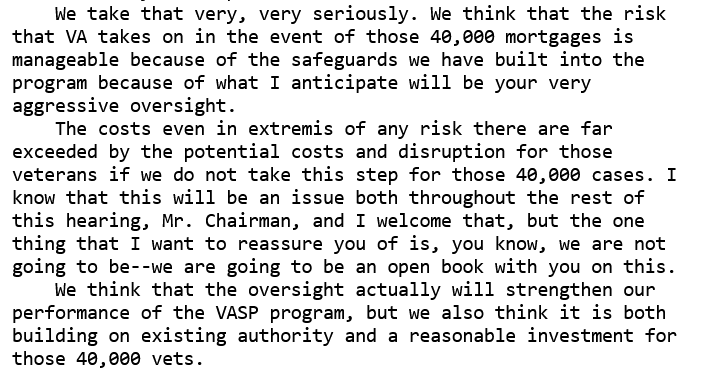
"We think that the risk that VA takes on in the event of those 40,000 mortgages is manageable because of the safeguards we have built into the program"
Why it mattersThe scale was known and stated on the record, in February 2024, before the program launched.
"it is both building on existing authority and a reasonable investment for those 40,000 vets."
Why it mattersThe Department described the authority as already held. That is its own characterisation, given to Congress, and it is quoted here without being extended.
What the period did. Families inside the pause were told to pay the full arrears or lose the house. Where an alternative was offered it raised the monthly payment. Both of those were happening in the months before the replacement program opened.
February 2024, in one month, in one room
Two answers, and they are not a contradiction. The Department told the subcommittee it could not offer a partial claim, and gave a reason: unlike two other federal agencies it has no explicit authority to advance guaranty funds for loss mitigation, and it carries about a quarter of the default risk where those programs carry most of it. DOCUMENTED FACT S052
In the same month it named the authority it did hold for the program it was about to launch: "Yes, sir, 38 USC 3732, as an authorization for VASP, as well as our current regulation at 38 CFR 4320." DOCUMENTED FACT S056 S023
Read those two carelessly and they look like a reversal. They are not, and the difference matters. One advances money against the guaranty. The other buys the loan outright. The Department was distinguishing between two instruments, not changing its mind, and anyone who reads this record should know that before they use it.
PROJECT ANALYSIS What the pair does show is the shape of the position. It was never that the Department could not act. It was that it could act one way and not another, and it said which was which, on the record, before either gap opened.
The authority named in that room is the same authority that was disavowed later. The rebuttal record sets that out: no neutral body has ever found the purchase program unlawful, and the Department itself called the authority existing. This page does not reopen that argument. It records where the authority claim started.
And the part that keeps this from being a party story, because it is the part most often left out. Creating foreclosure-prevention tools by administrative action is not one administration's invention. The COVID-era tools were created in 2020, continued by the administration that followed, and the partial claim program in force today is itself run on administrative guidance rather than finished regulation. Three administrations, one practice. The disagreement has never been about whether the Department prevents foreclosures. Only about how.
Two limits travel with this and are not optional. The authority claim was contested at that hearing by the subcommittee chair, and this record does not resolve who was right. And the no-partial-claim position is a February 2024 position: Congress created the permanent partial claim in July 2025, which settles the question going forward. The purchase program also differed from earlier uses of the same authorities in scale and in structure. Those are legitimate policy criticisms and they are not a finding that anything was unlawful.
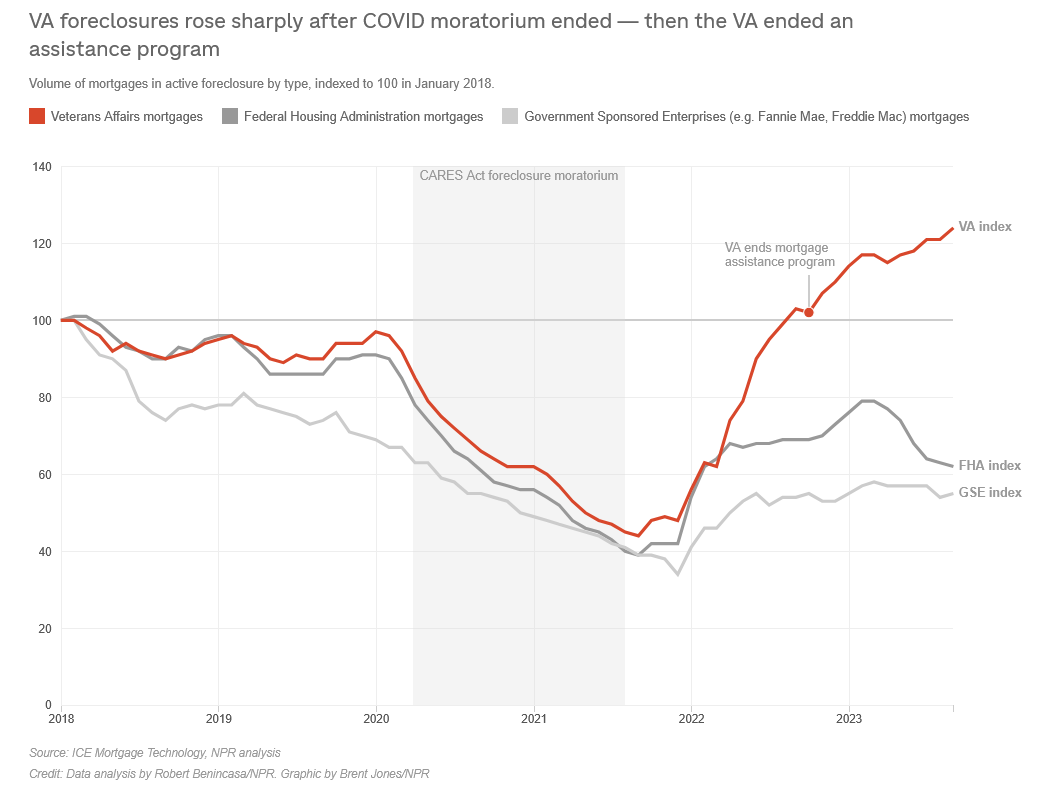
"Volume of mortgages in active foreclosure by type, indexed to 100 in January 2018."
Why it mattersAll three loan types are measured against the same clean pre-pandemic year, so the lines can be compared to each other without any arithmetic of ours.
The three lines move together until the moratorium ends. After it, they separate, and only one of them keeps climbing.
| Point on the chart | VA | FHA | GSE |
|---|---|---|---|
| January 2018, the baseline | 100 | 100 | 100 |
| Early 2020, just before the moratorium | about 95 | about 90 | about 75 |
| Mid 2021, the low point, INSIDE the moratorium | about 44 | about 42 | about 39 |
| Late 2022, where the graphic marks the assistance program ending | about 102 | about 68 | about 50 |
| Peak reached during 2023 | about 123 | about 79 | about 58 |
| End of the series, late 2023 | about 123, still rising | about 63, falling | about 55, flat |
What the picture shows, in one sentence. Through 2018 and 2019 the three loan types tracked each other. They fell together during the moratorium. After it, all three rose, and then they separated: the VA line went past its own pre-pandemic level and kept going, while the other two turned back down.
Why there is no percentage anywhere in that table, and this is deliberate. The low point sits inside a foreclosure moratorium, which is a period when foreclosures were largely prohibited rather than merely rare. Any growth figure measured from it would be enormous and would mean nothing, because the baseline was set by a policy and not by conditions. This project's methods page sets out that rule. The comparison that survives is against 2018, which the graphic already uses.
And the limit on what the divergence proves. The graphic's own headline places the end of the assistance program in the sequence. A sequence is not a cause. Other things moved in the same period, and nothing here establishes that one produced the other. What the record holds is that the three lines separated after the moratorium and only one of them kept climbing, which is a fact about the picture and checkable against it.
May 2024 to May 1 2025
The replacement ran for eleven months and ended on about eight days notice
Families entered it, and it was terminated with most of them still outside it.
What the period did. A program that had been described to Congress as building on authority the Department already held was stood up, used, and withdrawn inside a year. The withdrawal was not phased. Families mid-application were inside a process that stopped existing.
The dated record for this period, and the circular that ended the program, are set out in full on the policy page and on the chronology.
AWAITING CAPTURE The entry for this period rests on three warning letters this project holds and has not captured to publication standard. No receipt, no card. That is the rule this page runs on and it is not bent for a period that would benefit from it.
May 2025 to June 2026
The second gap, and this one was disclosed in advance
Congress passed a replacement in July 2025. Servicers are required to offer it by November 28 2026.
What the period did. The difference between this gap and the first one is that nobody had to discover this one. The implementation window was stated in the Department's own transmittal. The receipt for that is on the evidence page, quoting the transmittal directly: the program was called live on June 15 2026, and full implementation was set at no later than 180 days from publication of the final policy.
The delay and exclusion section on the policy page sets out what that window does to a household that is behind while it runs.
AWAITING CAPTURE A foreclosure-activity entry covering 2025 and 2026 is drafted and unpublished for want of a capture from the registered data sources.
What this page refuses to do
Four rules, and they are the reason it is shorter than it could be
Every one of them costs this page material it would otherwise carry.
No entry ships without its paper. Several periods above hold documents this project has read and can describe. They are not quoted here, because a quotation on this page is a line read off a capture with a checksum, and a paraphrase presented in that frame would be pretending.
No new facts. Every entry carries a claim number and a source number that existed before this page did. If an entry would need a fact that is in neither register, the entry waits.
No family's case. This project holds detailed case material. It does not appear here in any period, and the harm paragraphs are written about what the periods did generally, not about any household.
No asks. This page ends by pointing at them once, and does not argue for them. What a reader can do is on Take Action.