Policy & Fiscal Analysis
Congress wrote the authority. The VA wrote the exclusions.
Both are on the record, with what each one costs.
The three-layer rule
This page keeps three layers visibly distinct: documented authority (statute, regulation, VA manual, hearing record), factual analysis (our source-supported reading), and community-reported illustration (a consented, de-identified household experience). We never let one stand in for another, every label on this site is defined at Data & Methods →
Three pages, one question each
This page is the record in order. The analysis sits on the three pages below.
- Who each barrier excludes. Congress wrote three conditions. The handbook lists ten. Which family each one shuts out, and what authority Congress actually gave.
- How the rule changed. Four documents in eleven months, side by side, and the protection that was narrower at the end than at the start.
- The fiscal case. Foreclosure is the most expensive outcome for the family, the servicer, VA and the taxpayer. The numbers, with their sources.
Part 1
The record, in order
What each party said and did, in sequence, from the promise made in 2020 to the policy that is final but not yet operational everywhere. Every entry is a primary document or a dated report.
2020 · The promise
Sources S049, S259, S260, S262, S263, S264, S265 · claims C042, C046
What VA told the mortgage companies to do
In 2020, federal guidance told mortgage companies they could not make a VA borrower pay a lump sum right after leaving COVID forbearance.
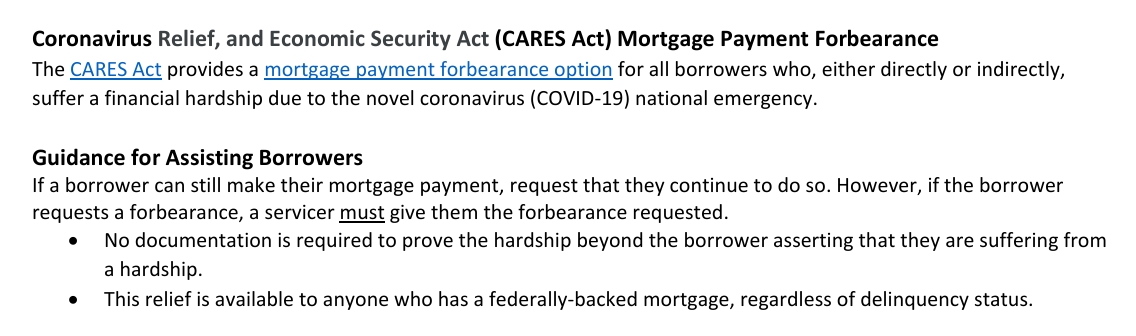
These pages are from the interagency fact sheet for servicers of FHA, VA and USDA loans (S049). The document that told servicers what they could and could not require of a borrower leaving a CARES Act forbearance. It is reproduced here because the instructions are unambiguous and were published to the servicers themselves.
VA said the same thing in its own voice twelve days after the CARES Act passed. Circular 26-20-12, signed by the Director of the Loan Guaranty Service on April 8, 2020 (S259), told servicers that when a borrower attests to a COVID hardship, “the servicer must grant the forbearance request, with no additional documentation,” that “the borrower, not the servicer, is entitled to determine the period of the forbearance,” and that a servicer’s failure to pursue every loss mitigation option “could impact a future claim payment.” A one-page change order on September 9, 2020 (S260) extended the foreclosure moratorium “through December 31, 2020.” VA never reissued the base circular. The PDF on VA’s website, read on September 12, 2026, still prints the 60-day moratorium the change order replaced.
On September 14, 2020, Circular 26-20-33 (S262) gave servicers a way out of forbearance that cost the family nothing: the missed payments move to the end of the loan “with no added cost, fees, or interest to the borrower.” The same circular says deferment “is not a loss mitigation option for which VA has authorized an incentive payment,” and that it “is not allowed in cases where the veteran will need a post-forbearance payment reduction.”
Four of the 63 circulars this record holds say whether they bind anyone. The two that extended the foreclosure and eviction moratoria on August 24, 2020 (S263, S264) say their contents “are part of the guaranty contract and therefore are intended to have the force and effect of law and are meant to bind the public.” The two on helping a borrower keep the loan, refinance access after forbearance on June 30, 2020 (S265) and deferment on September 14, 2020 (S262), say their contents “do not have the force and effect of law and are not meant to bind the public in any way.” All four carry the same signature. Circular 26-20-12 itself says nothing either way.
 Open full capture ↗
2020 · The repayment instruction
Paid back over time, not in a lump sum
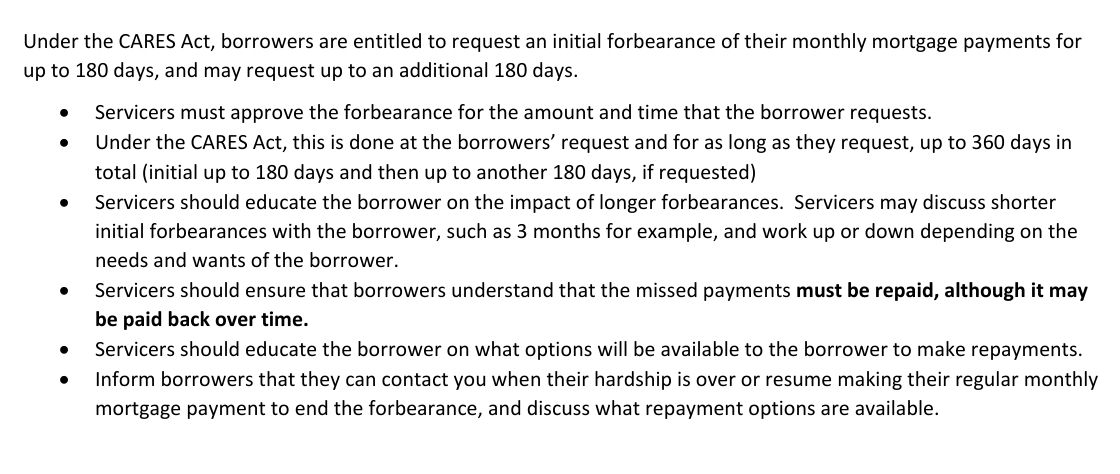
The repayment instruction, in the servicers’ own guidance: missed payments “must be repaid, although it may be paid back over time,” and servicers are to inform borrowers they can “resume making their regular monthly mortgage payment to end the forbearance, and discuss what repayment options are available.” Evidences C046.
2020 · VA loans specifically
No lump sum on exit from forbearance
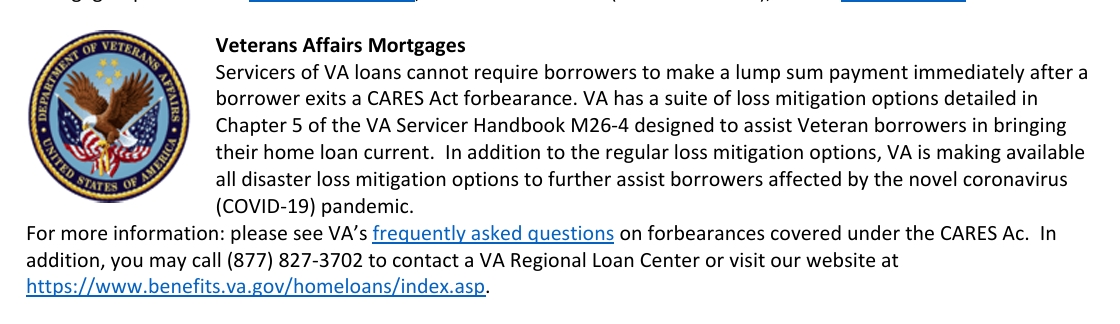
The VA-specific instruction: servicers of VA loans “cannot require borrowers to make a lump sum payment immediately after a borrower exits a CARES Act forbearance,” and are pointed to the Chapter 5 loss-mitigation options in the M26-4 servicer handbook. Evidences C042, C046.
Oct 2022 to May 2024 · The first gap: the COVID partial claim expired, VASP not yet launched.
What happened in the years with no partial claim
In late 2023, NPR reported that a veteran’s mortgage company told him to pay the full amount back or go into foreclosure, after VA had announced a foreclosure pause.
The COVID partial claim expired October 28, 2022 (S052). Veterans Affairs Servicing Purchase (VASP) did not launch until May 2024. National reporting in late 2023 documented what veteran families were being told in that gap, by NPR (S057) and in NPR reporting carried by OPB (S058).
Claims resting on this reporting: C050, C051, C052, C053
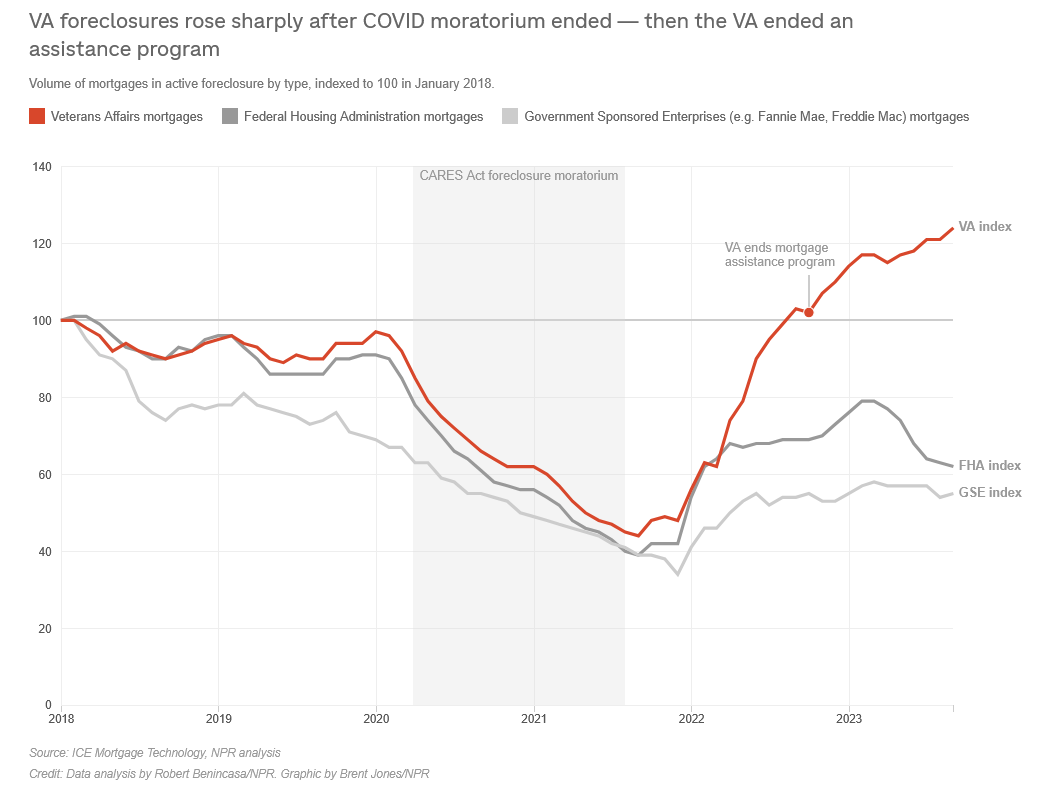
These are copyrighted news reports, not government documents. The two family accounts are quoted briefly under fair use and linked to the publishers, with no article pages reproduced. NPR’s chart is reproduced as the cited source for C052, credited to NPR and ICE Mortgage Technology in the caption.
 Open full capture ↗
VA foreclosures diverged from every comparable program. NPR’s analysis of ICE Mortgage Technology data indexed active foreclosure volume to 100 in January 2018: after the CARES moratorium ended, the VA index rose above its 2018 level to roughly 123 by late 2023, while the FHA index fell to about 63 and the GSE index to about 55. The chart marks the point where VA ended its mortgage assistance program. VA was the only one of the three without a partial claim.
NPR analysis of ICE Mortgage Technology data · S057 (C052)
Veterans were still being told to pay the full arrears or lose the house, after VA had announced a foreclosure pause. One veteran told NPR he read that VA was pausing foreclosures so families like his could get help; his servicer, Mr. Cooper, told him “you have to pay the full amount back or you’re going into foreclosure.” The report notes the pause message “did not appear to be trickling down” to mortgage-company staff. The same family faced about $20,000 in missed payments after a decade in the Marine Corps and four combat tours.
Reported by NPR, carried by OPB · S058 (C050)
The alternative offered in place of a lump sum raised the payment. A veteran was told the missed payments would move to the back end of a 30-year mortgage; in September he was told the deal had changed and he owed $57,000 or could take a modification. He could not pay it, and the modification raised his payment by $1,300 a month, to $3,600, first payment due the day the article ran. This is the same pattern VA’s own incentive schedule points at (C033, C034).
Reported by NPR, carried by OPB · S058 (C051)
The pause was temporary, and it was not a remedy. VA’s Secretary said the pause would run “through May 31 next year, 2024” to give VA “the additional time that we need” to help veterans stay in their homes. At that point 40,000 VA borrowers were in foreclosure or delinquent without a modification. The Secretary also said VA had met with servicers of more than 90% of all VA loans and that they would comply.
Reported by NPR, carried by OPB · S058 (C053)
February 2024 · Congress asks whether VA has the authority.
Hearing record · February 15, 2024 · S056
What Congress and VA said to each other before any of it happened
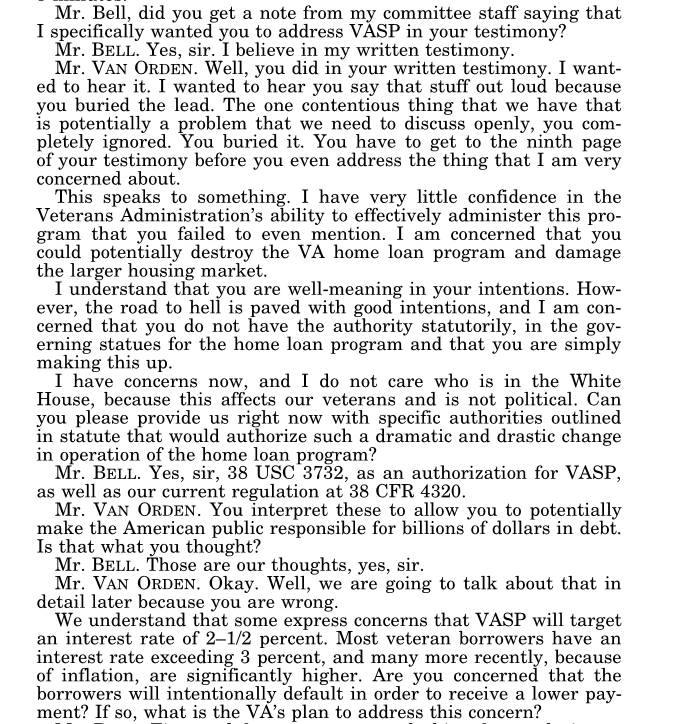
In February 2024 a House subcommittee asked VA what law allowed VASP, and VA named the statute.
You may have heard: “VASP was cancelled because it was illegal” →
Three months before VASP launched, and fourteen months before it was terminated on May 1, 2025, the House Veterans’ Affairs Subcommittee on Economic Opportunity questioned VA about it directly. The subcommittee’s chair set the standard for that scrutiny in his own words. “I have concerns now, and I do not care who is in the White House, because this affects our veterans and is not political”, and pressed VA to name the statute it was relying on. This project applies that standard to the whole record, before and after January 2025, and to every party in it. The pages below are reproduced from the transcript.
Asked to name the statute, VA named it. Pressed to “provide us right now with specific authorities outlined in statute,” VA’s Executive Director of Loan Guaranty Service answered: “Yes, sir, 38 USC 3732, as an authorization for VASP, as well as our current regulation at 38 CFR 4320.” VA said it was “looking for a solution to be able to help 40,000 borrowers stay off foreclosure,” and that its own protocols required six months of mortgage payments on a modification within the loss-mitigation waterfall. That is VA asserting existing authority three months before the April 2024 launch materials already cited here.
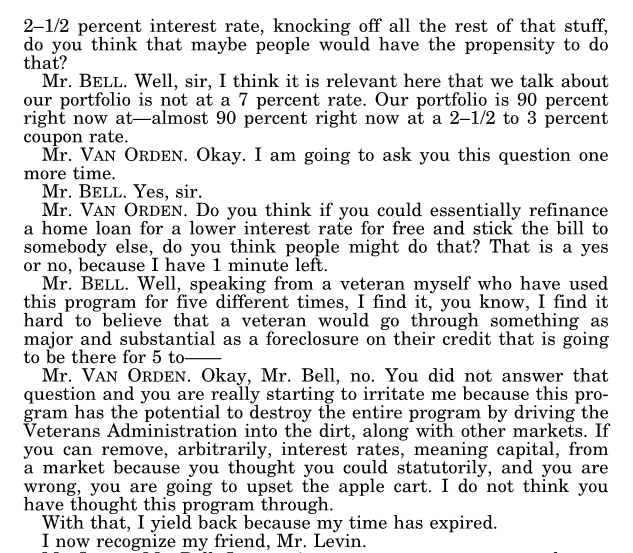
The interest rate on a modification was already the argument, from the opposite direction. The subcommittee pressed VA on whether veterans might “intentionally default in order to receive a lower payment,” observing that “most veteran borrowers have an interest rate exceeding 3 percent.” VA replied that “almost 90 percent” of its portfolio sat at a 2–1/2 to 3 percent coupon rate. In February 2024 the objection to the rescue program was that its rate was too low. Fourteen months later, on May 1, 2025, the program was terminated on roughly eight days’ notice, and the authority question raised here became the question the whole record turns on.
February 2024 · The authority question
Asked on the record, answered on the record
Hearing 118-53, February 15, 2024, the authority question and the answer. Evidences C047 (VA names 38 U.S.C. §3732 and 38 C.F.R. 4320) and C048 (the “I do not care who is in the White House” standard, shown in the paragraph that sets it). Source: S056.
February 2024 · The rate exchange
The objection, in full and in context
Hearing 118-53, February 15, 2024, the rate exchange in full. Evidences C049: in February 2024 the objection was that the rescue rate was too low. Source: S056.
July 2024 · Before the law existed
The gap was documented in public a year before Congress acted
In July 2024 the Urban Institute named the authority gap and found that a standard loan modification raises most VA borrowers’ payments.
You may have heard: “VASP was cancelled because it was illegal” →
What this section is: eight pages from one public study, the Urban Institute’s Housing Finance Policy Center, July 2024 (S053), reproduced in full so the wording can be checked against the claims it supports.
Why it is here: it was published twelve months before Congress created the permanent partial claim on July 30, 2025, and ten months before VASP was terminated on May 1, 2025. It already named the authority gap, the undefined servicer standard, and the fact that a standard modification raises most VA borrowers’ payments. None of that was discovered afterwards. It was on the record, from a mainstream housing-finance analyst, in time to act on.
Claims resting on these pages: C037, C038, C039
Ordered by the event each page describes, not by page number.
March 2020
The promise made to families
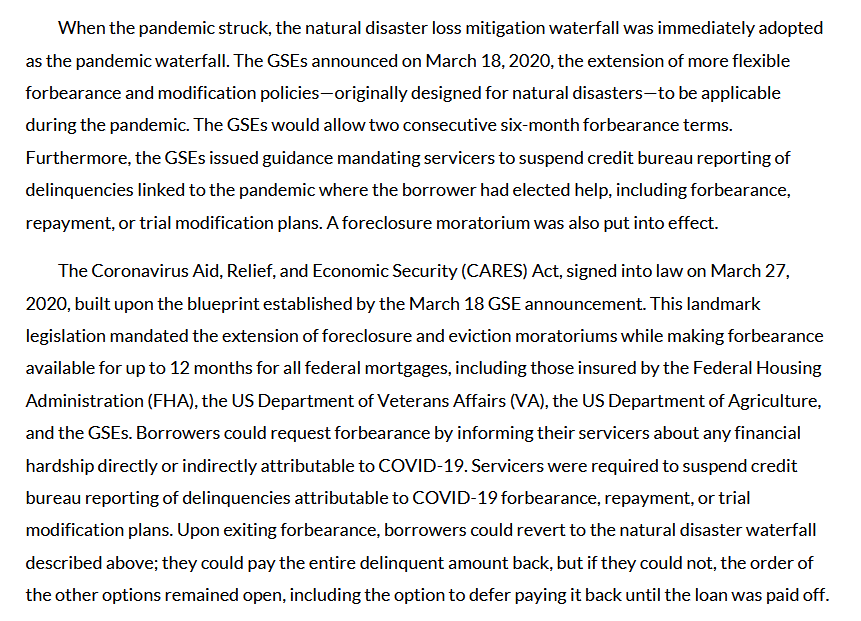
Urban Institute, July 2024. What families were offered. Forbearance for up to 12 months on all federal mortgages including VA, requested by simply informing the servicer of a COVID-19 hardship, with deferral to the end of the loan among the exit options. This is the promise at the start of the chronology; C029 carries VA’s own version of it.
Jul 2021 – Oct 2022
The partial claim appears, then expires
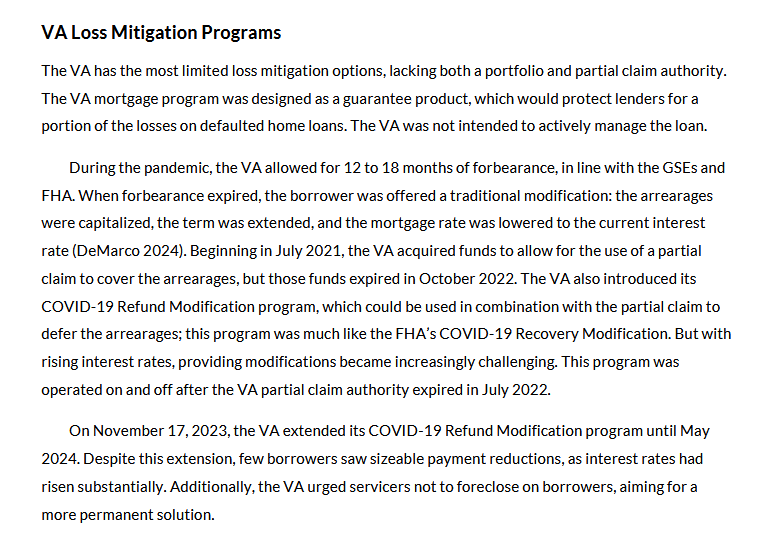
Urban Institute, July 2024, “VA Loss Mitigation Programs.” The source for C037: “the VA has the most limited loss mitigation options, lacking both a portfolio and partial claim authority.” This page also carries the funding chronology, partial-claim funds acquired July 2021, expired October 2022, the Refund Modification then “operated on and off” through a series of extensions to May 2024. VA’s own date for the COVID-VAPCP expiry is October 28, 2022 (S052); the July 2022 date later in this same paragraph refers to the partial-claim authority behind those extensions.
May 2024
The stopgap VA built instead
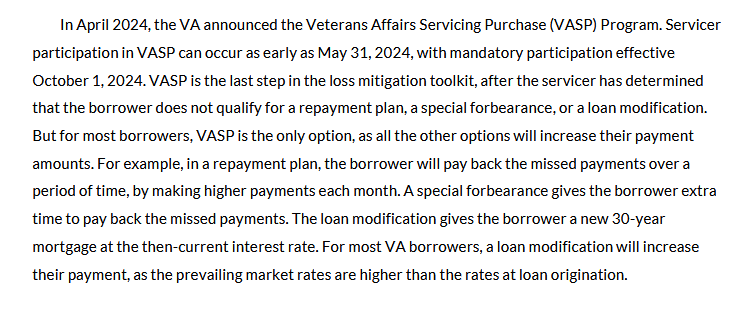
Urban Institute, July 2024, why the alternatives did not work. “For most VA borrowers, a loan modification will increase their payment, as the prevailing market rates are higher than the rates at loan origination,” which is why VASP was “the only option” for most. Context for C039 and for the modification terms families were offered after forbearance.
May 2024
Why a standard modification does not help
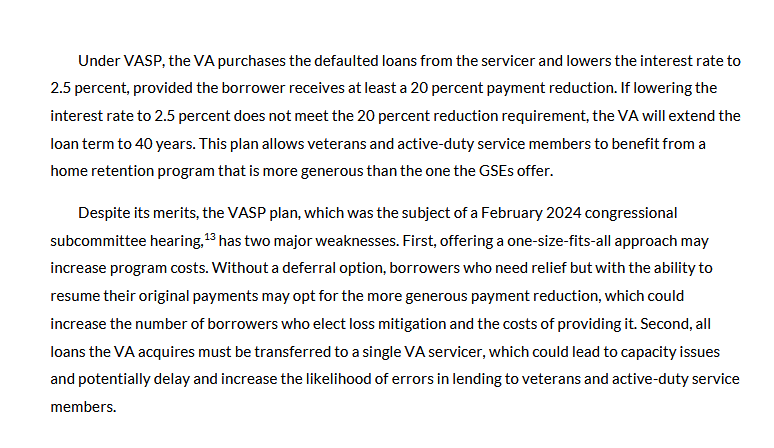
Urban Institute, July 2024, VASP as designed: purchase, 2.5 percent, a 20 percent payment-reduction floor, 40-year term if needed, described as “more generous than the one the GSEs offer.” The named weaknesses are the absence of a deferral option and the transfer of every acquired loan to a single VA servicer. The February 2024 subcommittee hearing referenced here is S052.
In the same paper
The standard nobody defined
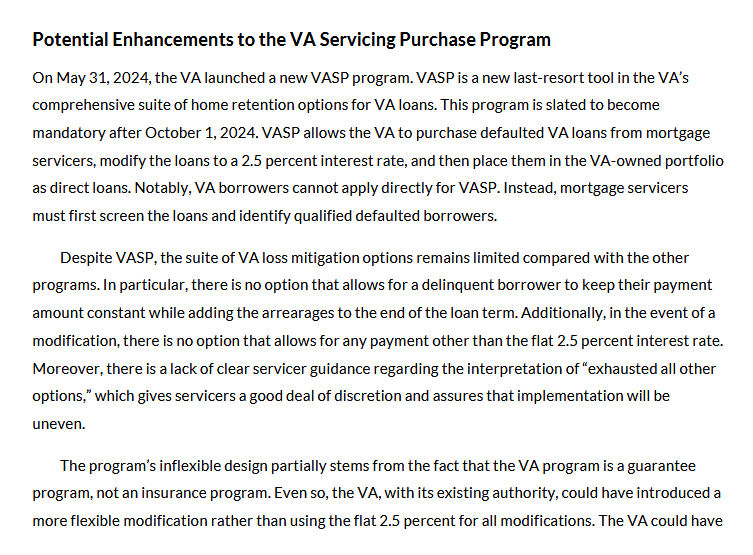
Urban Institute, July 2024, the prediction, in print. The source for C038: the interpretation of “exhausted all other options” was undefined, which “gives servicers a good deal of discretion and assures that implementation will be uneven.” The same page records that veterans could not apply for VASP themselves, servicers screened and identified them, and, for C039, that “the VA, with its existing authority, could have introduced a more flexible modification.”
The recommendation
What they told Congress to do
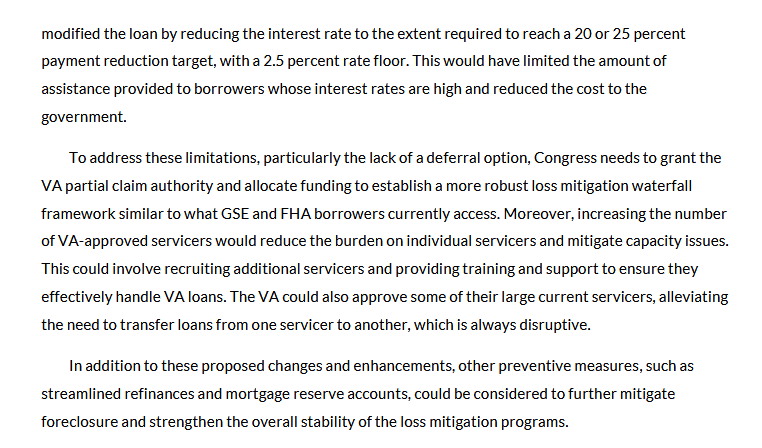
Urban Institute, July 2024. The recommendation. “Congress needs to grant the VA partial claim authority and allocate funding to establish a more robust loss mitigation waterfall framework similar to what GSE and FHA borrowers currently access.” Published a year before Pub. L. 119-31. The costed alternative above it, a 20 to 25 percent payment-reduction target with a 2.5 percent floor, at lower cost to the government, supports C039.
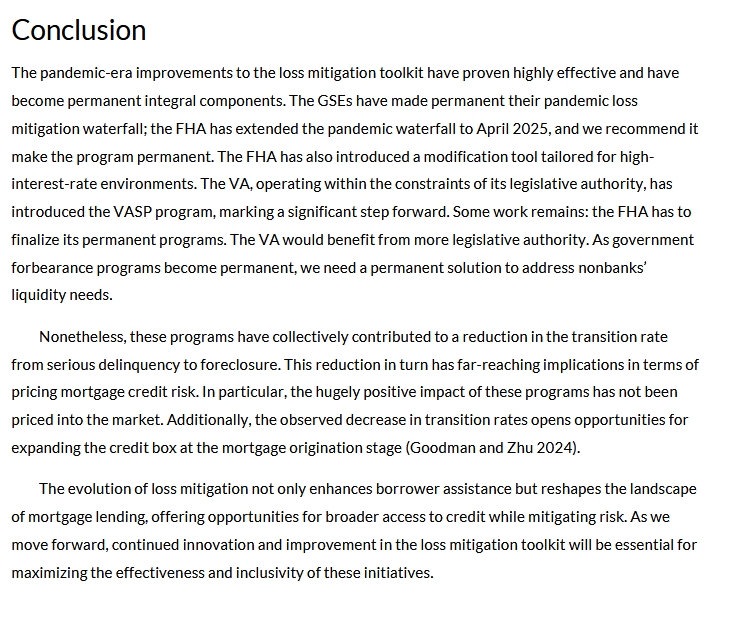
The conclusion
In their own words
Urban Institute, July 2024, conclusion. “The VA, operating within the constraints of its legislative authority, has introduced the VASP program … The VA would benefit from more legislative authority.” The authority gap stated as a finding, not an advocacy position.
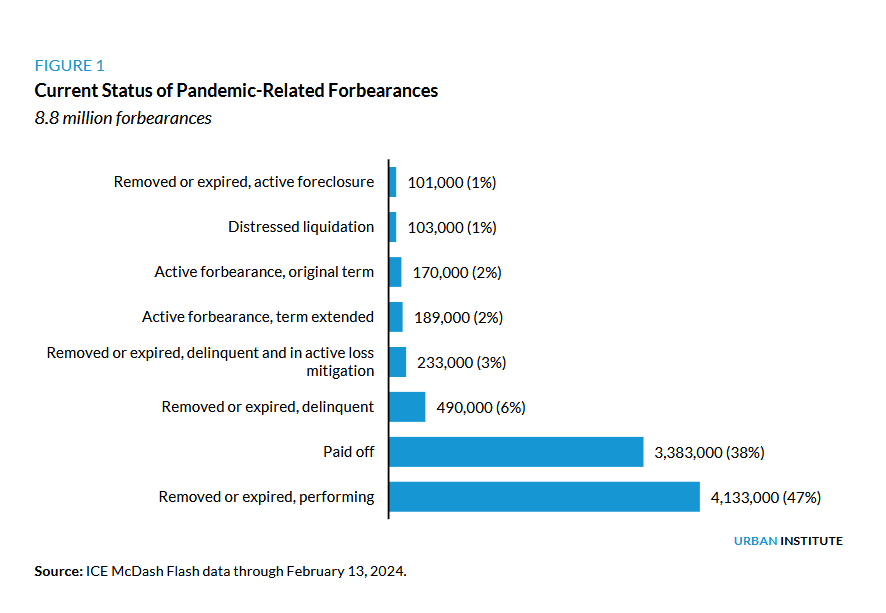
Scale of the cohort
How many forbearances there were
The same report charts the size of the pandemic forbearance cohort: 8.8 million forbearances, most of them resolved, performing, paid off, or modified, and a much smaller number still unresolved when the paper went to print, including 101,000 in active foreclosure and 103,000 in delinquency without a loss-mitigation plan.
Urban Institute, July 2024, Figure 1, the scale of the pandemic forbearance cohort: 8.8 million forbearances, of which 101,000 were in active foreclosure and 103,000 in distressed liquidation as of February 2024. Limit: these are all federal and GSE mortgages, not VA loans, and are not broken out by program, no figure on this site is derived from this chart. It is included to show the size of the population the pandemic waterfall was managing.
The statutes, circulars and guidance, in order
Filtered to the authority layer: what was written, by whom, and when.
March 2020
Federal agencies issue written guidance to FHA, VA and USDA servicers stating paused payments are repaid over time and a lump sum is not required.
DOCUMENTED FACT S049
Apr 23, 2025
VBA Circular 26-25-2 issued, announcing the VASP program wind down.
DOCUMENTED FACT 26-25-02
Jul 30, 2025
Creates the Partial Claim Program at 38 U.S.C. 3737. Section 3737(h) permits the Secretary to act by administrative guidance before regulations.
DOCUMENTED FACT Source
Nov 12, 2025
Pub. L. 119-37, div. G, title III. Sec 7307(a) narrows the 38 U.S.C. 3720(h) foreclosure protection. Sec 7307(b) to (e) amend 38 U.S.C. 3737.
DOCUMENTED FACT
Jun 1, 2026
VA issues final partial claim policy: M26-4 Chapters 5 and 22. Ten qualifying criteria in section 22.02, seven of which do not appear in 38 U.S.C. 3737.
DOCUMENTED FACT
These entries are set in the page. The full chronology, with every dated entry and its source, is on The Record.
This sits inside a wider GAO-documented pattern of VA non-implementation. Three GAO reports in early 2026 document parallel failures across veteran programs. GAO-26-107517 (March 30, 2026) found 174,045 homeless veterans were not referred to HUD-VASH supportive housing during 2020 to 2024, with the VA failing to document the reason in 87% of cases. GAO-26-108943 (March 4, 2026) and GAO-26-108070 (April 16, 2026) document parallel implementation gaps in VA caregiver support tied to the Elizabeth Dole Caregiver Act. The foreclosure gap is one instance of a pattern, not an isolated delay. PROJECT ANALYSIS
Part 2
What follows from the record
The authority that exists, what the Department has said about it, what “helped” is being made to mean, and what the arithmetic shows. These sections read the record above rather than adding to it.