Policy & Fiscal Analysis · The fiscal case
The fiscal case
Foreclosure is the most expensive outcome for everyone, measured, and the program facts behind the numbers.
What counts as help · the 173,000 number.
“Helped 173,000 avoid foreclosure”. Ask what counts as help
Rebuttal in one line: families they processed, not families they saved
The VA’s own figure lumps four very different outcomes together. Three of them are temporary or lossy. Only one means a family kept its home, and the VA has not published how large that bucket is. The number is now pinned to VA’s own launch press release, which says VA “worked with mortgage servicers to help 173,000 Veterans” in FY2025. What that verifies is that the VA said it, not that 173,000 families kept their homes. These buckets are shown as labeled categories, not to scale.
Bucket 1
Temporary forbearances
Counted by the VA as “avoided foreclosure.” A pause, not a cure. The arrears are still owed when it ends.
Bucket 2
Higher-rate modifications
Counted by the VA as “avoided foreclosure.” The family keeps the house at a payment higher than the one they could not pay.
Bucket 3
Short sales & deeds in lieu
Counted by the VA as “avoided foreclosure.” The family loses the home. It is a foreclosure alternative, not a family kept in place.
Bucket 4
Permanent home retention at a sustainable payment
The only bucket that means a family kept its home. Its size is unknown. The VA has not broken the total down.
Why resuming payments does not solve it
Families want to resume paying. This sets out the rules that stop a servicer from letting them.
Read the full record (473 words)
They want to. The system won't let them. When a VA loan is in default, the servicer will not accept regular monthly payments. They demand full lump-sum reinstatement, all missed payments, interest, fees, and escrow, upfront, in full, before any conversation. For a family that entered COVID forbearance, that's $35,000+. The partial claim takes that $35,000, places it in a second lien, resets the loan to current, and lets the family resume their regular monthly payment.
We called Freedom Mortgage a month before our forbearance ended to make sure we did everything right before resuming payments. We found out the COVID program had been cancelled, no notice, no plan, no path to restart. We are not asking for a handout. We are not asking for free mortgage payments. We are asking to be allowed to pay our mortgage.
Every safety net is down, simultaneously.
- Not yet requiredH.R. 1815 Partial ClaimSigned into law July 2025. VA says it was available and live on June 15, 2026. Servicers are not required to offer it until November 28, 2026.
- TransitionBRAVE (replacing HUD-VASH)Senate didn't fund. House funded $970M of $1.1B requested. Not operational. No transition timeline.
- LapsedEmergency Housing VouchersFunding ran out in March 2026. 59,000 households losing assistance. Was supposed to last until 2030.
- EliminatedUSICHFederal coordinating body for homelessness response. Eliminated in FY2026 budget. No replacement.
- UncertainSSVFPrimary program for veteran families at risk. Future uncertain under BRAVE restructuring.
- Coercion trackProject Safe HarborVA initiative being piloted in greater Los Angeles using the guardianship system as an intervention pathway. Project documents cited by Rep. Delia Ramirez (D-IL) at the 5/13/26 HVAC oversight hearing describe enrolling veterans "on the streets" as well as those already in care; VA's representative at the same hearing characterized the program as focused on hospitalized veterans lacking mental capacity for decision-making, and described earlier documents as outdated. The dispute is on the record. Either way, this is a guardianship-based involuntary-intervention pathway running in parallel to the safety-net programs being defunded above, coercion is not a substitute for the partial claim, housing vouchers, or homelessness coordination this list documents are missing. Source: 5/13/26 HVAC NCWI oversight hearing, ~1:27:35 mark.
Each change has a rationale. But when you zoom out: there is no functioning safety net for veteran families in foreclosure right now. Not one. You don't fix bureaucratic dysfunction by creating more bureaucratic dysfunction without a transition plan. Veterans understand phased operations. This isn't one.
GAO is documenting the pattern. GAO-26-107517 (3/30/26): 174,045 veterans not referred to HUD-VASH supportive housing 2020–2024; VA failed to document any reason in 87% of cases. GAO-26-108943 (3/4/26) and GAO-26-108070 (4/16/26): parallel implementation gaps in VA caregiver support tied to the Elizabeth Dole Caregiver Act. Same agency. Same non-implementation pattern. Different programs, same outcome for veteran families.
The fiscal case · what each outcome costs
Foreclosure is the most expensive outcome, for everyone
You may have heard: “VASP was cancelled because it was illegal” →
You may have heard: “why can’t they just start paying again” →
The fix Congress already passed converts arrears a foreclosure would write off into a zero-interest second lien, repaid when the veteran sells or refinances. It is funded by the Loan Guaranty Fund, veteran funding fees, not taxpayer appropriations. The family stays housed and the loan keeps performing. Foreclosure does the opposite, at far greater public cost.
Key finding
PROJECT ANALYSISSet that schedule against what the same regulation pays when the home is lost. CBO records that VA “typically pays lenders up to 25 percent of the outstanding mortgage balance if a borrower’s home is foreclosed upon.” On a $300,000 balance that is up to $75,000 through the guaranty; the same file worked to a successful modification pays $700. This project’s reading is that the money in the rules does not point toward retention, and that a policy relying on servicer initiative to reach families in default is relying on the weakest financial signal in the file.
The crisis right now
DOCUMENTED FACT$0
Zero-interest second lien, no cash out the door.
Loan Guaranty Fund, not appropriations
Scale it to the crisis
$2.3B
Projected cost of foreclosing on 31,500 veteran families.
72%
of the VA’s FY25 homeless-programs budget ($3.2B enacted; $3.46B requested for FY26).
By the VA’s own accounting, only about a quarter of that budget goes to prevention, and none of it prevents a foreclosure. The programs those families land in are already failing them. See the housing analysis →
The fiscal-responsibility rebuttal
Foreclosure is the spending. Retention is the offset.
The program was cut, and the barriers written, on a stated concern for cost and program integrity. The record scores it the other way: the outcome the barriers produce is the one that costs the Treasury more.
Congress’s own scorekeeper priced retention as the cheaper outcome. CBO scored the permanent partial claim as a decrease in net direct spending, with $294 million in avoided foreclosure-related payments, at a subsidy cost of roughly $27,200 per claim. Against that, this project’s model puts the cost of foreclosing on the 31,500 veteran families currently in active foreclosure at about $2.3 billion. Every barrier that moves a family from partial claim to foreclosure moves federal money from the smaller number to the larger one.
S005 · S003 · claim register (C054; builds on C004, C013, C032)
The money that does flow is on the disposition side. VA’s regulation pays a servicer at most $1,000 for a successful loss-mitigation outcome, and the largest incentive in the schedule is for a short sale, not a retention. Meanwhile post-foreclosure evictions are filed in the Secretary’s name by a VA contractor under a federal contract worth up to $374.4 million. Federal dollars are budgeted to take the house; the retention incentive is capped at four figures.
The fiscal argument for the partial claim is the committee’s own. Announcing the VASP phase-out on April 3, 2025, the HVAC Chairman and the Economic Opportunity Subcommittee Chairman wrote that the action “underscores House Republicans’ intent to establish a partial claims program at VA to ensure veterans’ can stay in their homes if they’re in financial hardship while still protecting the American taxpayer.” The statement sets out the arithmetic: “Instead of reinstituting the partial claim program for an average loan delinquency of $22,500VA chose to purchase these loans through the VASP program at an average of $292,000”, since risen to $320,000, and says a partial claim “could solve the majority of delinquent loans at a much less expensive clip to the taxpayer.”
S059 (C055)
Held to that standard, the record reads against it. VASP ended May 1, 2025, on roughly eight days’ notice. The partial claim was authorised July 30, 2025; its final policy published June 1, 2026; submissions opened June 15; servicers have until November 28, 2026, more than eighteen months after the tool it replaced was withdrawn. And the handbook barriers in Chapter 22 exclude families whose default or foreclosure fell inside that window, the cohort the withdrawal exposed. The cheaper option was named in advance by the people who ended the expensive one; the families it was named for are the ones it does not reach.
S059 · S010 · S013 · claim register (C056; builds on C015, C016)
Limit. The $2.3B figure is this project’s model from published per-foreclosure cost figures, not a government estimate, and the CBO numbers score H.R. 1815 as reported. The April 2025 joint statement is quoted from the committee’s own press release, and named here because its authors set the standard this section measures. Its characterisation of why VASP was created is theirs, quoted rather than adopted. Further statements by named officials are recorded and dated on the Accountability Tracker, where any still awaiting a Congressional Record or committee-video citation are labelled.
What a servicer is paid to save the home.
38 C.F.R. § 36.4319(b)
The full servicer incentive schedule
38 C.F.R. § 36.4319(b) on eCFR, the full servicer incentive schedule by tier ranking. Evidences C033; the comparison drawn at C034 is this project’s reading, not rule text.
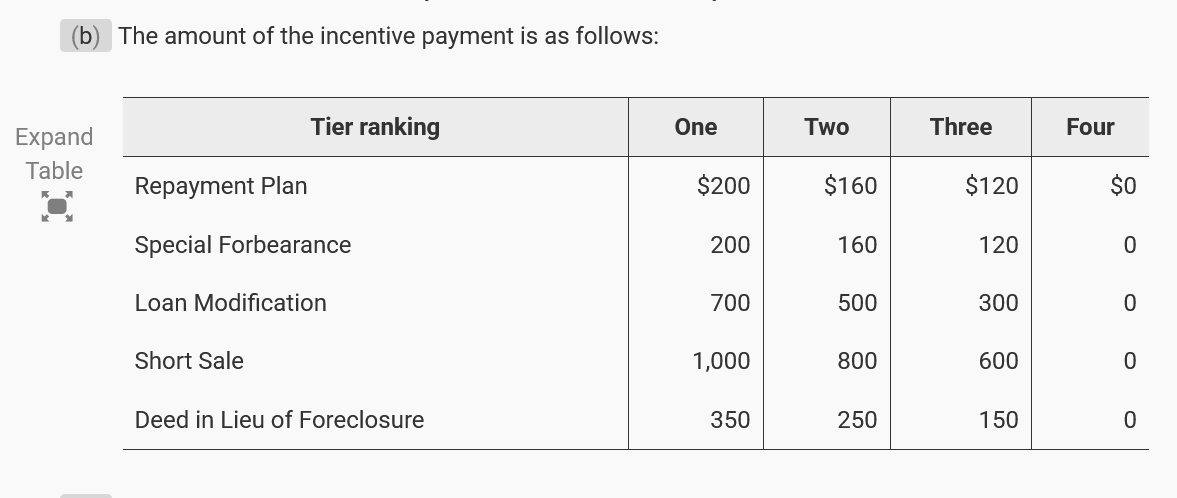
The incentive VA pays a servicer for a successful loss-mitigation outcome is set in regulation, and it is small. Under 38 C.F.R. § 36.4319(b), a completed repayment plan pays $200, a loan modification $700, a short sale $1,000, and a deed-in-lieu $350, at the top tier. Those amounts step down by servicer tier ranking and reach $0 at Tier Four. Nothing in the schedule pays more for keeping a family in the home than for disposing of it: the largest single incentive in the table is for a short sale.
Two limits on the comparison above. The incentive is paid to the servicer; the guaranty payment goes to the holder of the loan, which is often but not always the same company. And a guaranty payment reimburses a documented loss. It is not profit. The asymmetry is in what each path pays out, not a finding that any servicer profits by foreclosing.
Two paths, one family, three-year government cost
PROJECT ANALYSISPath A
What happens now, foreclosure
Path B
What H.R. 1815 does, partial claim
** Model built from the NCLC and CRL per-foreclosure cost figures (S003/S004), the Auction.com REO share (S008), NIH/PMC homeless-cost studies, CRS SSVF data, and the VA FY25 budget. Illustrative of one family; figures are estimates, labeled as analysis.
The VA isn’t just a guarantor anymore
DOCUMENTED FACT75–80%
of foreclosed veteran homes pass into the VA’s own REO inventory. Source: Auction.com.
Every foreclosure makes the VA the 100% owner
Sec. Collins, Rep. Bost, and Rep. Van Orden frame this around fiscal responsibility and cutting government waste, and argue the VA has no business owning mortgages. It already does. The VA lends directly through the Native American Direct Loan program, and roughly three in four foreclosed veteran homes move into the VA’s own REO inventory, where it becomes the sole 100% owner, not a guarantor. Foreclosure does not get the government out of the mortgage business. It puts the government on the hook for the entire house, then for the cost of the family it displaced.
On the record: Sec. Collins told the Senate the VA “shouldn’t be in the real estate business… that was not statutory.” Foreclosure is exactly what puts it there, at the direct loss shown above, versus the ~95% the VA recovered by holding the loan under VASP. Rep. Mark Alford (R-MO), Congressional Real Estate Caucus co-chair, put that inversion to the VA directly.
“Why can’t veterans just start paying again?”
They want to. The system won’t let them. When a VA loan is in default, the servicer will not accept regular monthly payments, it demands full lump-sum reinstatement (every missed payment, plus interest, fees, and escrow) upfront. For a family that entered COVID forbearance, that is $35,000 or more. The partial claim takes that balance, places it in a second lien, resets the loan to current, and lets the family resume its regular monthly payment.
The partial claim, scored
$147M
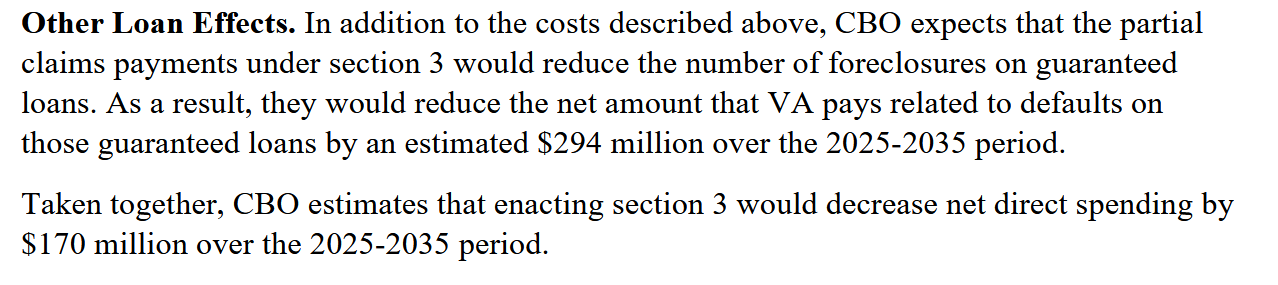
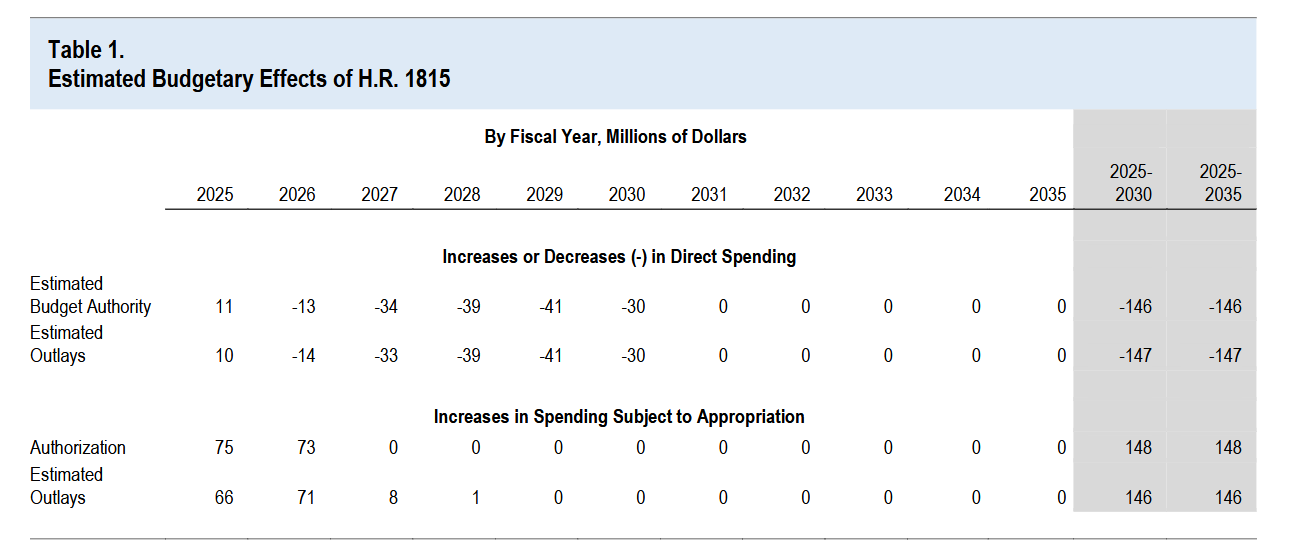
decrease in net direct spending over ten years (CBO; H. Rept. 119-104), driven by $294M in avoided default-related payments on guaranteed loans. Section 3 alone scores at −$170M. The same table authorizes $148M subject to appropriation, so the saving sits on the mandatory side of the budget. Even before the human cost, the fix is the cheaper option on paper.
S005 (C004, C013)
What the score also says
Five pages of the CBO estimate, and what each one is for
Congress’s own scorekeeper priced this bill before it passed. The two findings below rest on the pages reproduced beneath them, the terms and volume CBO assumed, the savings it projected, the budget table those savings come from, and the right of action it recorded the bill removing. Each capture is labelled with the section of the estimate it comes from and the claim it supports.
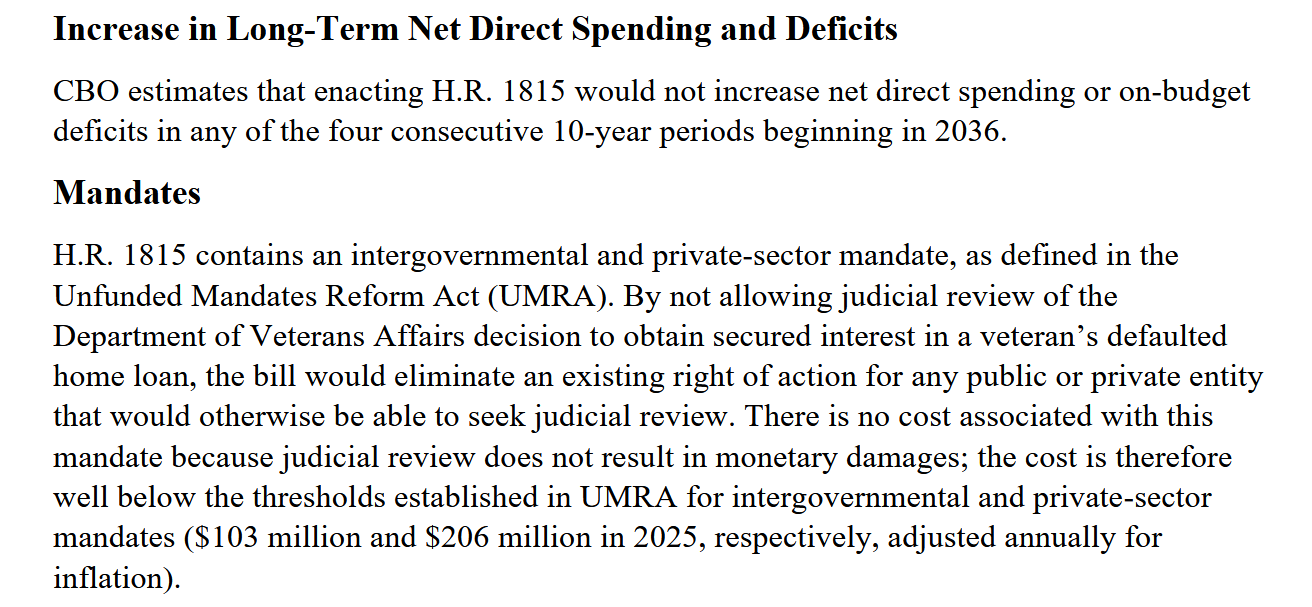
The CBO cost estimate for H.R. 1815 records, under Mandates, that by not allowing judicial review of the Department of Veterans Affairs decision to obtain secured interest in a veteran’s defaulted home loan, the bill “would eliminate an existing right of action” for any public or private entity that would otherwise be able to seek judicial review. CBO assigns the mandate no cost “because judicial review does not result in monetary damages.”
S005 · CBO estimate, H. Rept. 119-104 · claim register (C031)
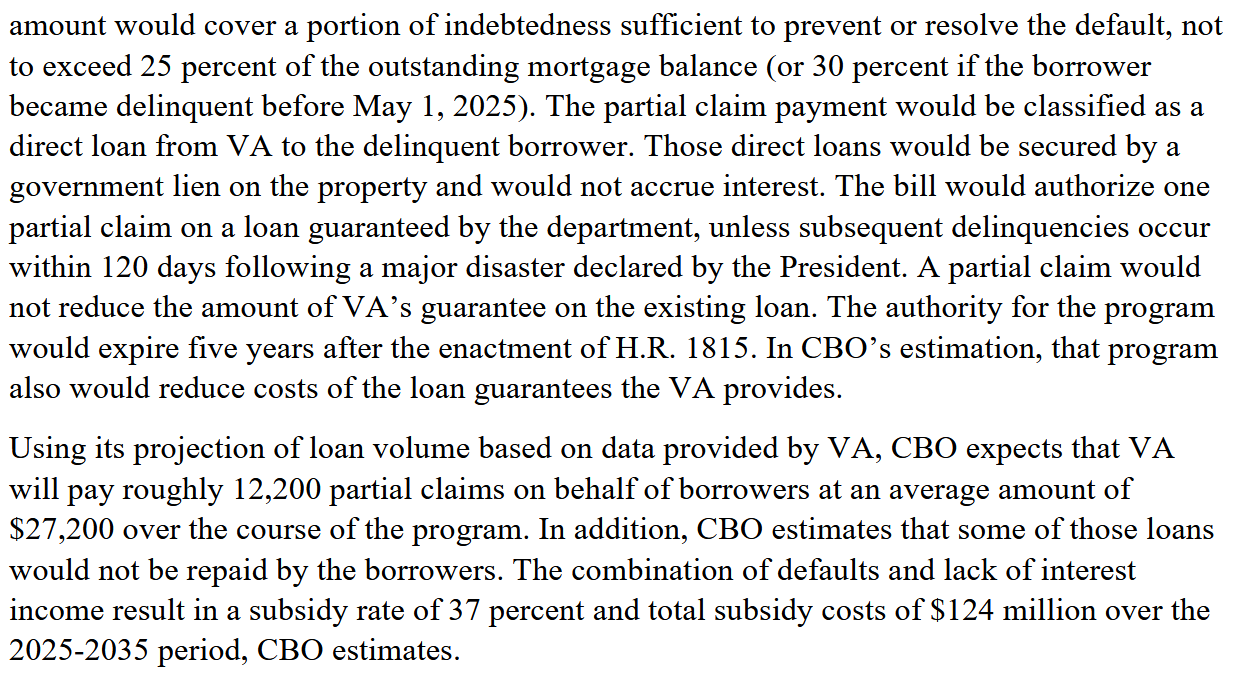
Using VA-provided loan-volume data, CBO expected VA to pay roughly 12,200 partial claims at an average of $27,200 over the course of the program, with a 37% subsidy rate and $124 million in subsidy costs over 2025–2035. The estimate also records that the program authority would expire five years after enactment, and that claims are capped at 25% of the outstanding balance, or 30% for borrowers delinquent before May 1, 2025.
S005 · CBO estimate, H. Rept. 119-104 · claim register (C032)
C032
What CBO assumed the program would be
CBO cost estimate, H.R. 1815, program terms and projected volume: the 25 / 30 percent ceilings and the May 1, 2025 delinquency trigger, the five-year sunset, and the 12,200 claims at $27,200. Evidences C032; corroborates the 30 percent trigger cited at C015.
C013
The savings CBO projected
CBO cost estimate, H.R. 1815, “Other Loan Effects.” The $294M in avoided default-related payments and the −$170M for section 3 alone. Evidences C004 and C013.
C019
Both spending lines, in one table
CBO cost estimate, H.R. 1815, Table 1. The −$147M is the direct-spending line; the table separately shows $148M authorized and $146M outlaid subject to appropriation. Both figures are on the same page, which is why this project states the saving as a decrease in net direct spending rather than a saving across the whole budget.
C034
What VA already pays when a home is lost
CBO cost estimate, H.R. 1815, “Partial Claim Program.” Background for the two findings above: VA already pays lenders up to 25 percent of the balance when a home is foreclosed, from the same mandatory account the partial claim would draw on. Context, not a claim of its own.
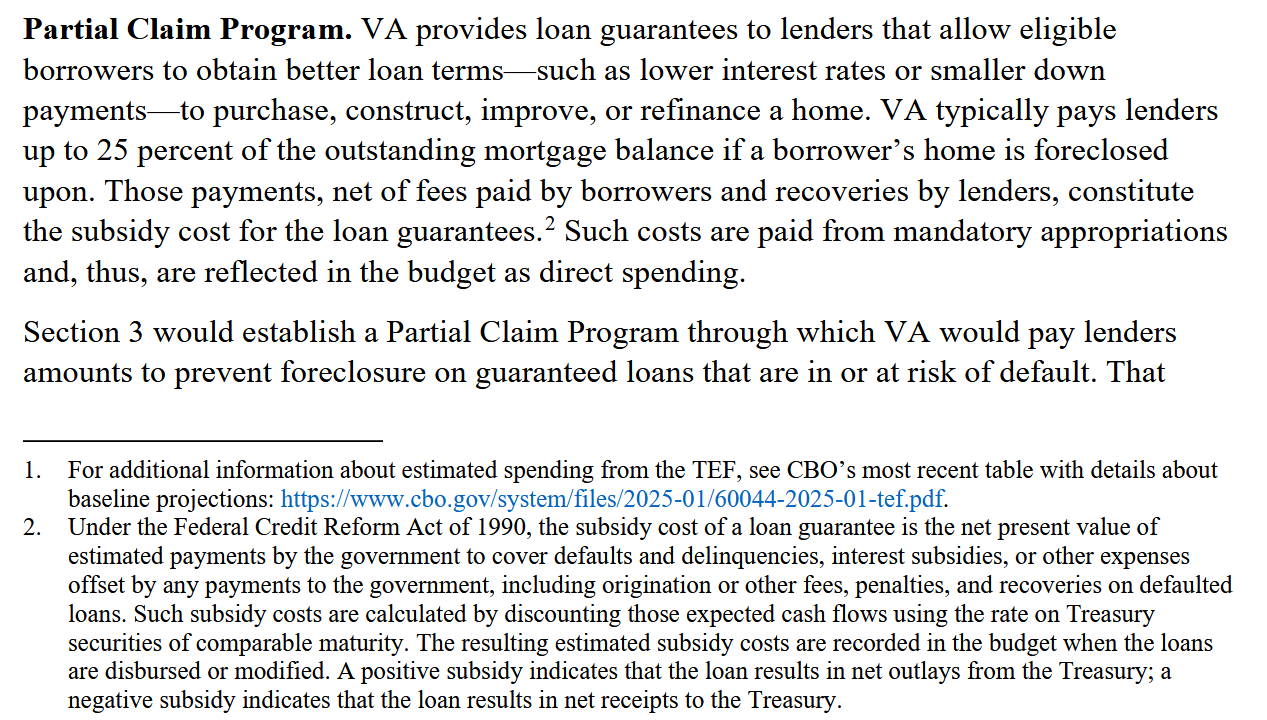
C031
The right of action the bill removes
CBO cost estimate, H.R. 1815, “Mandates.” The judicial-review elimination, in CBO’s words. Evidences C031.
Everyone got the same COVID help. Only veterans got trapped. CARES Act forbearance was universal, and FHA, Fannie Mae, and Freddie Mac all kept a permanent same-rate exit. Only VA borrowers lost theirs. Read the full chronology on the timeline, or the current status on what is happening.
Cost per outcome
What the claims register carries for one family under each of the two outcomes
Partial claim, per family
DOCUMENTED FACT C032 S005Average scored claim amount, CBO, H. Rept. 119-104Last verified Jul 25, 2026
Foreclosure, per family
DOCUMENTED FACT C005 S003 S004Two separately published figures for the same quantity, drawn as a range and never averaged$74,000 CRL
$0Scale maximum $74,000
One outcome costs $27,200 and the family keeps the house. The other costs between $72,000 and $74,000 and the family loses it.
Over the ten-year scoring window CBO put the permanent partial claim at $147 million in net savings and $294 million in avoided foreclosure-related payments.
Limitation, C032. 12,200 is a take-up projection, not a statutory cap; scores H.R. 1815 as reported, not enacted Pub. L. 119-37; cohort tiers are counted differently.
Limitation, C005. Cite whichever figure with its own source label; do not blend.
Limitation, C004 and C013. CBO estimate over the ten-year scoring window.
The same figures as a table
| Outcome | Figure | Publisher | Claim | Source | Content label | Last verified |
|---|---|---|---|---|---|---|
| Partial claim, per family | $27,200 | CBO | C032 | S005 | DOCUMENTED FACT | 2026-07-25 |
| Foreclosure, per family, lower published figure | $72,000 | NCLC | C005 | S003 | DOCUMENTED FACT | 2026-07-15 |
| Foreclosure, per family, upper published figure | $74,000 | CRL | C005 | S004 | DOCUMENTED FACT | 2026-07-15 |
| Net savings over ten years | $147 million | CBO | C004 | S005 | DOCUMENTED FACT | 2026-07-22 |
| Avoided foreclosure-related payments | $294 million | CBO | C013 | S005 | DOCUMENTED FACT | 2026-07-22 |
The fiscal case holds from both sides of the aisle
The cost argument for keeping families in their homes holds whether you start from fiscal restraint or from equity.
You may have heard: “helping them would cost taxpayers more” →
Read the full record (581 words)
The H.R. 6047 funding-fee debate sounds, from the floor, like a routine partisan offset fight. It is not. Both Ranking Member Takano and the Democratic caucus have repeatedly made clear they support the underlying benefit increases for catastrophically disabled veterans and Gold Star survivors. The disagreement is about long-term program viability, exactly the fiscal-responsibility frame Republicans usually invoke.
Rep. Mark Takano spelled out the argument at the HVAC Full Committee Legislative Hearing on May 20, 2026, and the math is the math, regardless of party:
"Many of the items on the agenda will have a cost. The majority has promised some kind of magic coupons that will be available if we just sunset everything after two years or take money away from other programs. That is hardly a responsible reauthorization process. Also, let's consider reality. The majority is putting a $4 billion bill on the floor this week that consumes all of the committee's offsets and then some. The chairman and Mr. Barrett are raising fees on financially distressed veterans to pay for some of it. And on top of that, we still have to pass our annual extenders bill that will also have a cost. So I again ask where will the money to pay for today's legislation come from for the fees and taxes on veterans' earned benefits? I do not think it's fair or responsible to engage in a convoluted legislative process when there's no realistic pathway to get most if any of these bills done."
Rep. Mark Takano (D-CA-39), HVAC Full Committee Legislative Hearing, May 20, 2026 (YouTube, HVAC Dems channel, ~30:39)
The "magic coupons" framing is the key. The H.R. 6047 funding-fee offset consumes the committee's entire offset capacity for the 2026 session. Every other veteran benefit bill, every reauthorization, every program update the committee wants to pass for the rest of the year now has to either find its own offset, compete with H.R. 6047's offset for the same money, or get pulled from the agenda altogether. The pattern is documented: at the HVAC 5/20 hearing alone, four foreclosure- and benefit-adjacent bills were pulled from the originally-noticed agenda before witnesses were called, including H.R. 1732, the GUARD VA Benefits Act (Pappas). VFW Director Kristina Keenan confirmed at the hearing that VFW strongly supports H.R. 1732 and that "every day that it doesn't [move forward], unaccredited claim sharks continue to exploit veterans and their benefits." Also pulled: H.R. 4876 (Brownley, Reproductive Freedom for Veterans Act, with Brownley confirming the removal at the hearing), H.R. 6755 (Accountable Leadership for Veterans Act), and H.R. 6861 (Consolidating Veteran Employment Services Act, listed as bill #11 in MRC Desmond's prepared written testimony, meaning the bill was on the docket late enough that the witness prepared content for it before Bost pulled it).
This is what Republicans usually call fiscal irresponsibility: committing all your offset revenue to one purchase and then promising future spending you have no plan to fund. The offset Republicans chose to fund H.R. 6047 with is being applied to the exact population currently absorbing the foreclosure crisis: 15,000+ veteran families have already lost their homes since VASP termination, 90,000 more are in foreclosure right now, and no § 3737(h) administrative guidance has been published. Adding compound-interest mortgage fees to the same families the federal government is failing to protect from foreclosure is not fiscal responsibility. It is fiscal compounding of a crisis the same Congress is supposed to be solving.
Foreseeability · who warned, and when
Nobody can say they weren’t warned
This is the part that cannot be explained as an unforeseen consequence. The mortgage industry, consumer advocates, national press, the Department’s own trade counterparties and the ranking members of the three congressional committees of jurisdiction, in a letter signed by 22 members. Each said, on the record and in advance, what would happen if the safety net came down before a replacement was running. Congress then said, on passage, what the replacement was for. The record below is chronological. Every line is a source already in this register.
Mar 2025
Mortgage Bankers Association
Warned that stripping the protection would end in one place for many veterans: “Foreclosure. Period.”
Blumenthal, Warren and Takano, to Secretary Collins
Six days after the announcement, the ranking members of the Senate Veterans’ Affairs, Senate Banking and House Veterans’ Affairs committees wrote to the Secretary in a letter signed by 22 Democrats and Independents: the closure was “leaving tens of thousands of veterans at risk for foreclosure… We write today to urge you to immediately reverse this decision, and avoid foreclosing on veterans who simply wish to keep paying their mortgage and keep their home.”
Rep. Mark Takano, HVAC Ranking Member
Put a figure on the exposure the same month: “With the sudden shutdown of the VASP program, as many as 80,000 veterans and military families have been stripped of a vital assistance program established to prevent the tragedy of foreclosure.”
Apr 30, 2025
CNN
Reported VASP cancelled on roughly eight days’ notice with about 75,000 borrowers three or more payments behind and only ~17,000 accepted.
Jul 2025
DLS Servicing
An executive whose firm works with 59 servicers began warning clients of rising FHA and VA foreclosures, a year before the mid-year data confirmed it.
Senate and House VA Committee leaders, on passage.
When Congress passed the replacement authority, its committee leaders described what it was for, in a bipartisan and bicameral statement: the legislation “will assist veterans who are facing financial hardships and provide VA with a tool to better help veterans stay in their homes and avoid foreclosure.” It was signed into law on July 30, 2025. The final policy implementing it was published June 1, 2026 and submissions opened June 15, 2026, and families were foreclosed on across that interval.
Mar 12, 2026
MBA & CHLA
Told VA in comment letters that its draft would leave veterans “substantially worse” off than Fannie, Freddie or FHA borrowers, and asked for at least 180 days to implement.
Apr 2, 2026
NPR
Published its investigation into VA foreclosures and the collapse of the rescue path.
May 2, 2026
Newsweek
Reported veterans facing a housing squeeze as VA relief ended and replacement housing plans stalled.
May 14, 2026
Mortgage Bankers Association
Quarterly survey put VA delinquency at 4.99% against 2.75% conventional, the stress already visible in the data.
May 20, 2026
Sen. Blumenthal
Told the Senate Veterans’ Affairs Committee that more than 15,000 veteran families had already been foreclosed on.
Jun 5, 2026
American Bankers Association
Called the final policy a real improvement over the draft, while noting several technical issues still requiring clarity from VA
Jun 23, 2026
Local broadcast press
Covered the surge and told veterans to contact their servicers early, guidance that only works if the servicer has implemented the program.
The outcome was named in advance, repeatedly, by the people best positioned to see it. The gap was left open anyway. (C027).
The finding that foreclosure is the expensive option is thirty-seven years old
A federal watchdog reached the same conclusion about VA home loans before most of today's borrowers were adults.
In December 1989 the Government Accountability Office published a report on the VA home loan program. Its title is the finding: Increased Use of Alternatives to Foreclosure Could Reduce VA's Losses. GAO reviewed how VA ends defaulted loans and recommended the Department work out what each alternative actually costs, so it could reduce the cost of the loan guaranty program.
DOCUMENTED FACT S241 GAO RCED-90-4, issued 20 December 1989, released 16 January 1990.
What happened to those recommendations matters, and it is not what it looks like. Both were later closed as not implemented, after Congress passed legislation barring VA from holding veterans responsible for losses on defaulted loans. GAO recorded that change as making the recommendations inapplicable.
So this is not a record of a warning ignored. It is a record of how long the underlying arithmetic has been known. The question of whether preventing a foreclosure costs less than completing one was examined at the federal level in 1989, and the answer then is the answer the Congressional Budget Office reached again in 2025.
PROJECT ANALYSIS The 1989 report is cited here for the age of the finding, not as an open recommendation.
VA does not cover the whole loan, which is why the servicer's choice decides who keeps a home
Most people assume a VA loan means VA pays the lender in full if things go wrong. It does not, and the gap is the reason a servicer's options matter so much.
On a loan above $144,000, VA guarantees the lesser of $60,000 or 25 percent of the original principal. The rest of the loss in a foreclosure sits with whoever holds the loan.
DOCUMENTED FACT S239 38 CFR 36.4302(a)(4), read from the govinfo primary text.
That single fact explains a great deal. A servicer is not made whole by a foreclosure, so the cheapest and cleanest way out of a defaulted loan is not a neutral question to them. It is a business decision, and the way a relief program is built decides whether that decision goes the family's way.
It also disposes of a common objection. If VA carried the whole risk, the shape of the relief program would barely matter. Because it does not, the shape is close to everything.
VA can end up owning the house
It writes the rules, checks the company, then takes the title.
In a foreclosure on a VA-guaranteed loan, the Department of Veterans Affairs can hold more than one position at the same time. None of it is hidden. Each position is written into the law and the regulations that build the program. The difficulty is that they arrive in the same file.
It writes the rules. VA prescribes the loss mitigation procedures and sets the terms a loan modification has to meet, including the ceiling on the modified interest rate.
It checks the company. 38 CFR 36.4350 sets out servicing duties for the holder of the loan, and 36.4319 pays the servicer an incentive for each completed loss mitigation outcome.
It can take the house and sell it. Under 38 U.S.C. 3720, the Secretary may "purchase at any sale, public or private, upon such terms and for such prices as the Secretary determines to be reasonable, and take title to, property, real, personal or mixed; and similarly sell, at public or private sale, exchange, assign, convey, or otherwise dispose of any such property". The next paragraph adds the power to "complete, administer, operate, obtain and pay for insurance on, and maintain, renovate, repair, modernize, lease, or otherwise deal with any property acquired or held pursuant to this chapter."
DOCUMENTED FACT S205
Read those three together. The same department that wrote the rules the mortgage company had to follow, and that was meant to check whether the company followed them, can finish the process holding the deed and selling the house.
PROJECT ANALYSIS S205
Each of those powers was written separately and each has a sensible reason behind it. A guarantor that cannot take title cannot make a lender whole. The point is not that any one of them is wrong. It is that when they land on the same family at the same time, nobody inside the arrangement is positioned to check it, which is what oversight from outside the Department is for.
And there is a fourth position, which sits on a different page of this record because it belongs to the servicing rules rather than the property ones. When a foreclosure completes, the Department pays the guaranty claim, and the payment is what ends the mortgage company's interest in the loan. So the same department that wrote the rules, that was meant to check whether the company followed them, and that can end up holding the deed, is also the party that settles the account at the end. The oversight page sets out one condition on the servicer that turns on this, and states the same thing in its own words: this is a requirement on the company, enforced by the Department that also guarantees the loan, pays the claim, and takes the property.
PROJECT ANALYSIS Four positions, one department, one file. Each was written separately, each has a reason, and none of them is hidden. The observation is about concurrency, not about conduct, and the question it raises is a structural one: who is positioned to check the arrangement from outside it.
PROJECT ANALYSIS
What VASP was, in the program's own documents
It bought the loan. It did not forgive it, and the veteran kept paying.
DOCUMENTED FACT VASP was a loan purchase. VA bought the defaulted loan from the servicer, re-serviced it at a fixed rate, and the veteran went on making a monthly payment. VA said in its own launch circular that it was using authority it already had, under 38 U.S.C. 3732 and 3720, so it was not a new spending programme built for the moment. It launched 31 May 2024 and was ended effective 1 May 2025 on about eight days of notice.
DOCUMENTED FACT The objection to it was cost per file, and the committee published the arithmetic. The joint statement from Chairman Bost and Rep. Van Orden sets the average delinquency being cured at $22,500 against an average loan purchased at $292,000, rising toward $320,000, with more than $5.4 billion of loans purchased since 31 May 2024. It states the intent to replace loan purchase with a partial claim.
PROJECT ANALYSIS That is a fiscal argument about the instrument, and this record accepts it as one. Buying a $292,000 loan to cure a $22,500 arrears is an expensive way to reach the arrears, and a partial claim reaches it directly. What the argument does not establish is that anything was forgiven. A purchased loan is still owed and still paid. Calling the programme a bailout describes a transfer that did not happen.
PROJECT ANALYSIS The gap is the part this record documents. The replacement was announced when the original ended, and it did not exist yet. At cancellation about 75,000 borrowers were behind and about 17,000 had been accepted into VASP. The partial claim did not open until 15 June 2026. Families in default in that window had the exit removed before the replacement arrived, and that is a matter of sequence rather than of policy preference.
Sources: S011 VASP programme record. S023 VA Circular 26-24-16, the existing-authority statement. S059 the Bost and Van Orden joint statement, which is where the cost figures come from. S020 the behind and accepted figures at cancellation.
VA removed the option servicers preferred and replaced it with the one they like least
The three ways a defaulted VA loan can end are not equally attractive to the company servicing it, and the difference explains the November 2026 deadline.
For the company servicing the loan, the options rank like this.
- The purchase program. VA bought the loan outright, so it left the servicer's books entirely. The cleanest exit available.
- Foreclosure. The guaranty claim pays out, and the process is fast and certain. Not a full recovery, but a predictable one.
- The partial claim. The servicer keeps the loan and keeps servicing it, for the least certain outcome of the three.
VA ended the option servicers preferred and replaced it with the option they prefer least. That is not an accusation about anyone's motives. It is a description of how the incentives sit, and it is the missing piece behind a date this site already carries: servicers are not required to offer the partial claim until November 28, 2026.
PROJECT ANALYSIS The ranking is an inference from the structure of the three options, not a statement by any servicer. S148 carries the November 28 2026 implementation deadline.
The replacement is structurally weaker at the one thing that decides whether relief reaches a family, which is whether the servicer offers it.
The office told to build the replacement had its administration budget cut by 15.8 percent in the same window
The Loan Guaranty Service runs foreclosure prevention. Its administrative funding fell while it was standing up the new program.
Administrative expenses, FY2024 enacted
$316,742,419
Administrative expenses, FY2026 enacted
$266,736,842
The difference is $50,005,577, a cut of 15.8 percent. It landed in the same period VA was required to stand up the partial claim program, and alongside a department-wide hiring freeze.
DOCUMENTED FACT S240 S019 Difference re-derived 2026-09-02.
Two limits on this. The FY2025 figure is not a separately enacted line. It is the FY2024 level carried forward by a full-year continuing resolution, which is well supported but is an inference. And the hiring freeze was department-wide rather than aimed at this office, with the documented reductions falling mostly elsewhere in the department.
PROJECT ANALYSIS What the record shows is a documented coincidence in timing, not a targeted cut.