Skip to content

Veterans Foreclosure Crisis

Closing the gap that puts veterans out of their homes

Who is engaged, and where it stands

Implementation & oversight tracker

Everything here is public record, with dates: what three officials admitted on the record, the deflection pattern, the still-open path, servicer readiness, the gaps the VA refuses to fill, and, at the foot of the page, the office-by-office tracker of who is engaged and where each stands.

In their own words, three admissions in five days.

The three officials with the most authority, on the record

DOCUMENTED FACT

Within one week in May 2026, the HVAC chairman, the author of H.R. 1815, and the VA Secretary each put a statement into the public record. Read together, they say the same thing: they know the crisis is real, and they are not moving to stop it.

Key finding

PROJECT ANALYSIS

The chairman used a closed rule so the protective amendment could not reach a floor vote. The procedural move is the substantive move. The author of the fix says the program matters more than the families it arrived too late for. The Secretary denies the authority his own department exercises. Each statement is consistent with the others, and with the votes leadership is taking: the budget line placed above veteran families’ homes.

Rep. Mike Bost (R-IL) · HVAC Chairman

“You can kick and scream all you want, but neither one of you is sitting up there asking questions or a veteran.”

To Democratic members questioning the funding-fee offset in H.R. 6047, the Sharri Briley and Eric Edmundson Veterans Benefits Expansion Act. On the closed rule, he added the offset would be “a poison pill for this bill.” The offset Bost defended appeared in that bill; the same approach carried into the Take Care of America’s Veterans Act (H.R. 9237 / S. 4744, “TCAVA”).

House Rules Committee, May 19, 2026

Rep. Derrick Van Orden (R-WI) · author, H.R. 1815

“And yes, there were veterans that lost their homes during this period… that is very unfortunate… But we must make sure that… this program has to go on in perpetuity.”

Acknowledges the losses, then pivots immediately to protecting the program, over the families displaced before it took effect.

House floor, week of May 18–22, 2026 · Cong. Record cite pending

VA Secretary Doug Collins

“Remember the VA is about putting people in homes. We don’t take people out of homes. Those are the mortgage bankers that take them out. We don’t take anybody out of homes.”

Disclaims the agency’s authority over foreclosures on the very loans its program guarantees, and over the evictions the VA files as plaintiff on homes it now owns.

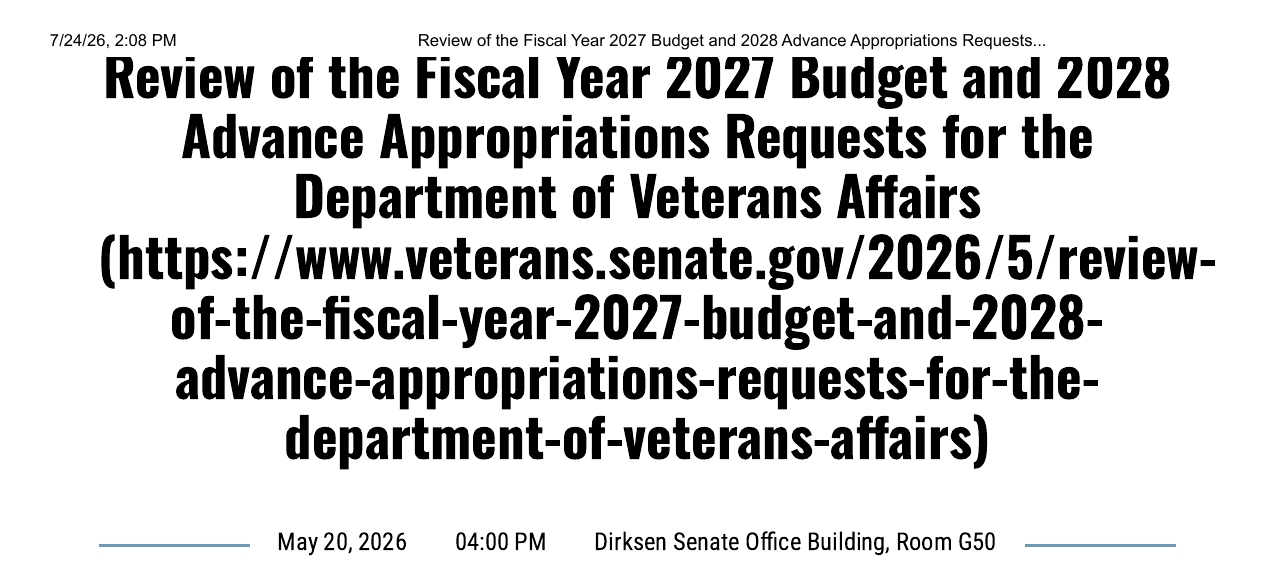
Senate Veterans’ Affairs Committee, May 20, 2026

The deflection pattern

A commitment on the record, and a deflection in the same breath

At the May 20 SVAC hearing, Sec. Collins committed to June 15, 2026 as the Partial Claim standup date, under questioning from Sen. Richard Blumenthal (D-CT), who anchored it: “that’s a commitment and we will hold you to it.” Pressed on the 15,000+ already foreclosed on, the Secretary’s answer ran in a fixed sequence.

STEP 1 · BLAME THE SERVICERS

The “we don’t take anybody out of homes” line, quoted in full above, the department’s authority reassigned to the servicers.

STEP 2 · BLAME THE VETERANS

“If the mortgage company decides to foreclose, it’s not because we have not done everything we possibly can”, implying families failed to use existing tools.

THE ORIGINAL CAUSE

Federal action: COVID forbearance ended, then the VA cancelled VASP, with nothing operational to replace it. The framing leaves veterans at fault no matter what.

Housing instability is a documented upstream driver of veteran suicide. Mission Roll Call testimony to HVAC on May 20 named the pathway directly: “Housing is a foundational component of mental health stabilization, and consistent access to permanent housing is an integral factor in suicide prevention.” Leadership is, structurally, choosing to spend more downstream, crisis lines, emergency mental-health care, homeless assistance, than on the upstream prevention a foreclosure pause would provide. PROJECT ANALYSIS.

Consistency test · a member’s own record

The accountability standard, applied to the people applying it

The oversight standard these members set for other agencies, measured against how they have applied it here.

Read the full record (1,166 words)

Why does the GOP HVAC majority move fast and aggressively on some categories of veteran financial harm while refusing to engage the foreclosure crisis at all? Rep. Van Orden's own legislative record answers that question more clearly than any external analysis.

Test Case #1, George Washington University Investigation (May 8, 2026). On 8 days noticeRep. Van Orden launched a formal HVAC Economic Opportunity Subcommittee investigation into George Washington University, sending a letter to GWU President Granberg and a letter to VA Inspector General Cheryl Mason demanding a full investigation. The trigger: student veterans were being told days before summer classes started that they must pay $14,000–$20,000 out-of-pocket because GWU allegedly mismanaged Yellow Ribbon Program funds. Van Orden's quote: "Student veterans will now be forced to pay thousands of dollars in out-of-pocket expenses... I am concerned that this issue may have occurred in previous years, but was not brought to the attention of the Committee or appropriate entities until now."

Test Case #2, H.R. 984, the Expedited Equitable Relief Act (originally introduced April 12, 2024 with Rep. Pappas as H.R. 7971 in the 118th Congress; reintroduced as H.R. 984 on February 5, 2025 in the 119th, currently pending in HVAC). Van Orden authored a bipartisan bill requiring VA to deliver equitable relief no later than 120 days after any administrative error is identified. The bill changes the operative verb from "may" to "shall", making the 120-day timeline mandatory. This is the same mandatory-language convention Van Orden used in the version of H.R. 1815 that became law: Section 3(h)'s administrative-guidance authority also uses "shall." Van Orden has championed the "shall, not may" enforcement principle across two consecutive Congresses and two separate veteran-protection bills. Quote at introduction: "We have a duty to take care of our veterans. The last thing they should be worried about is unexpected or incorrect issuances of thousands of dollars of debt. The Expedited Equitable Relief Act will ensure that no one else will be held accountable for VA's errors besides VA and that they must rectify those mistakes in a timely manner."

The foreclosure cohort fits exactly the category Van Orden's own H.R. 984 was written for and exactly the procedural toolkit he deployed against GWU within 8 days. In one documented cohort case: Freedom Mortgage never submitted the loan to VALERI; the VA never evaluated the loan for VASP per a VA loan specialist's written confirmation; the foreclosure was completed without the mandatory mitigation sequence Section 3(h) of Van Orden's own H.R. 1815 requires. In the broader cohort: 35,000+ veterans received erroneous foreclosure notices (the Pappas–Takano–Budzinski letter to Sec. Collins, September 2, 2025, remains unanswered 263 days later); 15,000+ families have been displaced since VASP termination; 90,000 more are in foreclosure right now. This is precisely the category of "administrative error causing thousands of dollars of debt to a veteran family" that Van Orden's own bill says VA must resolve within 120 days. The procedural toolkit that resolved the GWU question within 8 days, letter to the institution, letter to VA OIG demanding investigation, public hearing, would apply identically to Freedom Mortgage and the broader servicer pattern.

The accountability ask is therefore not partisan. It is a request for logical consistency with documented prior action: "Rep. Van Orden, you sponsored H.R. 984 (Expedited Equitable Relief Act) which requires VA to deliver equitable relief within 120 days of any administrative error. You moved within 8 days to launch a formal investigation into George Washington University with letters to the institution and to VA OIG when student veterans faced $14,000–$20,000 in out-of-pocket harm. Will you apply your own bill's 120-day standard to the 35,000-veteran wrongful-notice cohort? Will you send letters to mortgage servicers responsible for the wrongful-notice cohort and to VA OIG demanding the same investigation you launched into George Washington University?"

The bipartisan frame already exists, foreclosures are the missing piece. Protecting veterans from predatory mortgage servicers, claim sharks, and benefit-targeting fraud is not a partisan position. Sec. Doug Collins has stated on the record in oversight testimony that protecting veterans from predatory actions, fraud, and scams is a priority for the Department. The VFW's National Legislative Service (Kristina Keenan, Director) has actively pushed the bipartisan claim-shark agenda this Congress, with formal coverage in Stars and Stripes (March 3, 2026). The Predatory Lending Elimination Act (S. 3793, 119th Congress) and parallel House counseling and disclosure bills move on a bipartisan track. The CFPB has formally designated specific VA-program mortgage servicers as "repeat offenders" across consent orders in 2019, 2023, and 2024, with a DOJ False Claims Act settlement in 2016 and multiple state attorney general actions including Washington State (DFI, 2009) and New Jersey (AG, 2024). The foreclosure crisis is the same predatory-actor pattern bipartisan legislation is already addressing. What is missing is the application of that bipartisan principle to the families already being foreclosed on. The principle the Secretary has publicly endorsed (protect veterans from predatory actors) cannot logically stop at the mortgage door.

The Briley and Edmundson families chose to publish their case in Stars and Stripes on May 18, 2026 specifically to drive national attention to the long-term cost of military sacrifice on surviving spouses and catastrophically injured veterans. Two days later, the House Veterans' Affairs Committee Republican press operation reproduced the full op-ed on the official HVAC GOP press page (DocumentID=7914, May 18, 2026), using the families' own framing as the official advocacy material to advance H.R. 6047. In their op-ed, the families wrote:

"The folded flag did not close a chapter; it began a lifetime of responsibility... We are grateful, for survival, for sacrifice, for the honor of loving those who served. But gratitude does not pay a mortgage. It does not fund adaptive equipment. It does not replace lost earning power... Service members are not wounded as Republicans or Democrats. They are wounded as Americans. The promise to care for them, and for those who live with the lifelong consequences of their service, should rise above party lines just as clearly."
Sharri Briley (Gold Star widow) and Edgar "Ed" Edmundson (father of severely wounded Iraq War veteran Eric Edmundson), Stars and StripesMay 18, 2026, full text reproduced by HVAC GOP at DocumentID=7914

This is the framing the families themselves chose and that the HVAC GOP committee staff officially amplified to advance their own bill. The line "gratitude does not pay a mortgage" applies with identical accuracy to the foreclosure-track families whose mortgage payments the same federal government, through VASP termination, Section 3(h) inaction, and the new H.R. 6047 funding-fee hike, has made structurally unaffordable. The leadership trio's refusal to apply consistent logic to both fights is the strongest internal evidence we have of the asymmetric pattern. The families being foreclosed on right now deserve the same official committee amplification, and the same legislative urgency, the HVAC GOP press operation extended to the Briley and Edmundson families on May 18.

③ What must happen · The path is still open

The leadership trio is a posture, not the whole party

The same weeks these statements were made, Republican-side openings were documented. The fix is administrative and costs nothing, so it has no natural partisan opponent, only an institutional one. Separating the trio from reachable rank-and-file members is this project’s central task.

The clearest single ask for any reachable member.

Sign the discharge petition on H.R. 2102 (Major Richard Star Act), or the parallel path on H.R. 984 (the Expedited Equitable Relief Act, which Van Orden himself cosponsored).

Both bills are stuck because leadership refuses floor votes; both reach combat-injured veterans, including those in or facing foreclosure. A signature on either is a public defection from the trio’s “we are not going to act” posture.

Framing · the split both sides skip

This is not two positions. It is three.

The debate is usually reported as two sides. This sets out the third position both of them skip.

You may have heard: “Everyone is either for it or against it”.

Read the full record (387 words)

The H.R. 6047 fight has been framed in the press as binary, support the bill or oppose it. The actual VSO landscape is three positions, and the distinction matters for understanding who is publicly accountable for what:

  • Position 1, Support the bill, decline to take a public position on the funding-fee offset. The Elizabeth Dole Foundation (5/21 press release), the bill's namesake families Sharri Briley and Edgar "Ed" Edmundson (Stars and Stripes op-ed, 5/18), and Wounded Warrior Project (5/21 press release) all applauded House passage without addressing Sections 3 and 4. That is a deliberate institutional posture, not silence by accident. These are organizations whose mission requires bipartisan workability with whoever holds the gavel.
  • Position 2, Support the benefits, oppose the offset. The VFW (Kristina Keenan testimony. The funding-fee hike would "break the longstanding promise" per VFW December 2025 pending-legislation page), the American Legion (Resolutions 314 and 38 opposing Section 4), Common Defense ("Bost Home Tax" and "VA: Not For Sale" campaigns), Mission Roll Call (Desmond HVAC 5/20 testimony on housing-instability-to-suicide pathway), and the National Consumer Law Center (Alys Cohen HVAC EO testimony, March 26) have publicly opposed the funding-fee offset on the record. DAV, PVA, MOAA, and IAVA have publicly supported the broader bill; their specific public position on the funding-fee mechanism is being verified against their written testimony for the May 20 HVAC legislative hearing.
  • Position 3, Defend the offset as necessary. The House Republican leadership trio (Bost, Van Orden, H.R. 6047 sponsor Rep. Tom Barrett) has defended the funding-fee mechanism as the only fiscally acceptable path. At Rules Committee on May 19, Chairman Bost called the Takano amendment to strike the fees a "poison pill" for the bill and refused to make it in order (Rules Cmte 5/19, ~0:38:55).

Bost conceded on the record that the VSO letter does not support the offsets specifically. When Rules Cmte Ranking Member McGovern read the 19-VSO letter Bost submitted for the record, he pointed out that the letter says nothing about the offsets, only the legislation. Bost's response: "It does say they support for legislation. Correct? Okay. I did say offset because the legislation includes the offsets." (Rules Cmte 5/19, ~0:32:21) This is verbatim documentation that VSO support for the bill does not extend to support for the funding mechanism.

Servicer readiness

Until a servicer publishes an ETA, assume nowhere

No servicer has published an implementation date. This directory fills in as ETAs become public; the deadline for all servicers is November 28, 2026, 180 days from the June 1 final-policy publication. Servicer names are withheld until each publishes verifiable status.

Servicer A Partial-claim status: unknown No published ETA
Servicer B Partial-claim status: unknown No published ETA
Servicer C Partial-claim status: unknown No published ETA
Servicer D Partial-claim status: unknown No published ETA
Servicer E Partial-claim status: unknown No published ETA

The data gap, reported vs needed

What the Department still won’t publish

Current foreclosure count
Congress and the public cannot see whether the crisis is growing or slowing.
Who should publish: U.S. Dept. of Veterans Affairs
Requested since: Since spring 2026
VA-as-plaintiff eviction filings
The VA files evictions on homes it now owns; the volume is unpublished.
Who should publish: U.S. Dept. of Veterans Affairs
Requested since: Ongoing
Servicer-level partial-claim uptake
No way to verify the “available” narrative without per-servicer implementation data.
Who should publish: VA + servicers
Requested since: Since Jun 2026 launch
Loss-mitigation denial reasons
Whether denials complied with the rate cap and waterfall is unknowable in aggregate.
Who should publish: VA (VALERI system)
Requested since: Ongoing
State- / district-level breakdown
No office can see its own constituents’ exposure.
Who should publish: VA
Requested since: Never published

Families keeping their own records are, at this moment, the only running count in the country. NPR has led the national reporting on this crisis, tracking it across successive administrations, programs, and years. See data & methods for definitions and the stale-stats note, or Ask #3 to make the Department count.

The tracker · office by office

Fourteen offices and committees, and what each has actually done

Filter by where each stands, sort by name, date or status, and see what to ask for.

■ Engaged▣ Stalled or reversed▲ Opposed○ Neutral

All 14 entries shown

Engaged

Rep. Mark Takano (D-CA)

HVAC Ranking Member, minority champion

One of the two HVAC minority members leading the fight for these families, and among the most consistent. Confirmed the hearing cancellations on the record. See the committee row; called the partial-claim substitute not fully operational; and has made the VA home loan fee increase central to his case against the Take Care of America’s Veterans Act (H.R. 9237). That the bill is paid for by charging veterans more to use the very home loan benefit this crisis has already cost families (floor-record citation being pinned).

What to ask for: Thank him for putting the crisis on the record and for naming the home loan fee increase as a pay-for; urge him to keep pressing for the foreclosure-and-eviction pause and a hearing that reaches families already displaced.

Jun 23, 2026 · Takano at Rules, June 23 ↗

Engaged

Rep. Chris Pappas (D-NH)

EO Subcommittee RM, minority champion

Led 27 colleagues, 28 signers, in a letter demanding the VA implement a targeted foreclosure moratorium, resting the ask on the VA’s existing authority. The VA has not substantively responded.

What to ask for: Thank him for the 28-member moratorium demand; ask him to renew it and press the VA for the written legal analysis of its authority the letter required.

May 26, 2026 · 28-member letter led by Rep. Pappas ↗

Engaged

Sen. Richard Blumenthal (D-CT)

SVAC Ranking Member

Put the 15,000+ foreclosed figure on the record; led 46 Democratic senators in the June letter to Secretary Collins opposing the rating cuts and the bill codifying them. Co-led the April 9, 2025 letter with Sen. Warren and Rep. Takano, signed by 22 Democrats and Independents, pressing Secretary Collins to reverse the VASP termination: “urge you to immediately reverse this decision, and avoid foreclosing on veterans who simply wish to keep paying their mortgage and keep their home.”

What to ask for: Thank him for the 15,000+ figure, the 46-senator letter, and the April 2025 letter on the VASP termination; ask him to keep the rating cuts and home loan fee increases out of any Senate vehicle, and to press the Department on why the partial-claim authority still does not reach the displaced cohort.

May 20, 2026 · S060 · Blumenthal, Warren & Takano to Collins, Apr 9 2025 ↗

Engaged

Sen. Patty Murray (D-WA)

Appropriations / constituent casework

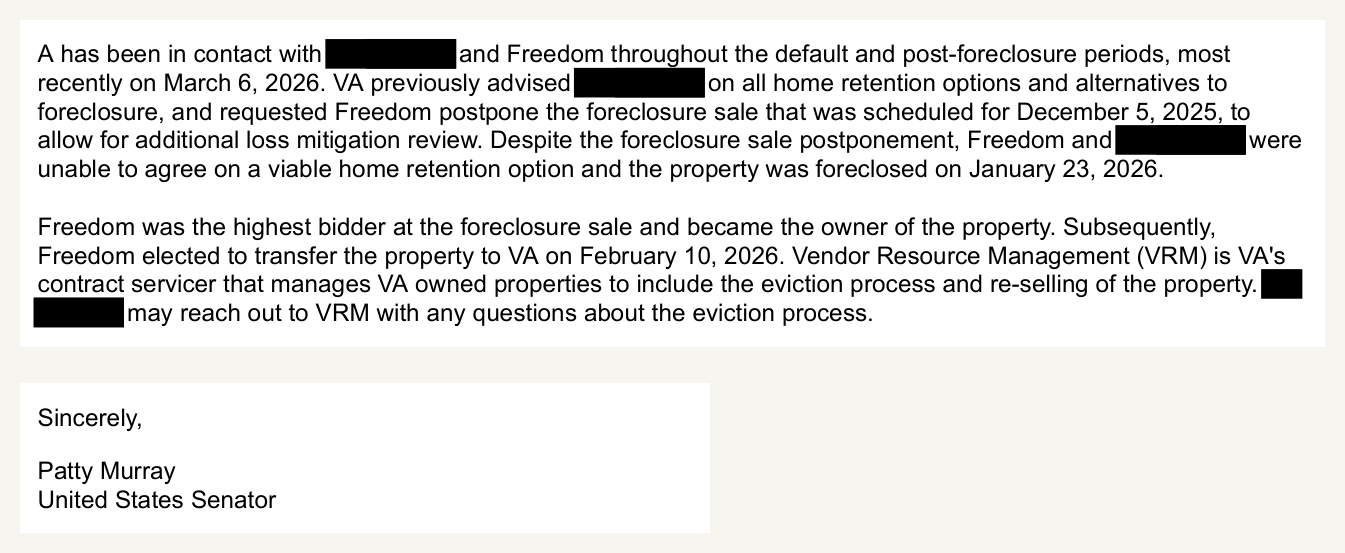
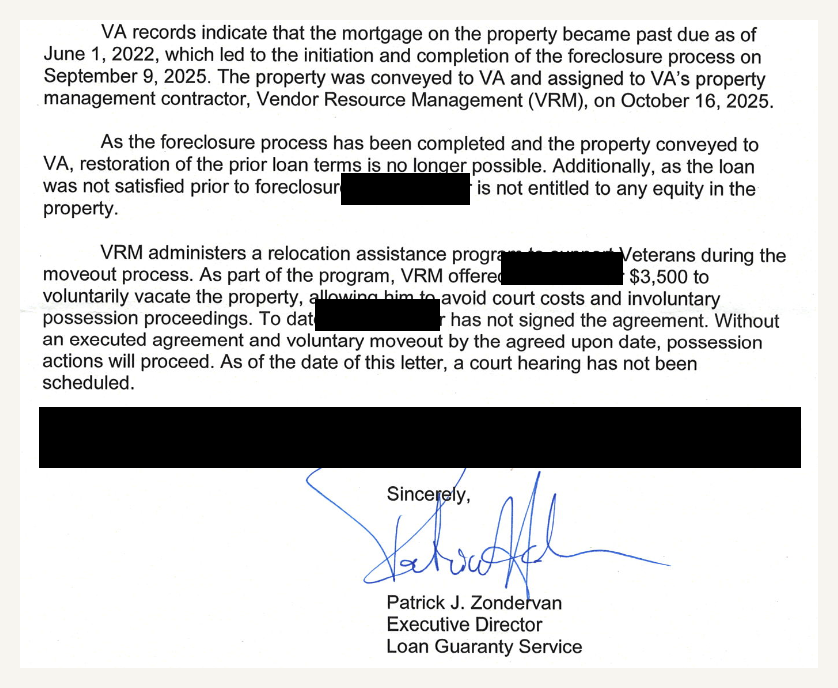
Active casework in the cohort produced the VA’s written rate-cap concession; protected Legal Services Corporation funding and highlighted its veterans foreclosure-defense work.

What to ask for: Thank her for the written rate-cap concession and for protecting LSC funding; ask her to defend LSC funding again in FY2027.

2026

Engaged

Rep. Eugene Vindman (D-VA)

Author, H.R. 9379, Affordable Homes for Veterans Act of 2026

Author of the Affordable Homes for Veterans Act of 2026 (H.R. 9379), a 45-day review deadline for complete VA loan-assumption applications, with Inspector General oversight, which was on the docket of both cancelled hearings; office actively working with families to extend it to loss mitigation.

What to ask for: Ask him to extend his servicer processing-clock and IG-oversight architecture to loss mitigation and partial-claim processing, where the harm is happening now.

2026

Engaged

Rep. Veronica Escobar (D-TX)

Author, H.R. 9404, VA Home Loan Navigator Act

Introduced the VA Home Loan Navigator Act (H.R. 9404), independent housing counselors to help veterans navigate loss mitigation, so families are not left relying on the same servicers driving the foreclosures.

What to ask for: Ask her to advance the VA Home Loan Navigator Act and tie its independent counselors to families already in foreclosure or trapped in unaffordable modifications.

2026 · Escobar at Approps, May 21 ↗

Engaged

Bipartisan openings

H.R. 1815 & Senate co-authorship

H.R. 1815 passed with overwhelming bipartisan support; veteran housing-stability legislation has drawn Republican co-authorship in the Senate. The fix is administrative and costs nothing, so it has no natural partisan opponent, only an institutional one.

What to ask for: Ask any office, either party, to co-author the administrative fix; it needs no new appropriation and no natural partisan opponent can be named.

2025

Stalled or reversed

Rep. Derrick Van Orden (R-WI)

EO Subcommittee Chair; author of H.R. 1815

Pressed the VA on implementation-gap foreclosures at his March 26 hearing and asked for a pause, then nothing followed publicly. Wrote the Section 3(h) emergency authority; his subcommittee’s hearing was one of the cancelled family-witness hearings. See the committee row.

What to ask for: Ask what came of his March 26 pause request, and to use the Section 3(h) authority he wrote to pause VA foreclosures AND evictions.

Mar 26, 2026 · HVAC EO hearing, March 26 ↗

Stalled or reversed

Rep. Mike Bost (R-IL)

HVAC Chairman, controls the calendar

As majority chairman he controls the committee calendar on which the family-witness hearings were cancelled. See the committee row. He also defended the funding-fee offset on a closed rule that kept the protective amendment off the floor.

What to ask for: Ask why the family-witness hearing was cancelled twice, to reschedule it, and to back a pause on VA foreclosures AND the VA’s own evictions.

Jul 16, 2026 · Bost on veterans questioning ↗

Opposed

VA Secretary Doug Collins

Department of Veterans Affairs

Let the VASP moratorium lapse, terminated VASP on eight days’ notice, has never exercised the Section 3(h) authority, approved the gates that exclude harmed families, and files eviction actions as plaintiff while campaigning on foreclosure prevention.

What to ask for: Press Asks 1–3, pause, use 3(h), publish the counts → Take Action.

May 1, 2025

Neutral

House Veterans’ Affairs Committee

Bost (R) majority / Takano (D) minority

The family-witness hearing, at which displaced veteran families were to testify, was scheduled and cancelled twice by the majority, which controls the calendar: first on June 25, 2026, then again on July 14, 2026, when the day was given over instead to a press conference urging passage of the Take Care of America’s Veterans Act (H.R. 9237). It has never been rescheduled. The minority, Takano and Pappas, has pressed the issue throughout, and Takano has carried the home loan fee increase into the floor debate on H.R. 9237 (citation being pinned).

What to ask for: Ask the majority to restore the family-witness hearing and let it proceed before the August recess.

Neutral

Senate Veterans’ Affairs Committee

Moran (R) chair / Blumenthal (D) RM

Chairman Moran co-sponsors S. 4744, the Senate companion to the Take Care of America’s Veterans Act (H.R. 9237); the committee is where the 15,000+ figure and the 46-senator letter entered the record. See the Blumenthal row.

What to ask for: Ask the committee to hold the VA to the partial-claim launch and to demand servicer-level compliance and uptake data.

May 20, 2026

Neutral

House Financial Services / Senate Banking

CFPB & Regulation X servicing rules

The consumer-protection half of this crisis sits in their lane; the seam between veterans and banking committees is part of why servicer conduct has escaped oversight.

What to ask for: Ask them to examine servicer dual-tracking and above-cap modification offers under Regulation X (12 C.F.R. 1024.41) and the VALERI reporting gap.

Neutral

Appropriations (MilCon-VA; CJS / LSC)

Legal Services Corporation funding

Foreclosure-defense capacity depends on civil legal aid. The Legal Services Corporation seeks $2.143 billion for FY2027; its own request records that grantees turn away 49% of eligible applicants, about 1.8 million people, for lack of resources. The White House FY2026 budget proposed eliminating LSC entirely, leaving $21 million for close-out costs; Sen. Murray’s office states she protected $540 million that year and rejected the defunding proposal, and that House Republicans sought to cut the program by nearly half.

What to ask for: Ask them to fund the Legal Services Corporation at its FY2027 request level, legal-aid foreclosure-defense capacity for veteran families depends on it.

FY2027 · S044 · LSC FY2027 request · S043 · Sen. Murray on LSC funding ↗

The pay-fors · who advanced them

What they chose to charge veterans for

The same members who invoke fiscal responsibility when asked to reach the families already foreclosed on wrote the offsets below. This belongs on this page, beside their own words and their own votes, because the choice of who pays is an accountability question and not a policy abstraction.

Key finding

PROJECT ANALYSIS

These are not competing claims about who deserves help. They are one group of veterans being asked to fund another, while the families already foreclosed on are told there is no money for them, and the organisations that represent veterans, the mortgage industry, and the ranking member of the House committee of jurisdiction each said so on the record before the vote.

The pay-for problem

DOCUMENTED FACT

To fund other bills, they made veteran home loans cost more

0.5% → 1.42%

The VA refinance (IRRRL) funding fee, nearly tripled. The loan-assumption fee doubles, 0.5% → 1.0%.

$8,000+

Added cost to the average veteran over the life of a loan (Common Defense). On a $325K refinance the fee jumps ~$1,625 → ~$4,615.

The Take Care of America’s Veterans Act (H.R. 9237 / S. 4744), led by the same members central to the foreclosure story, Reps. Bost and Van Orden and Sen. Moran, pays for its new benefits two ways: by raising these VA home-loan funding fees, and by codifying an estimated $57 billion in future disability-rating cuts for tinnitus and sleep apnea (Section 108). A refinance is one of the few tools that can lower a struggling veteran’s payment, and tripling its fee pushes many past the VA’s own 36-month recoupment test, so it stops penciling out.

PROJECT ANALYSIS: the same leadership that invokes fiscal responsibility to withhold foreclosure relief is financing other priorities on the backs of veteran borrowers and future disabled veterans. The VFW and DAV oppose these offsets; the VFW calls disability compensation “an obligation of the nation, not a source of savings to fund unrelated priorities”, citation being pinned; neither statement is yet registered as a source.

The Take Care of America’s Veterans Act (H.R. 9237) reached the House floor on July 16, 2026, where the motion to recommit failed 210–211 on roll call 249; leadership then withdrew the bill from floor consideration. It is a 62-bill veterans package covering benefits, health care and VA administration, not a home-loan bill; the VA Home Loan Affordability Act (H.R. 8532) is a separate introduced measure. Bill record: S041. Fee figures: S031 (Stars and Stripes). Life-of-loan estimate: Common Defense; Section 108 scale: VA analysis via DAV, both citations being pinned. Reporting that the mortgage industry criticised the fee increase is also being pinned; S026 records the industry on loss-mitigation options, not on the fee. (C058).

One set of veterans, set against another

This section reports what others have already said on the record. The trade is in the bill’s own text: new benefits for one group of veterans, financed by charging veteran borrowers more and by reducing what future disabled veterans will be paid. The objections below are the objectors’ own words.

Three of the five lines below are quoted from sources already in this register; the two marked “citation being pinned” are held to that standard and are not yet cited. This project adds no characterisation of anyone’s motives.

The bill’s own text

S041 · C058

New benefits across a 62-bill package are financed by raising the VA refinance fee from 0.5% to 1.42%, doubling the loan-assumption fee, and codifying an estimated $57 billion in future disability-rating reductions for tinnitus and sleep apnea (Section 108).

Who pays: veteran borrowers refinancing a home, and veterans rated for those conditions in future.

Veterans of Foreign Wars

Citation being pinned

Disability compensation is “an obligation of the nation, not a source of savings to fund unrelated priorities.”

The VFW and DAV both oppose the offsets. This quotation is carried from the block above and its VFW statement is not yet registered as a source. It is being pinned before this row is treated as cited.

Rep. Mark Takano

Tracker row

Has made the home loan fee increase central to his case against the bill. That it is paid for by charging veterans more to use the very benefit this crisis has already cost families.

Citation being pinned; see the tracker row.

Mortgage Bankers Association

S026

Told VA its draft framework could leave veterans with “substantially worse” loss-mitigation options than Fannie Mae, Freddie Mac or FHA borrowers.

The industry’s own comparison of what veterans get against other federal borrowers.

House Veterans’ Affairs Committee majority

S059 · C055

Described the program that had been keeping veterans in their homes as having been “created for political purposes,” and argued for the replacement on cost grounds.

Their words, reproduced rather than endorsed. The standard their authors set is what C056 measures.

Counter-deflection · verbatim from C-SPAN

The same non-answer, three times, from three senators

Three senators asked versions of the same question and each received the same non-answer, transcribed from C-SPAN.

The C-SPAN human-reviewed transcript of the first portion of the May 20 SVAC hearing confirms that Sec. Collins used the same "opinions vs. facts" deflection structure with at least three different senators when challenged on data or specifics:

  • To Sen. Blumenthal (D-CT), on the claims-to-appeals backlog shift: "Opinions and facts are different."
  • To Sen. Blumenthal (D-CT), minutes later, on direct vs. community care staffing reductions: "You are entitled to that opinion. It is just not backed up by the facts."
  • To Sen. Duckworth (D-IL), on the budget's 17% community-care increase versus the 2.8% direct-care increase: "You're entitled to your opinion but not your facts. When you say we are privatizing that is just wrong. It is flat out wrong."

This is the documented behavioral pattern, not a one-off exchange. The structure each time: deny the premise, dispute the data, and redirect to a favorable metric.

Congressional demand · May 26, 2026

Twenty-eight members asked for a moratorium and a legal basis

Twenty-eight House members asked the VA in writing for a foreclosure moratorium and for the legal basis of its position.

You may have heard: “VASP was cancelled because it was illegal” →

Read the full record (294 words)

On May 26, 2026, Rep. Chris Pappas (D-NH-1), Ranking Member of the House Veterans' Affairs Subcommittee on Economic Opportunity, led 27 colleagues, 28 signers in all, in a letter demanding that the VA immediately implement a targeted foreclosure moratorium on VA-guaranteed loans until the Partial Claim Program is fully operational and deployable by mortgage servicers.

  • First letter to cite the VA's existing authority. The letter rests the moratorium ask on the VA's current statutory authority to act, not only the additional authority Congress granted in the VA Home Loan Program Reform Act (H.R. 1815) in July 2025.
  • Written response required by June 2, 2026. The letter requires the VA to answer, in writing, whether it will implement a moratorium and, if not, to "identify what legal, statutory, or other constraints it believes prevent VA from doing so, and state whether VA has conducted a formal legal analysis of its authority to implement a moratorium (and if so, provide that analysis)."
  • Key line: "If a veteran has a reasonable opportunity to have their home saved through the [Partial Claim Program] under development, it would be cruel to foreclose on that veteran today."
  • The letter cites the NPR investigation (Arnold et al., April 2, 2026) and the documented scale as of that date: more than 10,000 veterans already lost homes since VASP ended in May 2025 (the figure as of that letter). The current figure is 15,000+ (per Sen. Blumenthal, Senate Veterans’ Affairs Committee, May 20, 2026), with 90,000 more in foreclosure right now.
  • Washington signer: Rep. Rick Larsen (WA-02). Read the letter and press release.

This is the strongest congressional push to date because it converts the moratorium from something the VA might choose to do into something it already has the authority to do and is declining to do, and forces that legal position onto the record by June 2. Outcome: no public response from the Department has been identified as of August 7, 2026, more than two months past the required date. UNVERIFIED · HELD

Washington State · on the record

Sen. Murray on Mann Grandstaff, and the Secretary’s answer

A Washington State exchange on a separate VA failure, and the answer the Secretary gave.

In a separate exchange that day, Sen. Murray pressed Sec. Collins on the VA's failure to implement Dole Act §5107, the Kids Care childcare program. Of the $22 million Congress appropriated, the VA used only $1 million and quietly stopped implementing. Sec. Collins's deflection (verbatim): "this was left for four years and no one did anything with it. We are trying to get it implemented." Sen. Murray's pin: "Let me be clear. This is a LAW. It is not a SUGGESTION."

Murray also pressed Sec. Collins on the Cerner/Oracle electronic health record rollout problems at Mann Grandstaff VA Medical Center in Spokane, Washington, origin point of the EHR troubles. Sec. Collins's admission on the record (verbatim, C-SPAN-confirmed): "What happened in Washington state was frankly wrong, it was bad. You had facilities allowed to act as if they were independent and you have software problems." Sec. Collins also confirmed he had not spoken directly with Mann Grandstaff providers recently. Source: C-SPAN program 679573 transcript and Sen. Murray's 5/20 press release.

A prior version of this section misattributed an OIG-funding concern. See the correction log, August 7, 2026.

Language tracking · whose words are being used

Which phrases officials have adopted, and when

A checklist of the specific phrases to listen for, and which officials have started using them.

You may have heard: “the VA isn’t the one foreclosing” →

These are the hooks that matter. Check each one off as you hear it called out in committee. The more of these that land on the public record, the harder it is for the VA to keep stalling.

Unanswered · letters and statutory demands

What Congress has asked for and not received

Every congressional letter and statutory demand still awaiting a substantive answer from the Department.

Read the full record (323 words)
April 9, 2025, bipartisan 22-signer letter to Sec. Collins demanding reinstatement of VASP. Senate signers included Sens. Blumenthal, Warren, Gallego, Hirono, King, Reed, Duckworth, Kim, and Blunt Rochester. House signers led by Rep. Takano with 18 colleagues. Status: unanswered.
October 28, 2025 (statutory deadline). Report on broker and servicer practices required under Section 4 of P.L. 119-31 (H.R. 1815). Status: no public evidence of filing.
2026, exact date not yet confirmed UNVERIFIED · HELD Reps. Pappas, Takano, and Budzinski letter to Sec. Collins demanding answers on approximately 35,000 erroneous foreclosure notices sent to VA-loan borrowers (per Task & Purpose reporting). Status: unanswered.
April 1, 2026Ranking Member Wasserman Schultz and Appropriations Ranking Member DeLauro joint letter to Sec. Collins on community care cost growth ($9B → projected $42B by 2028, 367% increase over 7 years). Status: unanswered (Sec. Collins acknowledged in the May 21 House Approps hearing that he had not responded).
H. Rept. 119-622FY27 MilCon-VA Appropriations Committee Report contains 5 formal oversight questions on partial-claim implementation, VASP, and foreclosure data. Status: none answered. The 5 unanswered questions are themselves evidence that no implementation data has been provided to Congress.

How to read this: Day counts increment from the date Sec. Collins made the verbal commitment, not from when the member first requested the information. In most cases, members had been formally asking VA for foreclosure data, partial-claim timelines, or constituent answers for weeks or months before Sec. Collins offered a verbal "we'll get back to you." The day counts above understate the wait. The pattern repeats at every hearing, and at the May 20 SVAC hearing, Sen. Duckworth publicly called Sec. Collins out for showing up empty-handed on commitments he had previously promised her under oath in February (now three months overdue). June 15 is a forward-looking deliverable, counter shows days remaining. Verbatim quotes are sourced from C-SPAN transcripts, official Senate and House records, congressional press releases, and member statements.

Oversight questions · what Congress asked

The five questions the VA has been asked to answer

The five questions the appropriations committee formally directed the VA to answer, in the committee’s own words.

Listen for whether Sec. Collins or CFO Topping addresses these specifically. These are the exact questions in the committee report, not opinions, not framing, just the questions Congress wrote down:

  1. What is the timeline for implementing H.R. 1815? What statutory authority, including Section 3(h), has the VA used or chosen not to use?
  2. Does the VA plan to reissue Circular 26-24-12? (This is the VA's own May 2024 mortgage-relief framework. It expired December 31, 2024.)
  3. Is the Secretary using his equitable relief authority for veterans hurt by administrative errors? (Examples: servicer dual-tracking violations, OIG email-routing failures.)
  4. What is the VA's plan to close the HUD-VASH referral gap? The Government Accountability Office (GAO-26-107517) documented 174,045 veterans who should have been referred to HUD-VASH housing assistance from 2020 to 2024 but were not.
  5. Will the VA include home-loan use and foreclosure-assistance data in its annual veteran suicide-prevention reporting? Congress asked the VA to make this connection explicit.
Rules Committee · May 19, 2026

Where the H.R. 6047 fight came to a head

What happened in the Rules Committee when the funding-fee bill reached it, and why it mattered.

Read the full record (957 words)

On May 19, 2026, the House Rules Committee considered H.R. 6047 and voted 7–3 along party lines to advance the bill to the floor. Rep. Mark Takano filed two amendments at Rules; both were "not made in order" on the same party-line 3–7 vote:

  • Takano Amendment #4, strike Sections 3 & 4 of H.R. 6047 (the provisions that raise VA home loan funding fees). Goal: remove the offset entirely.
  • Takano Amendment #5, strike Sections 3 & 4 AND replace the offset with an estate-tax-exemption reduction. Goal: keep the benefit increases but pay for them by reducing the estate-tax exemption rather than by raising veterans' loan fees.

Both amendments targeted the bill's funding-fee offset, not a foreclosure-prevention mechanism directly. The connection to the foreclosure crisis is Takano's substantive argument: the IRRRL fee that H.R. 6047 increases falls on "veterans in financial distress"Takano's exact phrase, who use the refinance program to lower their payments and stay in their homes. Raising the cost of that program directly undercuts foreclosure prevention. He laid out the argument on the record. Verbatim:

"H.R. 6047 increases benefits for veterans and survivors, but only at the expense of deepening the Trump administration's veteran foreclosure crisis."

"If we are to honor veterans with any sincerity, we must move beyond this paradigm of forcing one group of veterans to pay for the benefits of another group."

"[The bill makes it] more expensive for veterans in financial distress to access the Interest Rate Reduction Loan program known as IRRRL, which is one of the last available lifelines to help veterans stay in their homes."

Rep. Mark Takano (D-CA-39), HVAC Ranking Member
House Rules Committee, May 19, 2026

Takano directly named Rep. Tom Barrett (R-MI), the sponsor of H.R. 6047, on the record. His framing: "The choices Republicans and Representative Barrett have made have left me only with one choice, which is to oppose these bills. I reject the cynicism that permeates this legislation."

The bigger frame Takano laid out, "fiscal conservatives" only when veterans are paying

The sharpest part of Takano's argument was not the amendment math. It was a sustained critique of the GOP's claim to be the "party of fiscal responsibility" while expecting veterans to pay for veterans' benefits. Direct quotes from his Rules Committee exchange:

"I'm looking at the reconciliation bill that I'm sure that all of my friends here, all the great fiscal conservatives will end up supporting … most of it's not offset. The Senate bill that right now, according to CBO, is $72 billion. The war is not paid for. Nobody is talking about an offset for the war. The big ugly bill that you all supported added $3 trillion to the debt."

"There's money for these wars, there's money for tax cuts for the millionaires and billionaires, money for ballrooms. But when it comes to minor benefit increases for disabled veterans … [the offset is loaded onto veterans]."

Rep. Mark Takano, House Rules Committee, May 19, 2026

The point Takano made repeatedly: the GOP majority has had no problem passing trillions in unfunded spending on tax cuts, wars, and other priorities, but treats a few billion in benefit increases for catastrophically disabled veterans as something that must be paid for by raising fees on other veterans. This is the pattern, not a one-off.

Rep. James McGovern (D-MA), Rules Committee Ranking Member, echoed Takano's framing in the same hearing: "We have another veterans bill that helps disabled veterans, but pays for it by taking the money from other veterans." Later in the markup, on his own amendment, McGovern added: "Under this Republican-controlled government, there's always money to spend when it comes to giving tax cuts to the rich and funding illegal wars … Republicans spent $4.7 trillion on tax cuts that were not offset. But when it comes to this veterans bill, Republicans say we have to pay for it by jacking up fees on veterans who want to refinance their VA home loans."

Takano's prior record on VASP / foreclosure prevention, context for the pattern

Takano's H.R. 6047 fight is consistent with his work over the past year on the VA foreclosure crisis. After the VA terminated VASP in May 2025, Takano introduced legislation to reinstate the program, the FAIR Act (Foreclosure Assistance Immediately Reinstated), calling the termination "reckless" and "cruel" and noting that VASP had helped more than 15,000 veterans avoid foreclosure before it was cancelled (source: Congressional Record, 2025). H.R. 1815 (the partial claim law signed in July 2025) ultimately addressed part of the gap, but the VA has yet to implement it. (Note: The FAIR Act's exact introduction date and vote history have not been independently verified for this page; the framing here reflects Takano's documented Congressional Record remarks and the v2 SourcePack's confirmed-Congressional-Record entry. Verify the FAIR Act text against Congress.gov before citing it in a filing.).

The pattern Takano has been making visible: each time GOP leadership has had an opportunity to approve veteran foreclosure-prevention measures or block fee hikes that increase foreclosure risk, they have declined. The May 19, 2026 Rules Committee vote on H.R. 6047 was one more instance of that pattern.

The "Connected fight this week, H.R. 6047 and disabled-veteran funding fees" card below has the full context, including the two Takano amendments that failed 3–7 in the Rules markup and the prior HVAC committee markup amendment Takano offered on the same bill.

Sources: Takano press release on H.R. 6047 funding-fee offset · Stars and Stripes, May 19 Rules Committee coverage · Rules Committee video (5/19) · HVAC legislative hearing event page (5/20) · The Hill livestream of SVAC hearing (5/20) · C-SPAN program 679573, SVAC hearing record · Senate Veterans' Affairs Committee official hearing page

Quotes - chronological, on the record

Who said what, and when

You may have heard: “we have no record at this address” →

A dated, chronological record of what Congress, federal watchdogs, industry, VSOs and the national press have each said about this crisis.

Moved from Evidence on August 7, 2026. This is the chronological view of the same record the sections above cover thematically; where a quote appears in both, the section above carries the fuller context. Line-by-line reconciliation is tracked for the next build.

Read the full record (1,465 words)

Bipartisan congressional voices, nonpartisan policy experts, federal watchdogs, mortgage-industry leadership, major VSOs, and national press have all named the same gap. This is what the public record looks like, in order.

  • Apr 9, 2025CONGRESS, 22 House members (including Rep. Maxine Dexter, OR-3) send a letter urging the Secretary to reverse the VASP closure decision.
  • May 1, 2025NONPARTISAN, Center for Responsible Lending (Mike Calhoun): "It's a bedrock principle of federal housing policy that borrowers with a financial hardship should be able to bring their loans current and avoid foreclosure." (responsiblelending.org)
  • May 5, 2025VA SECRETARY, Sec. Collins, formal response to the 22-member letter: "Serving as a mortgage loan restructuring service is not VA's core mission, and VA was not given the authority from Congress to do so." Senate Committee on Veterans' Affairs formal designation: Unsatisfactory. Congress passed P.L. 119-31 explicitly conferring that authority 86 days later. (veterans.senate.gov)
  • Jul 2025CONGRESS, BIPARTISAN. Senate + House VA Committee leadership (Sen. Moran R-KS, Sen. Blumenthal D-CT, Rep. Bost R-IL, Rep. Takano D-CA), joint statement on H.R. 1815 passage: "No veteran should fall through the cracks or risk losing their home while a last-resort program is being implemented." (veterans.senate.gov)
  • Aug 2025NONPARTISAN, Urban Institute: "Nearly 90,000 VA loans are seriously past due, 33,000 of which are already in foreclosure." Multiple analyses confirm VA borrowers lack deferral and affordable-modification options available to FHA and GSE borrowers. (urban.org)
  • Dec 23, 2025LEGAL, 9th Circuit affirms Powers v. Collins (No. 24-6576; C.D. Cal. 2:22-cv-08357), Public Counsel's parallel litigation on VA non-implementation in the homeless-veteran-housing context. The same theory of unreasonable agency delay applies directly to the H.R. 1815 implementation gap.
  • Mar 4, 2026NONPARTISAN, NASDVA (President Terry Prince), joint House-Senate VA Committee testimony: "VBA has not yet promulgated the regulations necessary to implement these measures. Consequently, the process remains opaque to Veteran borrowers seeking to apply for and use HLPRA's partial claim structure." (testimony PDF)
  • Mar 26, 2026CONGRESS, H.R. 1815 SPONSOR. Rep. Derek Van Orden (R-WI), HVAC Economic Opportunity Subcommittee opening: "I am looking forward to full implementation of this partial claims program that will put the V.A. home loan program on par with other federal home loans in terms of options to mitigate foreclosure." Same hearing: asks the VA on the record to pause foreclosures until the replacement program is operational. (HVAC release)
  • Mar 26, 2026NONPARTISAN, NCLC (Alys Cohen), HVAC testimony: "Veteran borrowers facing financial hardship should have at least the same access to workout options…as borrowers with loans backed by Fannie Mae, Freddie Mac, and FHA." (nclc.org)
  • Mar 26, 2026INDUSTRY, MBA (Owen Lee, Chair-Elect), HVAC testimony: VA should "prioritize options that avoid increasing monthly payments." Confirmed partial claim ETA June 2026. (MBA Newslink)
  • Mar 30, 2026FEDERAL WATCHDOG. GAO-26-107517: 174,045 veterans not referred to HUD-VASH supportive housing between 2020 and 2024. In 151,296 cases (87%), VA did not document any reason for the missed referral. (gao.gov)
  • Apr 2, 2026PRESS, NPR (Chris Arnold + Quil Lawrence): "VA Loan Calamity", 10,000+ homes lost confirmed (ICE Mortgage Technology). Syndicated to 40+ NPR affiliates. (npr.org) Same day: ABA Banking Journal confirms 10,000+ veterans lost homes. (bankingjournal.aba.com)
  • Apr 6, 2026PRESS, Rachel Maddow Show (MSNBC): ~20-minute segment on the veteran foreclosure crisis. (YouTube)
  • Apr 11, 2026PRESS, Rolling Stone (Michael Embrich): "Veterans Are Facing a Housing Crisis. Trump Is Making It Worse." (rollingstone.com)
  • Apr 12, 2026PRESS, MS NOW / MSNBC Weekend Primetime (Max Rose): third national outlet to broaden the footprint of the story.
  • Apr 21, 2026VSO, Veterans of Foreign Wars (Patrick Murray, Director of National Legislative Service), HVAC Democratic-led roundtable: publicly demands VA implement H.R. 1815 and pause foreclosures. "Yesterday is too late." Same event: NCHV characterizes H.R. 1815 implementation as "low-hanging fruit". The policy fix is straightforward; the gap is implementation.
  • Apr 22, 2026PRESS, LA Times (Doug Smith): "Trump's big promise for veteran housing is AWOL in VA budget proposal." Quotes Mark Rosenbaum (Public Counsel) tying the systemic pattern to the Powers v. Collins precedent. (latimes.com)
  • Apr 2026CONGRESS, INVESTIGATION. Senate Veterans' Affairs Committee Minority (Ranking Member Sen. Richard Blumenthal, D-CT): SVAC Minority oversight team opens active investigation into the veteran-foreclosure cohort. Congressional Brief v9 (27-page case packet documenting the cohort and the regulatory pattern) delivered to SVAC Minority on May 6, 2026.
  • Apr 30, 2026CONGRESS, INVESTIGATION. House Veterans' Affairs Committee opens a higher-level review on the veteran-foreclosure cohort, coordinated through the Elizabeth Dole Foundation (VP Government Affairs Meredith Beck) and HVAC majority staff. Cohort case packet (Congressional Brief v9) on file with EDF May 5 and forwarded to HVAC May 6. Review is active.
  • Apr 30, 2026CONGRESS, ACCOUNTABILITY. Sen. Jon Ossoff (D-GA, Senate Appropriations MilCon-VA Ranking Member), April 30 Subcommittee hearing on VA's FY27 budget request: secures Secretary Collins's verbal commitment to work on foreclosure-prevention and veteran-homelessness-prevention programs. Same day: House Appropriations Committee reports out H.R. 8469 (FY27 MilCon-VA bill) with House Report 119-622, directs VA to answer five oversight questions on a 90-day reporting clock, encourages the Secretary to continue granting equitable relief in administrative-error cases, and ties foreclosure outcomes to suicide-prevention data reporting.
  • Spring 2026VSO, RESOLUTION, American Legion FL local post: passes a local-level resolution on the VA foreclosure crisis. Next step: review at the FL Department (state-level) conference, approximately June 15, 2026, for possible state-level passage. Carries institutional weight at major-VSO level.
  • May 2, 2026PRESS, Newsweek (Aliss Higham): "Veterans Lose Homes as VA Relief Ends and Housing Plans Stall." (newsweek.com)
  • May 8, 2026CONGRESS, ACCOUNTABILITY (filed; not floor-considered). Rep. Maxine Dexter (OR-3) files Amendment #60 V2 to H.R. 8469, bars use of any funds for the VA Secretary's travel budget until (1) the Secretary directs servicers to operate the targeted-moratorium framework already laid out in VA Circular 26-24-12, and (2) the Partial Claim Program is fully implemented under 38 U.S.C. § 3737 or six months after enactment, whichever is later. Update 5/13: the Rules Committee did not make the amendment in order under H. Res. 1275; it did not receive a House floor vote. The mechanism, pairing VA's own May 2024 Circular framework with a Secretary-level implementation incentive, remains available as a model for Senate-side action on the FY27 MilCon-VA bill.
  • May 13, 2026CONGRESS, OVERSIGHT HEARING. HVAC oversight hearing on the West LA VA campus + the National Center for Warrior Independence. Three on-record moments from this hearing:

    Chairman Bost (R-IL): "I am happy to see the oversight plan from V.A. that shows how the Department will comply with President Trump's Executive Order to transform this campus. However, this report was 248 days delayed. The Department owes this Committee a clear path forward." Same opening: "Oversight does not mean standing in the way. It means making sure the Department has the tools, authority, and direction to fix what has been broken." (Direct parallel: H.R. 1815 is at Day 289 since signing with no operational Partial Claim Program, 41 days past the 248-day benchmark Bost set this week.)

    Ranking Member Takano (D-CA): opens by naming Jeffrey Powers, the lead plaintiff in Powers v. McDonough (now Powers v. Collins under the current Secretary): "Jeffrey has repeatedly asked why VA continues to drag on its appeal, and when will VA finally do the right thing and implement Judge Carter's order? I share Jeffrey's frustration." The same theory of unreasonable agency delay applies directly to the H.R. 1815 implementation gap.

    Rep. Van Orden (R-WI), H.R. 1815 sponsor, on the West LA budget request: "There's no way in hell you're going to come here and say $500 million is a down payment. You can't tell me what the actual cost is. You're going to come back for more stuff. That is absurd... I think that this really is a gross demonstration of what we call corruption and it's been going on since 1888 and it's unacceptable and it's stopping." Same hearing, same H.R. 1815 sponsor whose 3/26 ask the VA is still ignoring 50 days later. This is bipartisan oversight tone, not partisan.

    Sources: HVAC majority release (Bost opening) · docs.house.gov event page · full hearing video.

    Same day: H. Res. 1275 (rule providing for consideration of H.R. 8469, FY27 MilCon-VA bill) agreed by the House 214-208. Floor consideration of H.R. 8469 followed on 5/13–5/14, with the bill passing the House ("First FY27 Bill" per House Appropriations Republicans). 51 amendments were considered (mix of D + R); Dexter Amendment #60 V2 was filed but not made in order by Rules under H. Res. 1275, so it did not receive a floor vote.
  • May 14, 2026VSO, VFW National Headquarters sends Secretary Collins a letter calling for a foreclosure moratorium pending Partial Claim Program implementation.
Commitments and demands, with dates

What was promised, and what was asked for

Filtered to commitments. Each one carries the date it was made and the date it came due.

Feb 15, 2024

House Veterans' Affairs Committee hearing. The partial claim gap and foreclosure exposure are raised directly, three months before VASP launches.

DOCUMENTED FACT Source S056

Mar 11, 2025

MBA testifies to the House VA Subcommittee on Economic Opportunity. Asked what happens without the rescue program, Elizabeth Balce answers: the short answer is foreclosure. Period.

DOCUMENTED FACT

Mar 26, 2026

NCLC testifies that the draft policy would push roughly 30,000 veterans into average payment increases of about 150 dollars per month.

DOCUMENTED FACT Source

May 14, 2026

VFW letter to the VA Secretary calling for a foreclosure moratorium until the partial claim is operational.

DOCUMENTED FACT

May 19, 2026

Rules Committee. The H.R. 6047 funding-fee fight comes to a head.

DOCUMENTED FACT

May 20, 2026

Senate Veterans' Affairs Committee. Sec. Collins commits under oath to a June 15, 2026 partial-claim standup date.

DOCUMENTED FACT Source

May 21, 2026

House Appropriations. The VA Chief Financial Officer testifies on what the Department does not know about its own portfolio.

Citation pending

May 26, 2026

Twenty-eight members of Congress, led by Rep. Chris Pappas, demand a targeted foreclosure moratorium and the VA's legal basis if it refuses. Written response required by June 2.

DOCUMENTED FACT Source

Nov 28, 2026

Deadline for servicers to update systems to deliver the partial claim. Roughly 16 months after H.R. 1815 was signed.

DOCUMENTED FACT

These entries are set in the page. The full chronology, with every dated entry and its source, is on the Timeline.

On the record, the commitment itself

The June 15 standup date, as committed

Every image below is a screenshot of the primary source. Nothing here asks you to take our word for it.

Sec. Collins on the June 15 standup date.

Screenshot of SVAC hearing, May 20 2026, Sec. Collins on the June 15 standup date
SVAC hearing, May 20 2026
Sec. Collins on the June 15 standup date · captured July 2026